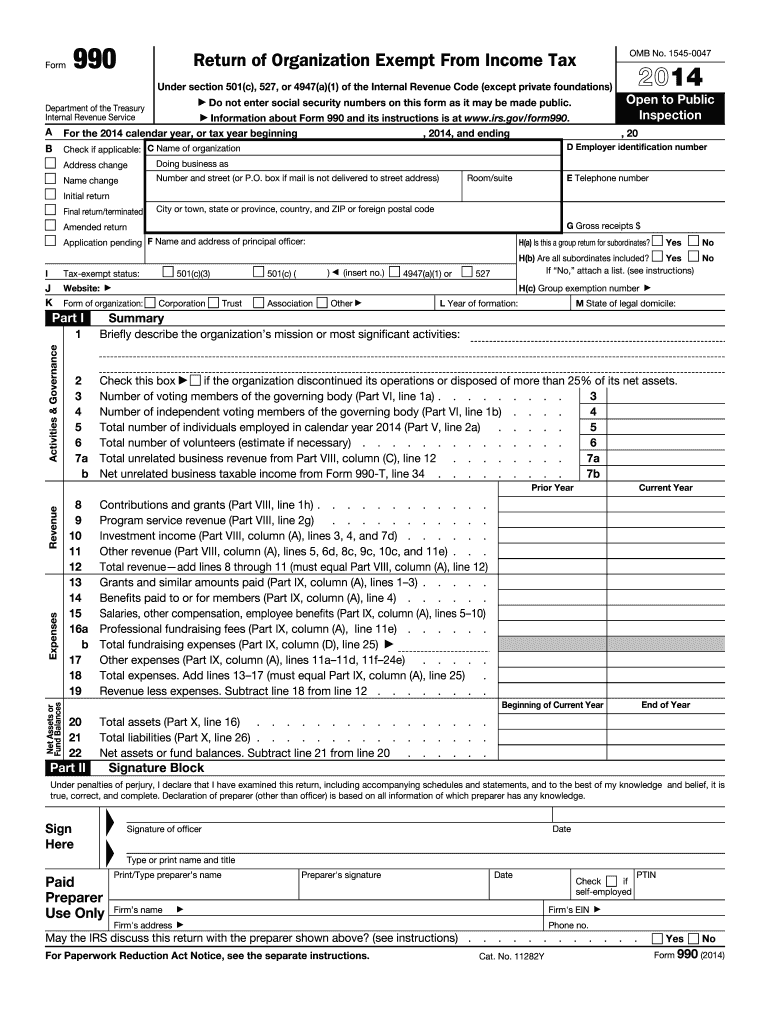
IX, column (D), line 25) Other expenses (Part IX, column (A), lines 11a 11d, 11f 24e) . . . . . Total expenses. Add lines 13 17 (must equal Part IX, column (A), line 25) . Revenue less expenses. Subtract line 18 from line 12 . . . . . . . . Total assets (Part X, line 16) . . . . . . . . . . Total liabilities (Part X, line 26) . . . . . . . . . . Net assets or fund balances. Subtract line 21 from line 20 Part II . . . . . . . . . . . . . . . . . . Signature Block Under penalti.
Loading

Open form follow the instructions

Easily sign the form with your finger

Send filled & signed form or save
How to fill out the IRS 990 online
Filing the IRS Form 990 is essential for organizations that are exempt from income tax under section 501(c), 527, or 4947(a)(1). This comprehensive guide will walk you through the steps needed to fill out this form online, ensuring compliance and accuracy.
Follow the steps to successfully complete your IRS 990 form online.
- Use the ‘Get Form’ button to access the IRS 990 form and open it in your preferred online editor.
- Begin by entering the required information regarding the organization, such as its name, Employer Identification Number (EIN), and address, as indicated in sections A through E.
- Complete section F by providing the name and address of the principal officer of the organization.
- In section G, report the gross receipts of the organization, ensuring that figures align with your records.
- Fill out parts related to the organization’s activities and governance in section H. Be clear if this is a group return for subordinates.
- In part I, summarize the organization’s mission and significant activities using concise and informative language.
- Proceed to parts relating to income and expenses in sections VIII and IX, recording all relevant financial data such as contributions, grants, and operational costs.
- Ensure to review part X for the balance sheet section, verifying that all assets and liabilities are accurately reflected.
- Complete parts XI and XII for reconciliation of net assets and financial statements, providing further context where needed.
- Before submitting, review the entire form for accuracy, and if satisfied, options to save changes, download, print, or share the completed form should be available in your online editor.
Begin your online filing process for the IRS 990 form today to ensure timely compliance and accurate reporting.
Experience a faster way to fill out and sign forms on the web. Access the most extensive library of templates available.
Related content
Feb 26, 2025 — Form 990 is the IRS' primary tool for gathering information about...
Jul 3, 2025 — Form 990-N is due every year by the 15th day of the 5th month after the...
1. Contributions, gifts, grants, etc., received (attach schedule). 2. Check ▷ if the...
Get answers to your most pressing questions about US Legal Forms API.
Who fills out IRS Form 990?
Typically, the chief financial officer or an authorized employee of the organization fills out IRS Form 990. It's crucial that the person responsible for this task has a comprehensive understanding of the organization’s finances. Utilizing tools and resources from uslegalforms can help make this process more straightforward and efficient.
How do I file my 990 electronically?
You can file your IRS 990 electronically using IRS-approved e-file providers. This method streamlines the filing process, helping organizations submit their forms quickly and efficiently. Many organizations find that using platforms like uslegalforms simplifies the filing process and ensures compliance with IRS regulations.
What does 990 mean?
The term 990 refers to a series of forms used by tax-exempt organizations to report their financial information to the IRS. These forms include the IRS 990, IRS 990-EZ, and IRS 990-N. Filing these forms ensures compliance and transparency while allowing organizations to communicate their financial health with stakeholders.
What happens if Form 990 is not filed?
Failing to file Form 990 can result in penalties from the IRS, including fines and potential revocation of tax-exempt status. This may also affect the organization’s ability to secure funding or grants. Therefore, submitting the IRS 990 is crucial for maintaining operational integrity and public confidence.
What is the purpose of the Form 990?
The IRS 990 serves as an annual information return for tax-exempt organizations. Its primary purpose is to provide transparency regarding financial health, governance, and compliance with federal regulations. Nonprofits benefit from filing this form by establishing credibility and trust with donors and the public.
What happens if a nonprofit does not file 990?
If a nonprofit fails to file the IRS 990, it may face severe penalties, including loss of tax-exempt status. This can have significant consequences for funding and public trust. Consistent filing is vital because it helps maintain accountability and transparency in nonprofit operations.
Who is required to file a 990 form?
Any tax-exempt organization, including charitable, religious, and educational entities, must file a 990 form if they meet certain financial thresholds. These specifics can depend on the organization's size and financial activity. By filing the IRS 990, organizations help the IRS monitor compliance and provide important information to the public.
Who is required to file an IRS 990?
Organizations exempt from federal income tax, such as nonprofits and charities, are typically required to file IRS 990 forms. This includes any organization that earns more than $200,000 in gross receipts or has total assets exceeding $500,000. It's essential for these organizations to stay compliant with tax regulations, as filing an IRS 990 showcases their financial transparency and accountability.
Who must file a 990 with IRS?
Most tax-exempt organizations with gross receipts above a certain threshold must file a Form 990 with the IRS. This includes charities, nonprofits, and private foundations. Staying informed about the filing requirements can save organizations from potential penalties, and using tools from USLegalForms can simplify the filing process.
Who gets reported on 990?
The IRS 990 requires organizations to report information about their executive staff, board members, and key employees. This includes details such as compensation and roles within the organization. Accurate reporting enhances transparency and accountability, important aspects that drive public trust.
Use professional pre-built templates to fill in and sign documents online faster. Get access to thousands of forms.
If you believe that this page should be taken down, please follow our DMCA take down process here.
This form is available in several versions. Select the version you need from the drop-down list below.