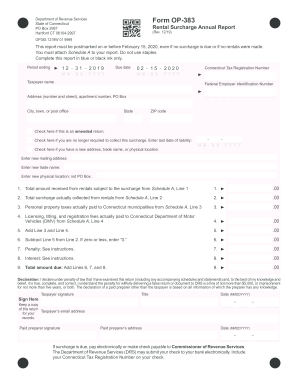
Or before February 15, 2020, even if no surcharge is due or if no rentals were made. You must attach Schedule A to your report. Do not use staples. Complete this report in blue or black ink only. Period ending 12 31 2019 Due date M M - D D - Y Y Y Y Taxpayer name Address (number and street), apartment number, PO Box City, town, or post office 02 15 2020 M M - D D - Y Y Y Y Connecticut Tax Registration Number Federal Employer Identification Number.
Open form follow the instructions
Easily sign the form with your finger
Send filled & signed form or save
How to fill out the CT OP-383 online
The CT OP-383 is an essential form for reporting rental surcharges in Connecticut. This guide provides clear and detailed instructions on how to accurately fill out the form online, ensuring compliance with state regulations.
Follow the steps to successfully complete the CT OP-383 form.
- Use the ‘Get Form’ button to access the CT OP-383 online document.
- Enter the period ending date, which is 12/31/2019, in the designated field.
- Provide the due date as 02/15/2020 in the appropriate section.
- Fill in your taxpayer name and your complete address, including city or town and ZIP code.
- Input your Connecticut Tax Registration Number and your Federal Employer Identification Number.
- Indicate whether this form is an amended return by checking the appropriate box.
- If applicable, check the box indicating that you are no longer required to collect this surcharge and enter the last date of liability.
- If there are changes regarding your address, trade name, or physical location, check the appropriate box and provide the new details.
- Complete lines 1 through 9 with the respective amounts and calculations based on the Schedule A data, ensuring that you follow the required rounding rules.
- Sign and date the form in the designated areas, confirming the accuracy of the information provided.
- Keep a copy of the completed return for your records.
- Finally, submit your report to the Department of Revenue Services by mail on or before the due date.
Complete your CT OP-383 form online today to ensure timely compliance and avoid penalties.
Experience a faster way to fill out and sign forms on the web. Access the most extensive library of templates available.
Related content
Name, Description, Revised Date, Due Date. OP-383, Rental Surcharge Annual Report...
Description. Computed tomography technologists operate advanced imaging equipment to...
Desmond Mpilo Tutu OMSG CH GCStJ (born 7 October 1931) is a South African Anglican cleric...
Get answers to your most pressing questions about US Legal Forms API.
How do I find my NY UI employer registration number?
Find this on any previously filed quarterly tax return (Form NYS-45). Call the NY Department of Labor at 888-899-8810.
Where can I find employer registration number?
Employer's Registration Number: Your Registration Number can be found on the top left corner of your Tax Clearance Certificate. It will contain either 8 or 9 characters, which may include letters and numbers.
How do I find my CT Tax Registration Number?
CT DOR Tax Registration Number Apply online at the DRS portal to receive the number within 7-10 business days. Learn more. Find an existing Tax Registration Number by calling the DRS at (860) 297-5962.
What is an underpayment penalty?
An underpayment penalty is a penalty charged to a taxpayer who does not pay enough toward his tax obligation throughout the year. Taxpayers subject to the underpayment penalty use Form 1040 or 1040A to determine the amount.
What is the IRS interest rate for 2019?
IRS interest rates will decrease to 5% for the third quarter of 2019. The Internal Revenue Service announced that interest rates on underpayments will decrease to 5% for the calendar quarter beginning July 1, 2019. The rate for noncorporate tax payers is based on the federal short-term rate plus 3 percentage points.
What is the underpayment penalty rate for 2018?
The federal underpayment rate is determined quarterly. The current rate is 4% per annum. State underpayment rates are generally higher. In addition, penalty and interest will accrue on 2018 tax not paid by the due date of 2018 returns in April, 2019.
What is the penalty rate for underpayment of estimated taxes?
The estimated tax penalty is essentially an interest charge for not paying taxes throughout the year. The interest rate for underpayments by individual taxpayers is 6 percent for the 2019 tax year. The IRS sets this rate each quarter.
What is the underpayment penalty rate for 2019?
IRS Federal Underpayment Penalty & Interest Rates The Internal Revenue Service announced that interest rates on underpayments will decrease to 5% for the calendar quarter beginning July 1, 2019. The rate for noncorporate tax payers is based on the federal short-term rate plus 3 percentage points.
What is CT 8379?
Purpose: Use Form CT-8379, Nonobligated Spouse Claim, if: You are a nonobligated spouse and all or part of your overpayment. was (or is expected to be) applied against: Your spouse's past due State of Connecticut debt (such as. child support, student loan, or any debt to any Connecticut state.
What is the penalty for Underwithholding?
The IRS is generally waiving the penalty for any taxpayer who paid at least 85 percent of their total tax liability during the year through federal income tax withholding, quarterly estimated tax payments or a combination of the two. The usual percentage threshold is 90 percent to avoid a penalty.
Use professional pre-built templates to fill in and sign documents online faster. Get access to thousands of forms.
If you believe that this page should be taken down, please follow our DMCA take down process here.
This form is available in several versions. Select the version you need from the drop-down list below.