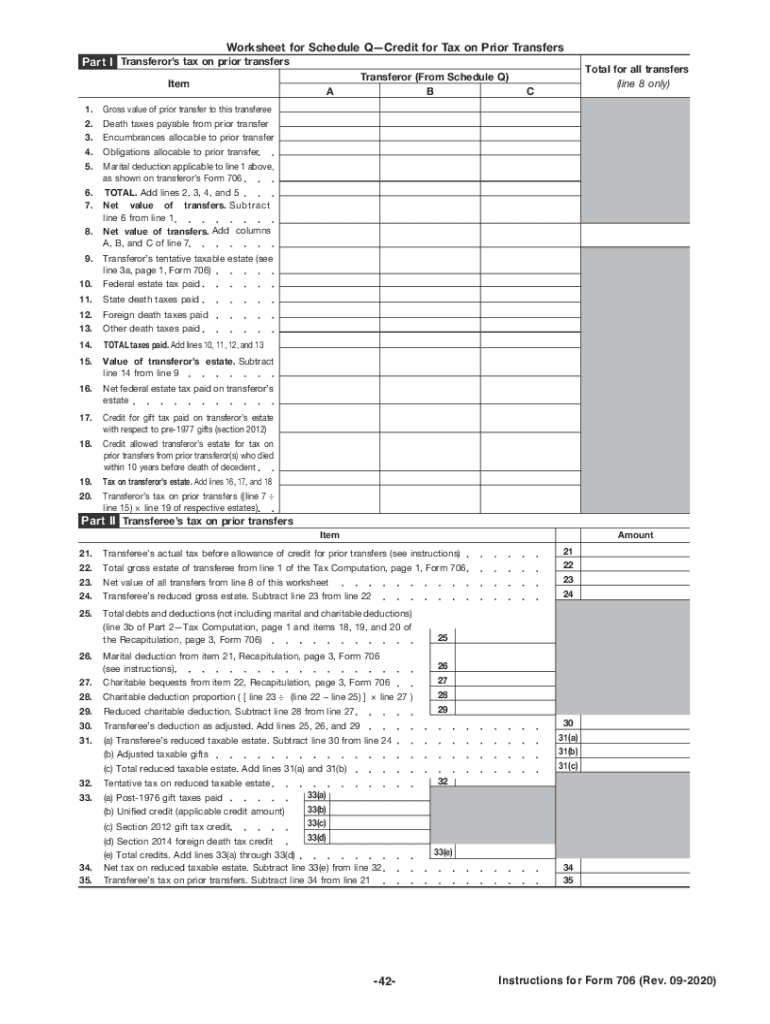
DSUE amount to the surviving spouse, are not required to report the value of certain property eligible for the marital deduction under section 2056 or 2056A or the charitable deduction under section 2055. However, the value of those assets must be estimated and included in the total value of the gross estate. See the instructions for Part 5 Recapitulation, lines 10 and 23, later, for more information. For more specific information, see the instructions for Schedules A through I. U.S. Citizens.

Open form follow the instructions

Easily sign the form with your finger

Send filled & signed form or save
How to fill out the IRS Instruction 706 online
Filling out the IRS Instruction 706 can seem daunting, but with a clear guide, you can navigate the process with confidence. This guide provides step-by-step instructions on completing this essential document online, empowering you to handle estate tax responsibilities efficiently.
Follow the steps to complete the IRS Instruction 706 online.
- Click ‘Get Form’ button to obtain the form and open it in your editing tool.
- Begin with Part 1—Decedent and Executor. Enter the decedent's social security number and provide the name and address of the executor. If there are multiple executors, include details for each.
- Continue to Part 2—Tax Computation. Here, you will need to report the gross estate value, applicable deductions, and calculate the estate tax using the provided rate schedule.
- Move to Part 3—Elections by the Executor where you may elect alternate valuation or special-use valuation for farm property.
- Complete Part 4—General Information with required information regarding the estate's administration and any exemptions.
- Proceed to Part 5—Recapitulation. Ensure all entries are complete, including totals for each schedule.
- Fill in Parts 6, 7, and additional schedules as necessary, depending on specific estate circumstances and assets.
- Review your entries for accuracy and ensure you include any required attachments such as a death certificate and the decedent's will.
- Once satisfied, save your changes. You may then download, print, or share the completed form as required before submission.
Start completing your IRS Form 706 online today and ensure your estate tax responsibilities are met.
Experience a faster way to fill out and sign forms on the web. Access the most extensive library of templates available.
Related content
English. Instructions for Form 706 - Introductory Material ...... $14,000 per donee. For...
For more information, see IRS Publication 559 (Survivors, Executors or Administrators)...
Publication 4163 Modernized e-File (MeF) Information for Authorized IRS e-File Providers...
Get answers to your most pressing questions about US Legal Forms API.
How do I request an estate tax closing letter?
Estate tax closing letters will only be issued upon request by the taxpayer or taxpayer's representative. There are two options for making a request for an estate tax closing letter: By facsimile to 855-386-5127 or 855-386-5128, or. By calling 866-699-4083.
How do I get an estate tax closing letter?
Estate tax closing letters will only be issued upon request by the taxpayer or taxpayer's representative. There are two options for making a request for an estate tax closing letter: By facsimile to 855-386-5127 or 855-386-5128, or. By calling 866-699-4083.
Who Must File Form 706?
IRS Form 706 must be filed on behalf of a U.S. citizen or resident whose gross estate, plus adjusted taxable gifts and specific exemptions, exceeds $11,180,000 in 2018, which is also known as the exclusion amount. The executor also has to file the form should the executor transfer any amount to the surviving spouse.
Do you have to file an estate tax return when someone dies?
When someone dies, their assets become property of their estate. ... IRS Form 1041, U.S. Income Tax Return for Estates and Trusts, is required if the estate generates more than $600 in annual gross income. The decedent and their estate are separate taxable entities.
Who has to file an estate tax return?
The executor must file a federal income tax return (Form 1041) if the estate has: gross income for the tax year of $600 or more, or. a beneficiary who is a nonresident alien.
What happens if you don't file taxes for a deceased person?
If you don't file taxes for the decedent and the estate promptly, the IRS can file a federal tax lien requiring you pay the decedent's income tax ahead of other bills. ... If the estate can't pay the debt because you spent the money on another debt or distributed assets to the heirs, the IRS may look to you for the money.
Does every estate have to file a tax return?
Most executors must file final state and federal income tax returns for the calendar year in which the deceased person died. A tax return is required if the deceased person received at least a minimum amount of income (set by federal law each year) in the last year of life.
Do I have to file an estate tax return if there is no income?
The executor must file a federal income tax return (Form 1041) if the estate has: gross income for the tax year of $600 or more, or. a beneficiary who is a nonresident alien.
Do you have to file an estate tax return if no tax is due?
Form 706 must generally be filed and any tax due must be paid within nine months of the decedent's date of death.
What is the due date for an estate tax return?
Generally, the estate tax return is due nine months after the date of death. A six month extension is available if requested prior to the due date and the estimated correct amount of tax is paid before the due date. The gift tax return is due on April 15th following the year in which the gift is made.
Use professional pre-built templates to fill in and sign documents online faster. Get access to thousands of forms.
If you believe that this page should be taken down, please follow our DMCA take down process here.