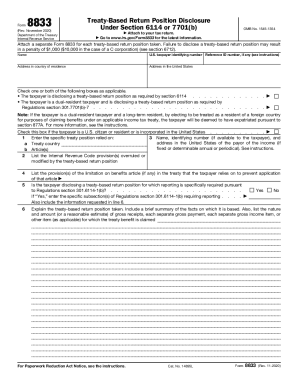
Interest (section 884(f)(1) (B)); For the latest information about developments related to Form 8833 and its instructions, such as legislation enacted after they were published, go to IRS.gov/Form8833. That a treaty exempts from tax or reduces the rate of tax on dividends or interest paid by a foreign corporation that are U.S.-sourced under section 861(a)(2)(B) or section 884(f)(1)(A); General Instructions That a treaty exempts from tax or reduces the rate of tax on fixed or determi.
Open form follow the instructions
Easily sign the form with your finger
Send filled & signed form or save
How to fill out the IRS 8833 online
This guide provides a clear and supportive approach to completing the IRS Form 8833 online, which is used for disclosing treaty-based return positions. By following these steps, users can ensure they submit the necessary information accurately and efficiently.
Follow the steps to complete the IRS 8833 form online:
- Click ‘Get Form’ button to obtain the form and open it in your editor.
- Enter your name as the taxpayer in the designated field.
- Input your U.S. taxpayer identifying number, which can be your social security number or individual taxpayer identification number.
- Provide your address in the country of residence including city, province or state, and country name.
- Fill in your address in the United States, as required.
- Indicate if you are disclosing a treaty-based return position under section 6114 and/or if you are a dual-resident taxpayer by checking the appropriate box(es).
- Describe the specific treaty position you are relying on in the relevant field.
- List the Internal Revenue Code provisions that are overruled or modified by your treaty position.
- If applicable, name the provisions of the limitation on benefits article that supports your claim for treaty benefits.
- Answer whether you are disclosing a treaty-based return position that requires specific reporting under Regulations section 301.6114-1(b). If yes, provide the necessary subsection information.
- Explain your treaty-based return position including a brief summary of the relevant facts and provide details on the income affected, including estimates where necessary.
- Review all filled sections for accuracy and completeness.
- Save your changes, and choose to download, print, or share the completed form as desired.
Complete your IRS forms online to ensure accurate and timely submissions.
Experience a faster way to fill out and sign forms on the web. Access the most extensive library of templates available.
Related content
Taxpayers use this form to make the treaty-based return position disclosure required by...
If you owe taxes and don't file, the IRS can assess penalty and interest and seize...
Go to www.irs.gov/Form8840 for the latest information. For the year January 1–December...
Get answers to your most pressing questions about US Legal Forms API.
Can I claim back US withholding tax?
In general, amounts withheld for US taxes are non-refundable. However, under certain circumstances, such as an incorrect rate being applied to withhold tax, a refund can be obtained.
How does a tax treaty work?
A tax treaty is a bilateral two-party agreement made by two countries to resolve issues involving double taxation of passive and active income. Tax treaties generally determine the amount of tax that a country can apply to a taxpayer's income, their capital, estate, or wealth.
What if there is no tax treaty?
If the treaty does not cover a particular kind of income, or if there is no treaty between your country and the United States, you must pay tax on the income in the same way and at the same rates shown in the instructions for Form 1040NR, U.S. Nonresident Alien Income Tax Return.
Do you have any wages exempted by a tax treaty?
Under these treaties, residents (not necessarily citizens) of foreign countries are taxed at a reduced rate, or are exempt from U.S. taxes on certain items of income they receive from sources within the United States.
Were you subject to tax in a foreign country on any of the treaty exempt income?
Under these treaties, residents (not necessarily citizens) of foreign countries may be eligible to be taxed at a reduced rate or exempt from U.S. income taxes on certain items of income they receive from sources within the United States.
Are green card holders required to file tax returns?
Like almost every other taxpayer in the United States, green card holders must file an IRS Form 1040 each year by April 15th. If you fail to file your United States taxes as a green card holder, you may hurt your chances of becoming a U.S. citizen.
Can resident aliens claim credit for other dependents?
Dependents who can't be claimed for the Child Tax Credit may still qualify you for the Credit for Other Dependents. This is a non-refundable tax credit of up to $500 per qualifying person. The qualifying dependent must be a U.S. citizen, U.S. national, or U.S. resident alien.
How do resident aliens file taxes?
U.S. resident aliens should file Form 1040EZ, Income Tax Return for Single and Joint Filers With No Dependents, Form 1040A, U.S. Individual Income Tax Return or Form 1040, U.S. Individual Income Tax Return at the address shown in the instructions for those forms.
Is the beneficial owner taxed as a resident of the selected treaty country?
The beneficial owner is a resident within the meaning of the income tax treaty between the United States and the country identified to the right.
Can resident aliens claim tax treaty?
Resident Alien with Tax Treaty - How to File a Federal Tax Return. As a resident alien for tax purposes, you file your taxes like a U.S. citizen using Form 1040 or Form 1040EZ. ... Then you would enter the amount for which treaty benefits are claimed in parentheses on Form 1040 in the "Other Income" line 21.
Use professional pre-built templates to fill in and sign documents online faster. Get access to thousands of forms.
If you believe that this page should be taken down, please follow our DMCA take down process here.