. . . . . . . . . . . . . . . . . . . . . . . . . . . . . 17 18 Health savings account and Archer MSA deductions (add line 12 and Archer MSA amount included on line 22 of federal Schedule 1) . . . . . . . . . . . . . . . . . . . . . . . . . . . . . . . . . . 18 19 One-half of self-employment tax and self-employed health insurance (add lines 14 and 16 of federal Schedule 1) . . . . . . . . . . . . . . . . . . . . . . . . . . . . . . . . . . . . . . . . 19 20 Deductions for alimony paid an.
Loading
Open form follow the instructions
Easily sign the form with your finger
Send filled & signed form or save
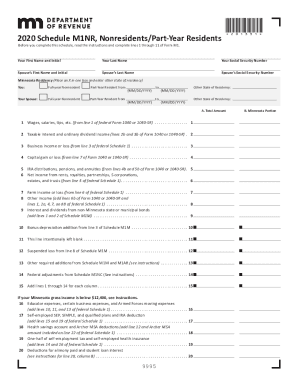
How to fill out the MN DoR Schedule M1NR online
Completing the Minnesota Department of Revenue Schedule M1NR is essential for nonresidents and part-year residents to accurately report their income. This guide provides step-by-step instructions on how to navigate the form online, ensuring you submit your information correctly.
Follow the steps to fill out the MN DoR Schedule M1NR online.
- Press the ‘Get Form’ button to obtain the Schedule M1NR form and open it in the editor for your convenience.
- Begin by entering your first and last names along with your Social Security Number in the designated fields.
- Complete your spouse’s details if applicable, including their first and last names and Social Security Number.
- Indicate your residency status by marking the appropriate box for 'Full-year Nonresident' or 'Part-Year Resident' and provide the other state of residency for both yourself and your spouse.
- Fill in the income details in Section A, starting from wages, salaries, and other relevant sources indicated on the form. Make sure to carry values from your federal Form 1040 where instructed.
- Proceed to enter the deductions and subtractions as indicated in Section B. Pay careful attention to specify what parts of your income are allocable to Minnesota.
- Review all the entries for accuracy and ensure that any required additions or adjustments, such as for educator expenses or business deductions, are included.
- When you have completed the form, you can save any changes made, download a copy for your records, print the form, or share it as needed.
Begin filling out your MN DoR Schedule M1NR online today!
Experience a faster way to fill out and sign forms on the web. Access the most extensive library of templates available.
Related content
Results 1 - 10 of 174 — Form Search | Minnesota Department of Revenue ... Search entire...
The Minnesota Department of Revenue's vision is “Everyone ... taxed by the other state...
Get answers to your most pressing questions about US Legal Forms API.
What is the federal income tax rate for 2019?
For most taxpayers, that'll be your return for the 2019 tax year which, by the way, will be due on April 15, 2020. The 2019 tax rates themselves are the same as the tax rates in effect for the 2018 tax year: 10%, 12%, 22%, 24%, 32%, 35% and 37%.
Do I need to file a MN tax return?
If you are a full-year Minnesota resident, you must file a Minnesota income tax return if your income meets the state's minimum filing requirement. ... If you are a part-year resident or nonresident, you must file if your Minnesota gross income meets the state's minimum filing requirement.
How much money do you have to make to file taxes in Minnesota?
For 2018, the Minnesota standard deductions are: $13,000 for taxpayers married filing jointly or surviving spouses/qualifying widow(er)s. $9,550 for taxpayers filing as head of household. $6,500 for single filers or those married filing separately.
How much do you have to make to file taxes in MN?
For 2018, the Minnesota standard deductions are: $13,000 for taxpayers married filing jointly or surviving spouses/qualifying widow(er)s. $9,550 for taxpayers filing as head of household. $6,500 for single filers or those married filing separately.
Who is required to file a Minnesota tax return?
According to Minnesota Instructions, If you are a full-year Minnesota resident, you must file a Minnesota income tax return if you need to file a federal income tax return. If you are a Part year resident or nonresident, you must file if your Minnesota gross income meets the state's minimum filing requirement.
What is a property tax refund?
The homestead credit refund is a state-paid refund that provides tax relief to homeowners whose. property taxes are high relative to their incomes. The program was previously known as the. homeowner's property tax refund program, or PTR, and sometimes popularly called the circuit. breaker.
Is Minnesota property tax refund taxable?
Is my MN property tax refund considered "state or local income"? That's not taxable income and is not reported on your federal tax return. That's a state income tax credit. It is not a "refund" of taxes paid.
When should I expect my MN property tax refund?
If the MN department receives your properly completed return and all enclosures are correct and complete, you can expect your refund: by mid-August if you are a renter or mobile home owner and you filed by June 15, or within 60 days after you file, whichever is later.
When can I expect my MN property tax refund 2019?
If the MN department receives your properly completed return and all enclosures are correct and complete, you can expect your refund: by mid-August if you are a renter or mobile home owner and you filed by June 15, or within 60 days after you file, whichever is later.
Who qualifies for a property tax refund in MN?
Your total household income (including a subtraction for dependents or if you are age 65 or older) for 2018 must be less than $61,320. The maximum refund is $2,150. You must have lived in a building in which property taxes were assessed or you made payments to a local government instead of property taxes.
Use professional pre-built templates to fill in and sign documents online faster. Get access to thousands of forms.
If you believe that this page should be taken down, please follow our DMCA take down process here.
This form is available in several versions. Select the version you need from the drop-down list below.