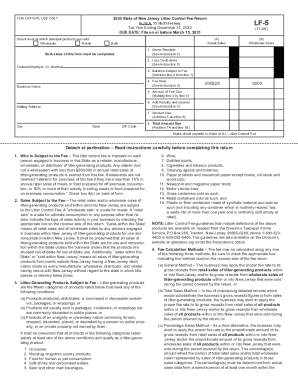
Pings; or (b) Products not usually sold in packages, containers, or wrappings but are commonly discarded in public places; or (c) Products of an unsightly or unsanitary nature commonly thrown, dropped, discarded, placed, or deposited by a person on public property, or on private property not owned by them. It shall be presumed that all products in the following categories listed satisfy at least one of the above conditions and qualify as a litter-generating product. 1. Groceries; 2. Nondr.
Open form follow the instructions
Easily sign the form with your finger
Send filled & signed form or save
How to fill out the NJ DoT LF-5 online
Filling out the NJ DoT LF-5 form online can be a straightforward process if approached step by step. This guide is designed to help individuals and businesses understand each section of the form, ensuring that all necessary information is accurately submitted.
Follow the steps to successfully complete the NJ DoT LF-5 online.
- Click the ‘Get Form’ button to obtain the form and open it in the editor.
- Complete the 'Gross Receipts' section by entering the total gross receipts from retail and wholesale sales of litter-generating products within New Jersey, ensuring amounts are reported in whole dollars only.
- In the 'Less Deductions' field, enter any qualifying deductions for litter-generating products sold to wholesalers or other exempt sales categories.
- Calculate the 'Balance Subject to Fee' by subtracting the deductions from the gross receipts.
- Indicate the 'Fee Rate'. Use the correct fee rate: .000225 for retail sales and .0003 for wholesale sales.
- Determine the 'Amount of Fee Due' by multiplying the balance subject to fee by the fee rate.
- Add any applicable penalty and interest charges to the fee due in the provided sections.
- In the 'Amount Due' section, add the Amount of Fee Due and any penalties or interest.
- Total the amounts due to find the 'Total Amount Due' for submission.
- After completing all sections, save the changes, and download, print, or share the form as needed.
Complete your NJ DoT LF-5 form online today to ensure compliance and timely submission.
Experience a faster way to fill out and sign forms on the web. Access the most extensive library of templates available.
Related content
5/17/2018, Earle Asphalt Company of Wall, NJ, Route 33 Business from Kondrup Way to...
Nov 7, 2018 - NJLTAP Enews Volume 20 – Issue 3 – May/June 2018. NJDOT received...
CR 43 · Monmouth County Route 44 NJ.svg · CR 45 ?. Route 36 is a state highway in...
Get answers to your most pressing questions about US Legal Forms API.
Who needs to file NJ state taxes?
If you are a resident of NJ, according to the NJ department of revenue, you are required to file an NJ resident state income tax return if: your filing status is married filing jointly and your gross income from everywhere for the entire year was more than the filing threshold of $20,000.
What is NJ gross income tax?
Overview. Description. This graduated tax is levied on gross income earned or received after June 30, 1976, by New Jersey resident and nonresident individuals, estates, and trusts. Rate. Rates for tax years beginning on or after January 1, 2004, range from 1.4% 8.97%.
What is the NJ state tax?
New Jersey has a 6.625% state sales tax, which was cut in steps from the previous rate of 7%.
What is NJ State Tax 2018?
On January 1, 2017, the tax rate decreased from 7% to 6.875%. On January 1, 2018, and after, the tax rate will decrease to 6.625%.
Is there local tax in NJ?
The New Jersey (NJ) state sales tax rate is 6.625%. Unlike many states, NJ does not allow the imposition of local sales tax the entire state has a single rate.
What is NJ Sui SDI Tax 2018?
Maximum Weekly Benefits for SUI and SDI For 2018, the maximum weekly benefit for unemployed workers is $681, while the maximum weekly rate for temporary disability is $637.
What is the NJ tax rate for 2019?
Beginning January 1, 2019, the withholding rate on income over five million dollars is 11.8 percent.
What is NJ withholding tax?
Click to read more on New Jersey's minimum wage increase. The withholding tax rates for 2019 reflect graduated rates from 1.5% to 11.8%. The 11.8% tax rate applies to individuals with taxable income over $5,000,000. The wage base increases to $34,400 for 2019.
What is NJ State withholding tax?
New Jersey Gross Income Tax The withholding tax rates for 2019 reflect graduated rates from 1.5% to 11.8%. The 11.8% tax rate applies to individuals with taxable income over $5,000,000.
Does New Jersey have local payroll taxes?
New Jersey requires employers to withhold state income and applicable local income taxes from employee paychecks in addition to employer paid state unemployment taxes. For New Jersey's tax rates, please click here.
Use professional pre-built templates to fill in and sign documents online faster. Get access to thousands of forms.
If you believe that this page should be taken down, please follow our DMCA take down process here.
This form is available in several versions. Select the version you need from the drop-down list below.