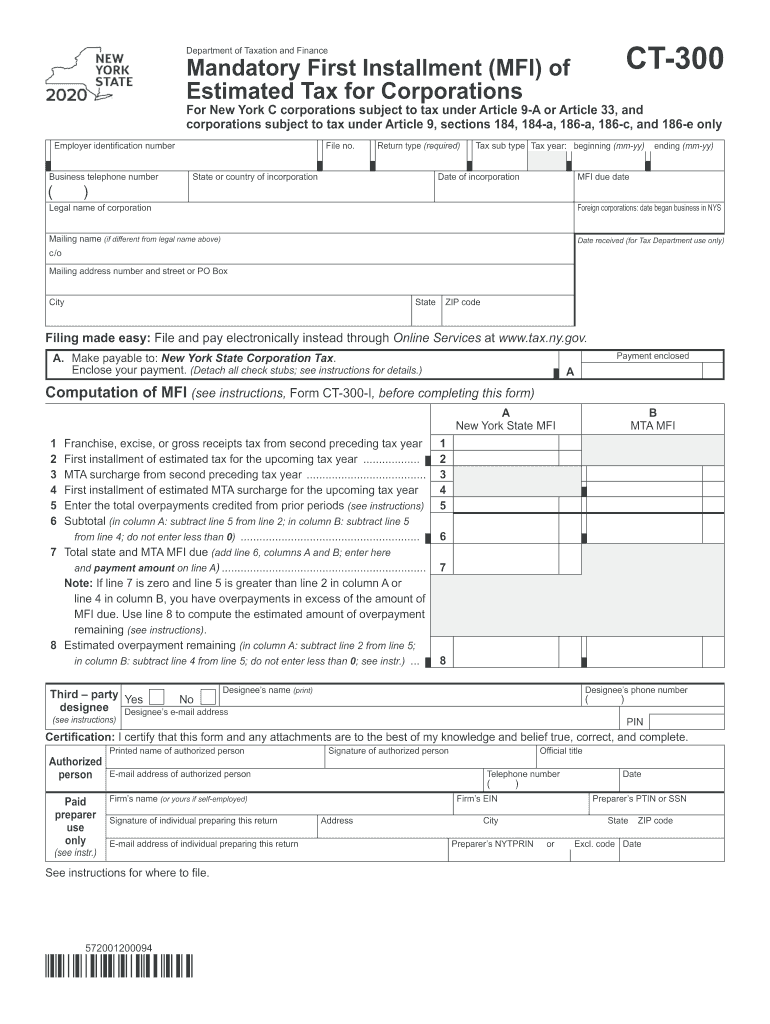
Orations subject to tax under Article 9, sections 184, 184-a, 186-a, 186-c, and 186-e only Employer identification number Business telephone number ( ) File no. Return type (required) State or country of incorporation Tax sub type Tax year: beginning (mm-yy) ending (mm-yy) Date of incorporation MFI due date Legal name of corporation Foreign corporations: date began business in NYS Mailing name (if different from legal name above) Date received (for Tax Department u.
Loading

Open form follow the instructions

Easily sign the form with your finger

Send filled & signed form or save
How to fill out the NY DTF CT-300 online
Filling out the NY DTF CT-300 form is essential for New York C corporations to submit their mandatory first installment of estimated tax. This guide will walk you through each section of the form, ensuring you understand the process and can complete it accurately.
Follow the steps to successfully complete the NY DTF CT-300 form online.
- Click ‘Get Form’ button to obtain the CT-300 form and open it in your document management application.
- Enter your employer identification number in the designated field.
- Fill in your business telephone number. Ensure it is accurate for effective communication.
- Specify your file number, if applicable, in the appropriate section.
- Choose the return type required for this filing.
- Indicate your state or country of incorporation.
- Select the tax sub-type for your corporation and specify the tax year, including the beginning and ending dates in the format mm-yy.
- Enter the date of incorporation of your corporation.
- Input the due date for the MFI.
- Provide the legal name of your corporation in the specified area.
- If a foreign corporation, indicate the date you began business in New York State.
- If the mailing name differs from the legal name, include that information.
- Fill in the mailing address, including number and street or PO Box, city, state, and ZIP code.
- Provide payment details as instructed, making the check payable to New York State Corporation Tax.
- Begin the computation of MFI by filling out lines 1 through 8: enter relevant taxes, estimated taxes for the upcoming year, and any overpayments from prior periods.
- Review and verify that the totals are correct, especially line 7 which indicates the total MFI due.
- Provide the designee's name, if applicable, and indicate whether they are a third-party designee.
- Complete the certification section by providing the printed name, signature, email address, and telephone number of the authorized person.
- If utilizing a paid preparer, fill in the preparer's details, including firm’s name, printed name, and signature.
- Once all sections are completed, save your changes, download, print, or share the form as needed.
Begin filling out your NY DTF CT-300 form online today!
Experience a faster way to fill out and sign forms on the web. Access the most extensive library of templates available.
Related content
Sep 20, 2018 - Web File Form CT-300 directly from your Business Online Services...
Volume 22, Issue 8, December 2018, Pages 1003-1013 ... DFT calculations ... 1H NMR and 13C...
Consider a mesh of size Nw = Nx × Ny × Nz , and distribute the task over Pw = Px...
Get answers to your most pressing questions about US Legal Forms API.
What is the 2018 corporate tax rate?
The Tax Cuts and Jobs Act of 2017 changed the top corporate tax rate from 35% to one flat rate of 21%. This rate will be effective for corporations whose tax year begins after January 1, 2018, and it is a permanent change. The corporate tax rate also applies to LLC's who have elected to be taxed as corporations.
What is the corporate tax rate for 2019?
The small business tax rate for 2019 is a flat 21% for a C-corporation. On average, the effective small business tax rate is 19.8%. However, businesses pay different amounts in taxes based on their entities.
How much is corporate tax in NY?
The business income base is based on federal taxable income with certain New York-specific modifications. The default tax rate is 6.5%. However, a lower rate of 5.5% applies to qualified emerging technology companies (QETCs) and a 0.0% rate applies to qualified New York manufacturers.
What is the 2018 tax rate for S corporations?
The Tax Cuts and Jobs Act of 2017 changed the top corporate tax rate from 35% to one flat rate of 21%. This rate will be effective for corporations whose tax year begins after January 1, 2018, and it is a permanent change. The corporate tax rate also applies to LLC's who have elected to be taxed as corporations.
Does an S Corp pay taxes on retained earnings?
Retained Earnings. Just like regular corporations, S corps can distribute profits to their shareholders, keep them as retained earnings or do a little of both. The difference is that the regular corporation makes this decision after it pays corporate income taxes. An S corp doesn't pay taxes.
Does an S Corp have to pay quarterly taxes?
Is an S corporation required to pay quarterly estimated tax? Sometimes an S corporation must make estimated tax payments. An S corporation must make installment payments of estimated tax if the total of these taxes is $500 or more: ... Investment credit recapture tax.
How is S Corp profit taxed?
S-corporations are pass-through entities. That is, the corporation itself is not subject to federal income tax. Instead, the shareholders are taxed upon their allocated share of the income. ... Shareholders do not have to pay self-employment tax on their share of an S-corp's profits.
Does an S Corp pay franchise tax?
S-corporations are pass-through entities. That is, the corporation itself is not subject to federal income tax. ... Shareholders do not have to pay self-employment tax on their share of an S-corp's profits.
What is the Texas franchise tax threshold for 2019?
Minimum Franchise Tax An entity that calculates an amount of tax due that is less than $1,000 or that has annualized total revenue less than or equal to $1,130,000 is not required to pay any tax. (See note for tiered partnership exception.)
What is the difference between sales tax and franchise tax?
Sales and Use tax and the franchise tax are separate state taxes. Sales and use tax is for the sales/use tax that is due from selling items that are taxable, and franchise tax is income tax from the profit on the business.
Use professional pre-built templates to fill in and sign documents online faster. Get access to thousands of forms.
If you believe that this page should be taken down, please follow our DMCA take down process here.