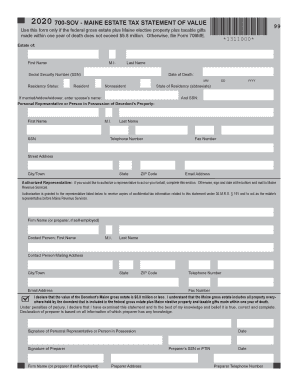
Uest a release of the lien on the decedent s property.* For more information on estate tax, including the Maine law and a guidance document titled Maine Estate Tax For Deaths Occurring After 2012, see the estate tax page on the MRS web site at www.maine.gov/revenue/incomeestate/estate. *Submit only one 700-SOV statement for the estate, even if completing and attaching multiple Certi cates of Discharge of Estate Tax Lien. GENERAL INSTRUCTIONS A worksheet is included in the Maine Estate Tax Gu.
Open form follow the instructions
Easily sign the form with your finger
Send filled & signed form or save
How to fill out the ME MRS 700-SOV online
The ME MRS 700-SOV is a crucial document for managing estate tax statements in Maine. This guide offers clear instructions on how to accurately complete the form online, ensuring compliance with Maine tax law while catering to users of all experience levels.
Follow the steps to fill out the ME MRS 700-SOV online.
- Click the ‘Get Form’ button to access the form and open it in your preferred online editor.
- Begin with the 'Estate of' section. Enter the first name, middle initial, and last name of the decedent, along with their social security number and date of death.
- Indicate the residency status of the decedent by selecting 'Resident' or 'Nonresident.' If applicable, include the name of the spouse.
- In the 'Personal Representative or Person in Possession of Decedent’s Property' section, enter the representative's first name, middle initial, last name, social security number, and their contact information. Include their mailing address, city, state, zip code, and email address.
- If you wish to authorize a representative to act on your behalf, fill out the 'Authorized Representative' section with their firm name or the preparer's name, along with the contact person's information.
- In the declaration section, confirm that the value of the decedent’s Maine gross estate is $5.8 million or less. Review the information for accuracy.
- After completing all fields, finalize the form by signing it in the designated areas for both the personal representative and preparer, providing necessary dates and social security numbers.
- To conclude, save the completed form, and consider downloading, printing, or sharing it as needed.
Complete the ME MRS 700-SOV online to ensure timely management of your estate tax statement.
Experience a faster way to fill out and sign forms on the web. Access the most extensive library of templates available.
Related content
700-SOV Estate tax statement of value for lien discharge · Worksheet for determining...
“We're offering the first course during the Fall 2019 semester: CPS ... In this role Mr...
Sep 27, 2014 - FMC-173 Hubbell Wiring Device-Kellems HCT252471 CableTrak HUBBELL...
Get answers to your most pressing questions about US Legal Forms API.
What states have inheritance tax 2019?
The U.S. states that collect an inheritance tax as of 2019 are Iowa, Kentucky, Maryland, Nebraska, New Jersey, and Pennsylvania.
Does Maine have an estate or inheritance tax?
There is no inheritance tax in Maine, this would be tax that falls on the heirs and beneficiaries, not on the estate of the person who died. The Maine estate tax rate, however, is much lower than the federal estate tax rate; the maximum rate is 12%.
Does Maine have inheritance tax?
There is no inheritance tax in Maine, this would be tax that falls on the heirs and beneficiaries, not on the estate of the person who died. The Maine estate tax rate, however, is much lower than the federal estate tax rate; the maximum rate is 12%.
Does Maine have a gift tax?
It does not, however, avoid the Maine estate tax in most cases. Maine does not have a gift tax, although the value of gifts in excess of the federal annual exclusion, if made within one year prior to death, is included in the decedent's estate.
Do I need to file an estate tax return for 2018?
You must file Form 1041 (U.S. Income Tax Return for Estates and Trusts) by the 15th day of the fourth month after the tax year-end (adjusted for weekends and holidays). So for a person who died in 2018, the deadline is April 15, 2019, when the standard Dec. 31 tax year-end is chosen.
What is the gift amount for 2019?
In other words, if you give each of your children $11,000 in 2002-2005, $12,000 in 2006-2008, $13,000 in 2009-2012 and $14,000 on or after January 1, 2013, the annual exclusion applies to each gift. The annual exclusion for 2014, 2015, 2016 and 2017 is $14,000. For 2018 and 2019, the annual exclusion is $15,000.
What is the applicable credit amount for 2018?
In 2018, the credit on the basic exclusion amount is $4,417,800 (exempting $11,180,000 from tax).
What is the estate tax exemption amount for 2019?
The Internal Revenue Service announced today the official estate and gift tax limits for 2019: The estate and gift tax exemption is $11.4 million per individual, up from $11.18 million in 2018.
What is the estate tax exemption amount for 2018?
For 2018, the estate and gift tax exemption is $5.6 million per individual, up from $5.49 million in 2017. That means an individual can leave $5.6 million to heirs and pay no federal estate or gift tax. A married couple will be able to shield north of $11 million ($11.2 million) from federal estate and gift taxes.
What is an estate tax exemption?
The federal estate tax is collected on the transfer of a person's assets to heirs and beneficiaries after death. ... An estate valued at $10,000 more than the 2019 federal estate tax exemption is taxed at a rate of 18%, while an estate that exceeds the exemption amount by $1 million or more is taxed at 40%.
Use professional pre-built templates to fill in and sign documents online faster. Get access to thousands of forms.
If you believe that this page should be taken down, please follow our DMCA take down process here.
This form is available in several versions. Select the version you need from the drop-down list below.