Tments allocated to the listed client EIN from Form 940, line 12 (h) Total FUTA tax deposits from Form 940, line 13, plus any payment made with the return allocated to the listed client EIN . . . . . . . . . . . . . . . . . . . . . . . . . . . . . . . . . . . . . . . . . . . . . . Schedule R (Form 940) (Rev. 12-2017) 860717 Schedule R (Form 940) (Rev. 12-2017) Section references are to the Internal Revenue Code unless otherwise noted. Future Developments For the latest information abou.

Open form follow the instructions

Easily sign the form with your finger

Send filled & signed form or save
How to fill out the IRS 940 - Schedule R online
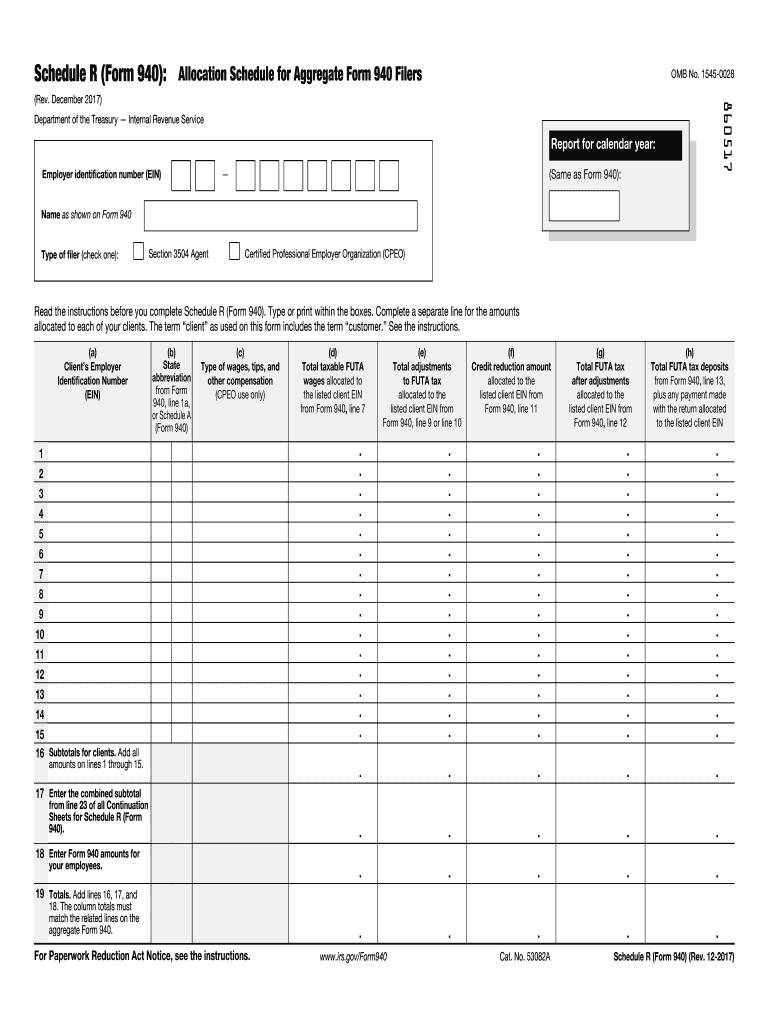
This guide provides a comprehensive overview of how to complete the IRS 940 - Schedule R online. You will find clear, step-by-step instructions to ensure accurate reporting for your clients and compliance with IRS regulations.
Follow the steps to successfully fill out Schedule R.
- Click ‘Get Form’ button to obtain the form and open it in the editor.
- Enter your business information at the top of Schedule R. Ensure the employer identification number (EIN) and business name match exactly with those on the attached Form 940. Check the appropriate box to specify if you are a section 3504 agent or a certified professional employer organization (CPEO).
- Indicate the calendar year for which you are filing the form at the top of Schedule R, making sure it matches the year on the attached Form 940.
- Report the following information for each client: (a) Client’s employer identification number (EIN). (b) State abbreviation based on Form 940, line 1a, or Schedule A. (c) Type of wages, tips, and other compensation (for CPEO use only) using the appropriate codes. If reporting multiple types for a client, complete one line for each type.
- For each client, complete the following columns: (d) Total taxable FUTA wages from Form 940, line 7. (e) Total adjustments to FUTA tax from Form 940, line 9 or 10. (f) Credit reduction amount from Form 940, line 11. (g) Total FUTA tax after adjustments from Form 940, line 12. (h) Total FUTA tax deposits from Form 940, line 13.
- If you have more clients than available lines, complete as many continuation sheets as necessary. Ensure to report the same information for your employees on Schedule R, line 18.
- After filling out the form, add the totals from lines 16, 17, and 18 to find the totals for line 19. Ensure that these totals match the related lines on the aggregate Form 940.
- Once all information is accurate and complete, you can save your changes, download, print, or share the form as required.
Complete your IRS 940 - Schedule R online today to ensure compliance and accurate reporting.
Experience a faster way to fill out and sign forms on the web. Access the most extensive library of templates available.
Related content
You must complete Schedule R if you file an aggregate Form. 940. Aggregate Forms 940 are...
Nov 22, 2011 — Use Form 940 to report your annual Federal Unemployment procedures...
Agents approved by the Internal Revenue Service to file Schedule R (Form 941 and 940)...
Get answers to your most pressing questions about US Legal Forms API.
What is IRS Schedule R used for?
IRS Schedule R is used for claiming the Credit for the Elderly or the Disabled by qualifying taxpayers. This form helps lower your tax burden by providing credits based on your age and income level, making it an essential part of financial planning for many seniors. Understanding how to utilize IRS 940 - Schedule R can significantly impact your tax savings. For detailed instructions and helpful insights, consider exploring USLegalForms’ extensive collection of resources.
What is the schedule R for payroll?
The Schedule R for payroll is associated with the Federal Unemployment Tax Act (FUTA) and allows employers to report their credit for payments made to state unemployment funds. Businesses use this form to calculate their payroll tax obligations connected to federal and state unemployment taxes. Using IRS 940 - Schedule R helps ensure compliance while maximizing potential credits. USLegalForms provides useful resources to help you complete this form accurately.
What is an IRS schedule R?
An IRS Schedule R is a supplemental form that allows eligible taxpayers to claim tax credits designed for seniors or disabled individuals. This form is typically filed with your 1040 or 1040SR to calculate the amount of credit you can receive based on your income and circumstances. Filing IRS 940 - Schedule R not only reduces your overall tax burden but also enhances your financial situation. For any questions related to completing this schedule, visit USLegalForms for specialized assistance.
Who needs to file Schedule R?
You need to file Schedule R if you are a qualified individual aged 65 or older, or if you're retired on permanent and total disability and have certain income levels. This filing helps ensure you receive the benefits associated with the Credit for the Elderly or Disabled. Understanding whether you meet the criteria can be complex, but using IRS 940 - Schedule R simplifies this process. For added clarity, you can find helpful guides on USLegalForms.
What is the Schedule R for income tax?
Schedule R is a form used to claim the Credit for the Elderly or the Disabled when you're filing your federal income tax. This schedule can reduce your tax liability if you meet specific income thresholds and age requirements. By using IRS 940 - Schedule R, eligible filers can benefit from credits designed to provide financial relief. For more detailed insights and examples, consider exploring USLegalForms’ resources to guide you through the filing process.
What is the difference between filing 1040 and 1040SR?
The main difference between filing the 1040 and the 1040SR lies in the eligibility criteria and the format. The 1040SR is specifically designed for seniors aged 65 and older, offering a simpler layout and larger font for easier reading. Both forms serve the purpose of reporting your income and calculating your tax, but they cater to different audiences. If you need assistance with understanding these forms, USLegalForms offers resources to help navigate your options.
How do I submit a payment to FUTA?
To submit a payment to FUTA, you can use the Electronic Federal Tax Payment System (EFTPS). Simply log into your EFTPS account, choose the payment type, and enter your payment details. Remember to keep your IRS 940 - Schedule R form handy, as it contains crucial information for accurately managing your FUTA payment.
Can I submit 940 online?
Yes, you can submit Form 940 online through the IRS e-file system. This process is convenient and allows for faster processing of your information. By submitting your IRS 940 - Schedule R electronically, you can ensure timely payments and avoid postal delays.
When must FUTA tax be deposited?
FUTA tax deposits must generally be made quarterly. Specifically, if your accumulated tax liability meets the $500 threshold, you'll need to deposit it by the end of the month following the quarter. Keeping track of these deadlines with the IRS 940 - Schedule R form helps you avoid penalties and maintain compliance.
How do I record a FUTA payment in QuickBooks?
To record a FUTA payment in QuickBooks, start by navigating to the Payroll Center. Select the 'FUTA' tax payment option. Enter the required details, including the amount and payment date, then save the transaction. Utilizing IRS 940 - Schedule R helps ensure correct reporting of your FUTA payments.
Use professional pre-built templates to fill in and sign documents online faster. Get access to thousands of forms.
If you believe that this page should be taken down, please follow our DMCA take down process here.