Osed during tax year a c d No tax item reported in Part III with respect to this asset Account jointly owned with spouse Maximum value of account during tax year . . . . . . . . . . . . . . . . . . . . . $ Did you use a foreign currency exchange rate to convert the value of the account into U.S. dollars? . . Yes No If you answered Yes to line 5, complete all that apply. (a) Foreign currency in which (b) Foreign currency exchange rate used to (c) Source of exchange rate used if not from U.S.
Loading

Open form follow the instructions

Easily sign the form with your finger

Send filled & signed form or save
How to fill out the IRS 8938 online
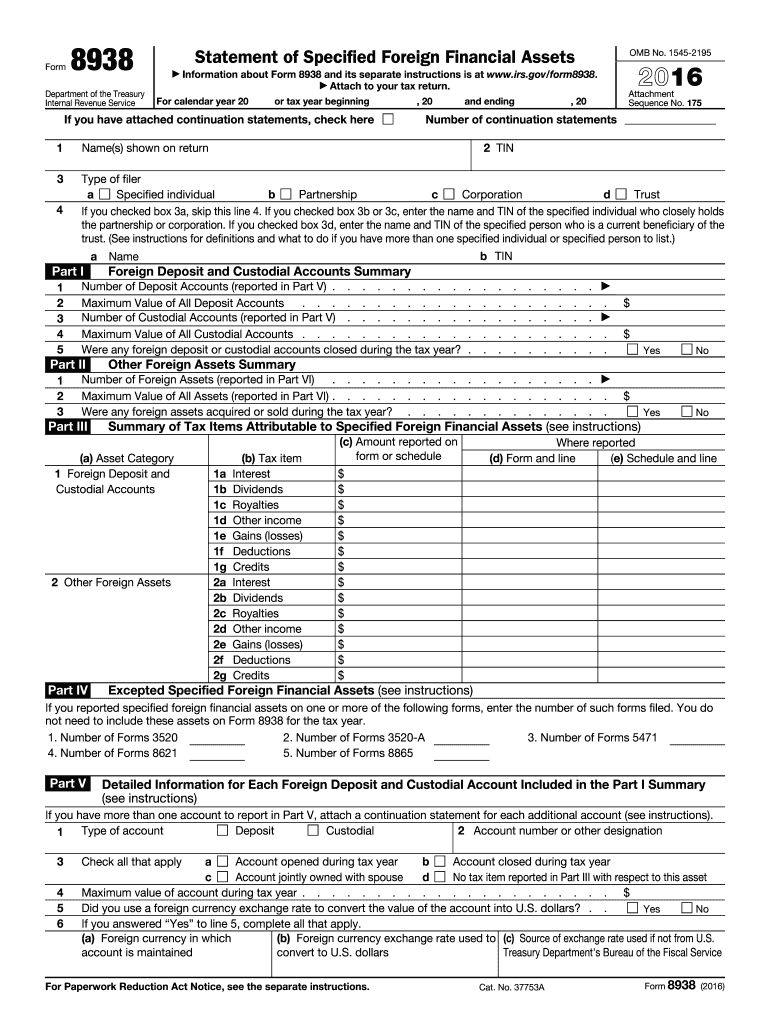
Filling out the IRS Form 8938 is essential for reporting specified foreign financial assets to the Internal Revenue Service. This guide provides step-by-step instructions to help users complete the form accurately and efficiently online.
Follow the steps to successfully complete the IRS 8938 form online.
- Press the ‘Get Form’ button to access the IRS Form 8938 and open it in your online document editor.
- Begin by filling in your name or names as they appear on your tax return. Ensure accuracy in this detail to avoid any discrepancies.
- Specify your type of filer by selecting the appropriate box, such as 'Specified individual,' 'Partnership,' 'Corporation,' or 'Trust.' If you are a specified individual, skip the following line.
- In Part I, summarize your foreign deposit and custodial accounts. Provide the number of deposit and custodial accounts, their maximum values, and indicate if any accounts were closed during the tax year.
- Proceed to Part II to report other foreign assets. Fill in the details about each asset, ensuring to include the tax items associated with these assets and their respective forms.
- In Part III, summarize tax items that are attributable to specified foreign financial assets. Provide necessary details such as the amount reported on the respective forms or schedules.
- Complete Part IV, detailing any excepted specified foreign financial assets and the number of related forms you have filed. This helps in indicating assets that do not need to be reported again.
- In Part V, give a detailed account for each foreign deposit and custodial account. Include information such as account identifiers, maximum values, and whether foreign currency exchange rates were used.
- Continue with Part VI to provide detailed information for each 'Other Foreign Asset'. Ensure to check any relevant boxes and provide values for the assets reported.
- Once you have completed all sections, review the form for accuracy. After all details are confirmed, save your changes and download your completed Form 8938 for printing or sharing.
Start filling out your IRS 8938 form online today to ensure accurate reporting of your foreign assets.
Experience a faster way to fill out and sign forms on the web. Access the most extensive library of templates available.
Related content
Use Form 8938 to report your specified foreign financial assets if the total value of all...
If a specified person fails to file a Form 8938, “Statement of Specified Foreign...
See the Form 8938 instructions for details. Change of address. If your child filed a...
Get answers to your most pressing questions about US Legal Forms API.
What happens if I have more than $100,000 in a foreign bank account?
If you hold more than $100,000 in a foreign bank account, you must report it to the IRS using FBAR and potentially Form 8938 as well. Not reporting these accounts can result in hefty fines and penalties. Utilizing platforms like USLegalForms can help you navigate these complex filing requirements and ensure you remain compliant.
What triggers an FBAR audit?
An FBAR audit may be triggered by various factors, including discrepancies in reported foreign accounts or the discovery of unreported income from foreign assets. The IRS may also target individuals with unusually large transactions or assets. Maintaining transparent records of your foreign finances can help minimize the risk of an audit.
What happens if you don't file form 8938?
Failing to file IRS Form 8938 can lead to severe penalties, including fines and interest accruing on any unpaid taxes. The IRS takes non-compliance seriously, particularly concerning foreign financial accounts. To avoid these consequences, it's best to understand the filing requirements and ensure that you accurately report your assets.
Do I need to file both FBAR and FATCA?
Yes, filing both FBAR and FATCA is often necessary for U.S. taxpayers with foreign accounts and assets. FBAR is required under the Bank Secrecy Act, while FATCA pertains to IRS regulations focusing on foreign accounts. Both forms help the IRS track foreign holdings, so ensure you fulfill each requirement to avoid complications.
Do I have to file both form 8938 and FBAR?
Yes, you may need to file both Form 8938 and the FBAR if you meet the reporting thresholds for each. While both are intended for reporting foreign financial accounts, they have distinct requirements and serve separate purposes. It's advisable to check the specific guidelines from the IRS to ensure compliance and avoid penalties.
What is an example of a specified foreign financial asset?
A specified foreign financial asset can include foreign bank accounts, foreign stocks or securities, and interests in foreign partnerships. Reporting these assets via IRS Form 8938 is crucial to ensure compliance with U.S. tax laws. Understanding what qualifies as a specified asset helps to prevent potential issues with the IRS.
What is the income limit for Form 8938?
The income limit for filing Form 8938 depends on your filing status and whether you live abroad. Typically, single filers must file if their foreign assets exceed $50,000 on the last day of the tax year, or $75,000 at any time during the year. For those married filing jointly, the limits increase, so check the IRS guidelines for specific amounts that apply to you.
Are bank accounts reported on 8938?
Yes, bank accounts held in foreign financial institutions must be reported on IRS Form 8938 if they meet the reporting threshold. This form is part of the IRS's efforts to ensure that U.S. taxpayers disclose their foreign financial assets. Understanding these requirements can help you stay compliant with tax laws.
Can the FBAR be filed separately?
Yes, the FBAR (Foreign Bank Account Report) can be filed separately from Form 8938. While both forms are meant for reporting foreign financial accounts, they serve different purposes and have different filing requirements. Therefore, it is important to ensure that you complete each form according to the specific guidelines set by the IRS.
Are foreign bank accounts reported to the IRS?
Yes, foreign bank accounts must be reported to the IRS if they meet certain thresholds, particularly through Form 8938. This form is part of the Foreign Account Tax Compliance Act, which targets tax evasion through offshore accounts. It's crucial for individuals with foreign assets to understand their reporting obligations to avoid penalties.
Use professional pre-built templates to fill in and sign documents online faster. Get access to thousands of forms.
If you believe that this page should be taken down, please follow our DMCA take down process here.
This form is available in several versions. Select the version you need from the drop-down list below.