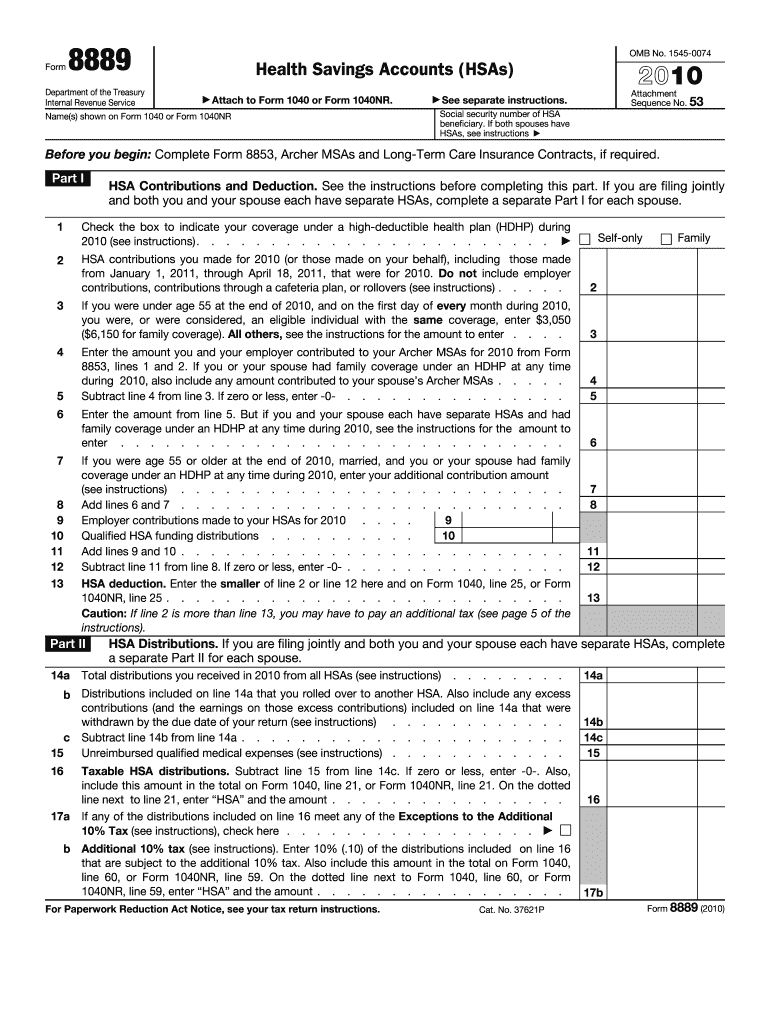
Use. Total distributions you received in 2010 from all HSAs (see instructions) . . . . . . . . b Distributions included on line 14a that you rolled over to another HSA. Also include any excess contributions (and the earnings on those excess contributions) included on line 14a that were withdrawn by the due date of your return (see instructions) . . . . . . . . . . . . c Subtract line 14b from line 14a . . . . . . . . . . . . . . . . . . . . . . 15 Unreimbursed qualified medical expense.
Loading

Open form follow the instructions

Easily sign the form with your finger

Send filled & signed form or save
How to fill out the IRS 8889 online
The IRS Form 8889 is essential for individuals with Health Savings Accounts (HSAs) to report contributions and distributions. This guide will provide a comprehensive overview and step-by-step instructions on how to fill out the form online, ensuring that users can accurately manage their HSA information.
Follow the steps to complete your IRS 8889 online accurately.
- Click ‘Get Form’ button to access the IRS 8889 form, which will open in your preferred digital environment.
- Enter your name(s) exactly as shown on your Form 1040 or Form 1040NR, along with the social security number of the HSA beneficiary. If applicable, complete a separate entry for each spouse if both have HSAs.
- In Part I, indicate your coverage under a high-deductible health plan (HDHP) during the applicable year by checking the appropriate box.
- List the total HSA contributions you made for that year, including those made on your behalf up until the tax deadline. Exclude employer contributions, cafeteria plan contributions, and rollovers.
- If you were under age 55 at year's end, enter the appropriate contribution limit based on your coverage, referencing the provided guidelines.
- If you or your spouse contributed to Archer MSAs, include that amount and perform the necessary calculations to determine the limitation on your HSA deductions.
- Complete the section regarding additional contributions if applicable, especially if you were age 55 or older at the end of the year.
- Submit the values in the designated lines to calculate your HSA deduction amount, which you will report on your Form 1040 or Form 1040NR.
- Proceed to Part II to report on HSA distributions. Record total distributions, any amounts rolled over, and taxes due on non-qualified distributions.
- In Part III, report any income and additional tax liability resulting from failure to maintain HDHP coverage, again ensuring to follow the instructions closely.
- Once all fields are accurately filled out, save your changes, and you can download, print, or share the form as needed.
Take action now and complete your IRS 8889 form online to manage your Health Savings Accounts effectively.
Experience a faster way to fill out and sign forms on the web. Access the most extensive library of templates available.
Related content
Jan 23, 2025 — File Form 8889 to: Report health savings account (HSA) contributions...
File Form 8889 with your tax return to report your HSA contributions and distributions...
May 2, 2017 — Also see Form 8889,. Health Savings Accounts (HSAs), and Pub. 969. Lost...
Get answers to your most pressing questions about US Legal Forms API.
Where do I get form 8889 T from?
To get form 8889 T, you can visit the IRS website or use tax preparation software that includes IRS forms. Additionally, platforms like US Legal Forms provide users with easy access to this and other tax-related documents. This can simplify your filing process, ensuring you have all necessary forms ready. Proper access to form 8889 T can help streamline tax preparation for your HSA.
Who must file form 8889?
Any taxpayer who has made contributions to an HSA or received distributions from one must file form 8889. This includes individuals and families that have established an HSA to manage their healthcare costs. By submitting this form, you can claim deductions and ensure compliance with IRS regulations. Understanding who needs to file is crucial for accurate tax reporting.
What happens if I don't file form 8889?
Failure to file form 8889 may result in penalties or audits by the IRS. It’s vital to include this form to show your HSA transactions clearly. If omitted, you could miss out on eligible deductions or credits associated with your HSA. Protect yourself by ensuring form 8889 is filed along with your tax return.
Do I need to report HSA contributions on my tax return?
Yes, you need to report HSA contributions on your tax return. IRS 8889 facilitates this by allowing you to declare all contributions made throughout the year. Reporting contributions accurately ensures that you receive the appropriate tax benefits associated with your HSA. This inclusion can significantly impact your overall tax savings.
What happens if you don't file form 8889?
If you don’t file form 8889, you may face penalties and interest due to underreported income. The IRS requires this form to accurately assess any tax liability related to your HSA. Not filing can lead to complications during an audit, as your tax return will lack crucial information. To avoid these issues, make sure to submit form 8889 with your tax return.
What is the IRS form 8889 used for?
IRS form 8889 is used to report contributions to and distributions from your Health Savings Account (HSA). It allows taxpayers to calculate their HSA deduction and report any taxable HSA distributions. By using IRS 8889, you can ensure that your tax return reflects your HSA accurately. This form is crucial for maintaining compliance with tax laws.
Do I have to report 1099-SA on my tax return?
Yes, you must report the information from Form 1099-SA on your tax return. This form details distributions from your HSA, and using IRS 8889 allows you to include this information accurately. Failure to report this could result in discrepancies in your tax filing. Thus, it's advisable to ensure all forms are correctly submitted.
Do I need to report my HSA on taxes?
Yes, reporting your Health Savings Account (HSA) on your taxes is essential. You will use IRS 8889 to report any contributions and distributions from your HSA. This helps ensure accurate tax calculations and compliance with IRS regulations. By including your HSA on your tax return, you can also claim your deductions effectively.
What is line 9 on form 8889 Part 1?
Line 9 on Part 1 of Form 8889 is where you report any contributions made to your health savings account for the year. This includes contributions made by you, your employer, or anyone else on your behalf. Correctly entering this information is vital for determining your maximum deduction and ensuring compliance with IRS regulations. To navigate these details confidently, use resources available through US Legal Forms.
Do I fill out form 8889?
You need to fill out Form 8889 if you have a health savings account during the tax year. This form captures your contributions and distributions, impacting your tax returns. By completing IRS 8889, you can claim potential deductions that may lower your overall tax liability. Accessing platforms like US Legal Forms can enhance clarity and accuracy in this process.
Use professional pre-built templates to fill in and sign documents online faster. Get access to thousands of forms.
If you believe that this page should be taken down, please follow our DMCA take down process here.
This form is available in several versions. Select the version you need from the drop-down list below.