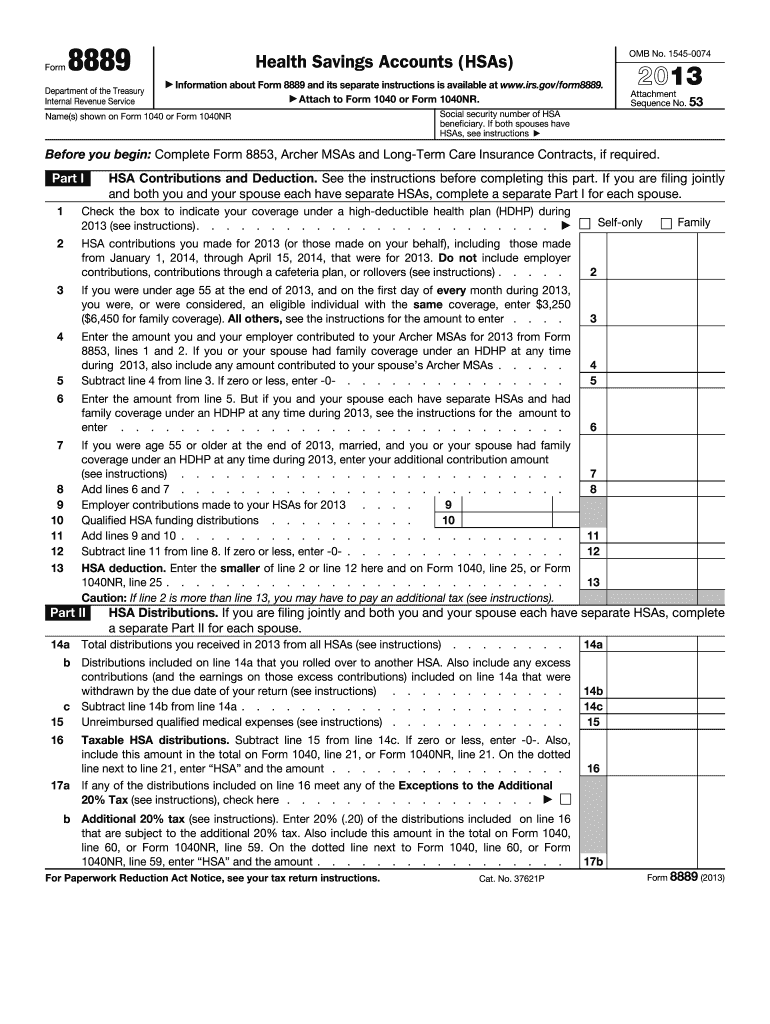
S, complete a separate Part II for each spouse. Total distributions you received in 2013 from all HSAs (see instructions) . . . . . . . . b Distributions included on line 14a that you rolled over to another HSA. Also include any excess contributions (and the earnings on those excess contributions) included on line 14a that were withdrawn by the due date of your return (see instructions) . . . . . . . . . . . . c Subtract line 14b from line 14a . . . . . . . . . . . . . . . . . . . . .
Loading

Open form follow the instructions

Easily sign the form with your finger

Send filled & signed form or save
How to fill out the IRS 8889 online
Filling out the IRS 8889 form is essential for individuals with Health Savings Accounts (HSAs) to report contributions and distributions. This guide provides step-by-step instructions to complete the form efficiently online.
Follow the steps to successfully complete the IRS 8889 form online.
- Click ‘Get Form’ button to obtain the form and open it in your selected editor.
- Begin by entering your name and social security number as they appear on Form 1040 or Form 1040NR.
- Complete Part I by checking the box to indicate your coverage under a high-deductible health plan during the tax year.
- Input the total HSA contributions you made for the year, including anything contributed on your behalf up to the relevant deadline.
- If applicable, enter the contribution limits based on your age and coverage type, utilizing the instructions provided to calculate accurately.
- Proceed to Part II to report total distributions received from your HSAs. Be sure to detail any amounts rolled over or excess contributions withdrawn.
- Complete Part III to detail any additional income and taxes relevant to the failure to maintain HDHP coverage.
- Review all entered information for accuracy. Once verified, save changes, download, print, or share your completed form as necessary.
Complete your IRS 8889 form online today to ensure compliance and take advantage of your Health Savings Account benefits.
Experience a faster way to fill out and sign forms on the web. Access the most extensive library of templates available.
Related content
Jan 23, 2025 — File Form 8889 to: Report health savings account (HSA) contributions...
File Form 8889 with your tax return to report your HSA contributions and distributions...
May 2, 2017 — Also see Form 8889,. Health Savings Accounts (HSAs), and Pub. 969. Lost...
Get answers to your most pressing questions about US Legal Forms API.
Do I have to report my HSA on my tax return?
Yes, you must report your HSA on your tax return if you made contributions or received distributions. IRS form 8889 is the designated form for reporting this critical information. Failing to report your HSA correctly can lead to unintended tax liabilities or loss of potential tax benefits. Using tools like US Legal Forms can help you navigate this process smoothly.
How do I file my HSA on my taxes?
To file your HSA on your taxes, start by completing IRS form 8889. Include details about your contributions and distributions from the previous year. Then, transfer the information from form 8889 to your Form 1040 when you file your tax return. By doing this, you can ensure you accurately report your HSA activity and maximize your tax benefits.
Who fills out the 8889 form?
Typically, any taxpayer who has an HSA must fill out IRS form 8889. This includes individuals who made contributions to their HSA or took distributions for medical expenses. If you're filing jointly with a spouse, each spouse must report their portion of contributions and distributions on their respective forms. Therefore, it's crucial to ensure accuracy when reporting HSA information to the IRS.
Do I need to file the IRS form 8889?
Filing IRS form 8889 is necessary if you made contributions to your Health Savings Account (HSA) during the tax year. Additionally, you must file this form if you received distributions from your HSA. Completing form 8889 helps to ensure that you comply with IRS requirements, maximizing your tax benefits related to your HSA. If you're uncertain, using US Legal Forms can simplify the process by providing the necessary resources.
Can I file form 8889 separately?
Yes, you can file IRS form 8889 separately if you choose to do so. However, it's often beneficial to file it alongside your Form 1040 to streamline your tax process. Filing it separately can complicate your situation, especially if you are married filing jointly. If you have unique circumstances regarding your HSA or your contributions, consulting with a tax professional could provide clarity.
How do I report HSA contributions on my tax return Turbotax?
To report HSA contributions using TurboTax, you should first gather your Form 5498-SA. On TurboTax, locate the medical expenses section and find the HSA contributions section. Enter the contributions you made during the tax year, followed by the information from your Form 8889. TurboTax will guide you through the process, ensuring you report correctly, which is essential for accurately filing your IRS 8889.
What happens if you don't file form 8889?
Not filing form 8889 can result in complications with the IRS regarding your HSA. You may incur penalties or taxes on unreported contributions and distributions. Additionally, not filing can lead to missed tax benefits that come from having an HSA. Ensure your compliance by filing the appropriate forms accurately and on time through resources like uslegalforms.
What happens if I don't report my HSA on taxes?
If you don't report your HSA on taxes, you may face penalties or additional taxes. The IRS can impose taxes on any unreported contributions, resulting in unexpected liabilities. Furthermore, failing to report could limit your ability to fully benefit from HSA advantages. It's best to include your HSA information on IRS form 8889.
What is the IRS form 8889 used for?
IRS form 8889 is used to report Health Savings Account (HSA) contributions and distributions. This form helps individuals track their contributions and ensure they comply with IRS rules. Furthermore, it assists in claiming the tax deductions associated with these accounts. Understanding form 8889 is essential for anyone utilizing an HSA.
Do HSA contributions reduce your taxable income?
Yes, HSA contributions can reduce your taxable income. Any contributions you make are tax-deductible, lowering the amount of income subject to taxation. This benefit is one of the key incentives to maximize your HSA contributions. For guidance, refer to IRS form 8889 when filing your taxes.
Use professional pre-built templates to fill in and sign documents online faster. Get access to thousands of forms.
If you believe that this page should be taken down, please follow our DMCA take down process here.
This form is available in several versions. Select the version you need from the drop-down list below.