Answering . . . . . . . . . . . . . . . . . . . . . Did the child live with the taxpayer in the United States for over half of 2015? See the instructions before answering . . . . . . . . . . . . 11 12 Child 1 Child 2 Child 3 Yes No Yes No Yes No Yes No Yes No Yes No Yes No Yes No Yes No Yes No Yes No Yes No Yes No Yes No Was the child (at the end of 2015) Under age 19 and younger than the taxpayer (or the taxpayer s spouse, if the taxpayer files jointly.
Open form follow the instructions
Easily sign the form with your finger
Send filled & signed form or save
How to fill out the IRS 8867 online
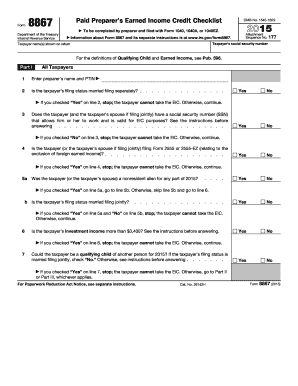
The IRS 8867 form, known as the Paid Preparer's Earned Income Credit Checklist, is essential for tax preparers to ensure that their clients qualify for the Earned Income Credit (EIC). This guide will provide comprehensive step-by-step instructions for filling out the IRS 8867 online, making the process straightforward and accessible for all users.
Follow the steps to successfully complete IRS 8867 online.
- Click the ‘Get Form’ button to obtain the IRS 8867 form and open it in your document editor.
- Enter the preparer’s name and Preparer Tax Identification Number (PTIN) in the spaces provided at the top of the form.
- For question 2, determine the taxpayer's filing status. If the taxpayer is married filing separately, select 'Yes'; otherwise, select 'No' and you will need to stop here as they cannot take the EIC.
- Proceed to question 3 and check if either the taxpayer or the spouse is filing Form 2555 or 2555-EZ. Respond 'Yes' or 'No' accordingly. A 'Yes' answer disqualifies the EIC eligibility.
- In question 4, confirm if the taxpayer and their spouse have valid social security numbers for work. They must select the appropriate response, as a 'No' response prohibits the EIC.
- Question 5 assesses whether the taxpayer or spouse was a nonresident alien at any point in the year. Depending on their response, follow the form’s guidance.
- Continue with the investment income question (question 6). If their investment income exceeds $3,400, they will not qualify for the EIC.
- Question 7 inquires if the taxpayer could be a qualifying child for another person. This requires careful consideration, as a 'Yes' response may disqualify the taxpayer from EIC if they do not file jointly with their spouse.
- For taxpayers with children, complete Part II. Begin by entering the child's name in question 8 and answering subsequent questions on the child's relationship to the taxpayer, marital status, and living situation.
- If addressing more than one child, ensure all questions from 8 to 14 are completed for each child before proceeding.
- In Part III, for taxpayers without a qualifying child, answer questions about residency and age to determine eligibility for the EIC.
- Move to Part IV, where the preparer confirms due diligence by answering questions related to the completeness and accuracy of the information received.
- Finally, review the responses to ensure all sections are complete. Users may now save changes, download, print, or share the completed form.
Complete your IRS filings accurately by filling out the IRS 8867 and other necessary documents online today.
Experience a faster way to fill out and sign forms on the web. Access the most extensive library of templates available.
Related content
Form 8867 is a Paid Preparer's Due Diligence Checklist for EIC, AOTC, CTC, and HOH filing...
Dec 14, 2016 — Form 8867 Due Diligence Webinar. New Form 8867 | The Paid Preparers Due...
athenahealth, Inc. provides cloud-based business services that help medical care givers...
Get answers to your most pressing questions about US Legal Forms API.
What is the purpose of form 8867?
The main purpose of form IRS 8867 is to ensure that taxpayers claim tax credits for which they are legitimately eligible. It serves as a checklist to verify that you have done your due diligence before filing your taxes. Using this form correctly can help maintain accuracy in your tax return and prevent future complications.
What is the penalty for failing form 8867?
If you fail to submit form IRS 8867, the penalties can be quite serious. This can result in missed tax credits and possibly monetary fines for each instance of non-compliance. Being proactive and filing the form correctly helps safeguard your financial interests.
How many IRS due diligence is required?
The IRS requires that taxpayers exercise due diligence whenever claiming certain credits, especially with IRS 8867. It is crucial to thoroughly assess your eligibility for these credits. Regularly reviewing your tax documents ensures you meet these due diligence requirements and protect your tax benefits.
What is the penalty for not doing due diligence?
The penalty for failing to perform due diligence can vary, but it often includes financial penalties from the IRS. Neglecting your responsibilities regarding IRS 8867 may lead to the disallowance of tax credits. To ensure compliance and keep your financial state secure, it's important to follow the due diligence guidelines.
What is the penalty for not filing form 8867?
Not filing form IRS 8867 can result in a penalty, which may include losing the ability to claim certain tax credits. In some cases, you can be fined for each instance of non-filing. To protect yourself and your finances, it is essential to understand and meet the requirements of form 8867.
What are the potential consequences of not meeting due diligence requirements?
Failing to meet due diligence requirements can lead to serious financial repercussions. The IRS may impose penalties, deny credits, or even audit your tax return. Staying compliant with IRS 8867 helps you avoid these consequences and ensures you receive the appropriate tax benefits.
Why is the IRS holding my refund because of child tax credit?
If the IRS is holding your refund due to issues with the Child Tax Credit, it often relates to incomplete or inaccurate information on IRS 8867. The IRS may require further verification of your eligibility for the credit. Taking the necessary steps to ensure all information is accurate can help in releasing your refund quicker.
What is the penalty for not exercising due diligence?
When you do not exercise due diligence, especially in relation to the IRS 8867, you may face significant penalties. This can include the loss of certain tax credits, such as the Child Tax Credit. Additionally, your tax return may be subject to further scrutiny, potentially delaying your refund and causing additional stress.
How long can the IRS hold your refund for processing?
The IRS can hold your refund for processing anywhere from a few days to several weeks, depending on the complexity of your return. If your return includes complications, such as the Child Tax Credit, the review time may increase. Using Form 8867 can help streamline your submission and potentially reduce unnecessary delays.
Why is the Child Tax Credit delaying my refund?
Delays in refunds involving the Child Tax Credit often occur due to the IRS’s verification process. They need to ensure that claims are accurate and legitimate, which can result in longer processing times. Properly filling out Form 8867 can aid in expediting this process, making it essential for taxpayers to be thorough in their submissions.
Use professional pre-built templates to fill in and sign documents online faster. Get access to thousands of forms.
If you believe that this page should be taken down, please follow our DMCA take down process here.
This form is available in several versions. Select the version you need from the drop-down list below.