On Act Notice, see the separate instructions. Cat. No. 24126N Form 8854 (2015) Form 8854 (2015) Part III Page 2 For Persons Who Expatriated After June 16, 2008, and Before January 1, 2015 If you made an election to defer the payment of tax, complete line 1. If you have an item of eligible deferred compensation, complete line 2. If you have an interest in a nongrantor trust, complete line 3. 1 Complete columns (a), (b), and (c) for all property on which you deferred tax on a.
Loading

Open form follow the instructions

Easily sign the form with your finger

Send filled & signed form or save
How to fill out the IRS 8854 online
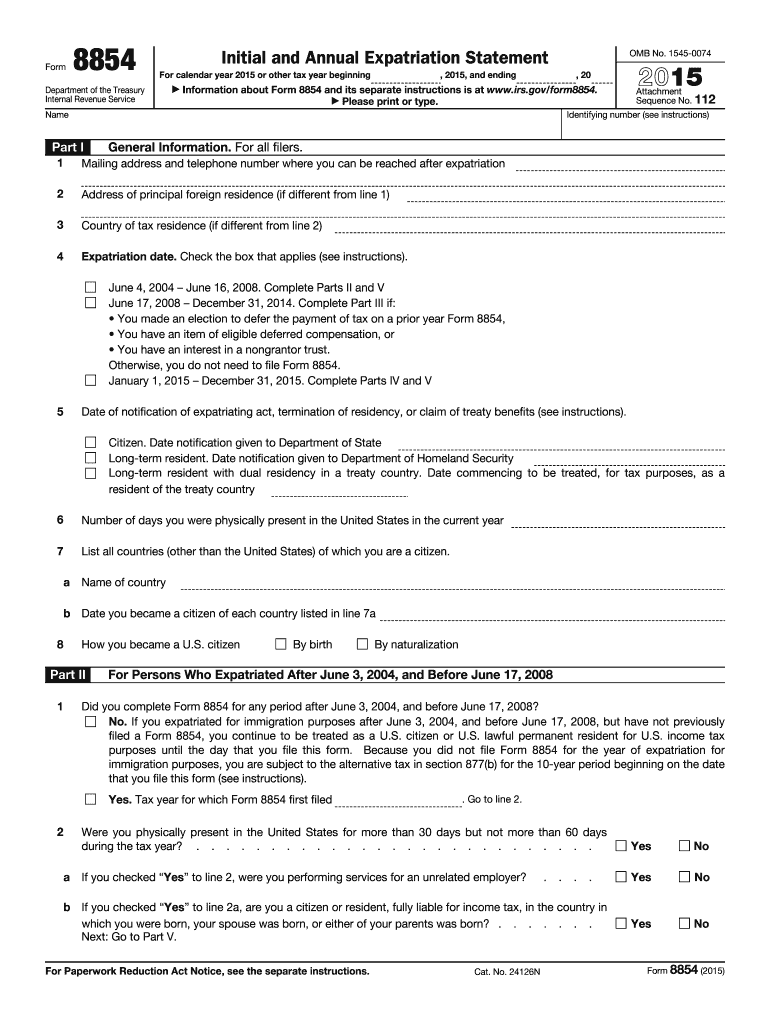
Completing the IRS Form 8854, the Initial and Annual Expatriation Statement, is essential for individuals who have expatriated. This guide provides a detailed, step-by-step approach to filling out the form online, ensuring users can navigate each section with confidence.
Follow the steps to accurately complete the IRS 8854 online.
- Click the ‘Get Form’ button to obtain the IRS 8854 form and open it for completion.
- Provide your name and identifying number in the designated spaces at the top of the form.
- Fill in your mailing address and telephone number where you can be reached after expatriation.
- Indicate your principal foreign residence address, if different from your mailing address.
- State your country of tax residence, if it differs from your principal foreign residence.
- Specify your expatriation date by checking the relevant box and completing the required sections based on the time of expatriation.
- Complete Part I, providing details on your physical presence in the United States for the current year.
- List all countries of which you are a citizen along with the dates you became citizens.
- Proceed to complete the applicable parts for your expatriation time frame, ensuring you answer each question accurately.
- Finish with Part V, where you will provide a balance sheet and income statement based on your financial status at the time of expatriation.
- After filling out all sections, save your changes and download the form for your records. You may also choose to print or share the completed form as needed.
Complete your IRS 8854 form online today to ensure compliance with your tax obligations.
Experience a faster way to fill out and sign forms on the web. Access the most extensive library of templates available.
Related content
Apr 24, 2025 — Form 8854 is used by individuals who have expatriated on or after June 4...
Instructions for Form 8854, expatriation initial information statement. Author: United...
Apr 15, 2015 — What's New. Premium tax credit. You may be eligible to claim the premium...
Get answers to your most pressing questions about US Legal Forms API.
How can I avoid US exit tax?
Avoiding the U.S. exit tax requires careful planning and an understanding of your financial situation. One approach is to reduce your net worth below the threshold, sell capital assets, or mitigate gains before renouncing citizenship. Engaging with skilled professionals familiar with the IRS form 8854 process can provide valuable insights. Platforms like uslegalforms can assist you in navigating your options effectively, ensuring you make informed decisions.
What happens if you don't file form 8854?
Failing to file form 8854 can lead to severe tax consequences, including penalties and ongoing tax obligations. The IRS may consider you a covered expatriate, which has significant tax implications. Without proper filing, you risk complications regarding your finances and future dealings with the IRS. To avoid these issues, consider using platforms like uslegalforms to guide you through the filing process efficiently.
What is the meaning of 8854?
The IRS form 8854 is known as the 'Initial and Annual Expatriation Statement.' It is used to report your expatriation from the United States for tax purposes. This form helps the IRS understand your tax obligations as you leave the U.S. tax system. Filing this form is essential to confirm your expatriation status and manage any exit tax implications.
Who must file the IRS form 8854?
Individuals who are expatriating, meaning they are renouncing their U.S. citizenship or terminating long-term residency, must file the IRS form 8854. This requirement applies to those who meet specific criteria, including tax obligations and benefits received from the U.S. government. Moreover, it's crucial for anyone who has held a U.S. passport or green card for a significant period to ensure compliance. By filing IRS form 8854, you establish your tax status and fulfill your responsibilities.
Who is required to file form 8854?
Form IRS 8854 is required to be filed by individuals who renounce their U.S. citizenship or abandon their long-term resident status. This includes individuals who meet certain income or net worth thresholds set by the IRS. Failing to file can lead to severe tax consequences. Using US Legal Forms can help ensure you meet all filing requirements effectively.
What is the tax rate for form 8854?
The tax rate for IRS 8854 depends on your specific financial situation and whether you qualify as a covered expatriate. Generally, covered expatriates are taxed on their unrealized gains as if they sold all their assets. This means that the effective tax rate can vary significantly based on individual circumstances. For clarity on tax rates, consulting with professionals through platforms like US Legal Forms can provide the guidance you need.
Who must file a federal estate tax return?
Individuals who pass away with an estate exceeding the exemption limit must file a federal estate tax return. This obligation applies even if no tax is owed. It's important to understand the rules surrounding estate taxes to ensure compliance with IRS regulations. US Legal Forms offers valuable tools and templates to help manage estate tax filings efficiently.
Who should file 8854?
Anyone who renounces their U.S. citizenship or long-term residency should file IRS 8854. This includes individuals who meet specific income or net worth criteria. It is crucial to comply with IRS guidelines to avoid potential penalties. If you're unsure about your eligibility, consider resources from US Legal Forms for expert assistance.
How to calculate the exit tax?
To calculate the exit tax under IRS 8854, you must determine the fair market value of your assets on the date of your expatriation. Then, you subtract your liabilities to find your net worth. If your net worth exceeds the exemption threshold, you may owe taxes on your unrealized gains. Utilizing platforms like US Legal Forms can help simplify this process and ensure you're accurately calculating your exit tax.
How to apply to the IRS for separation of liability relief?
To apply for separation of liability relief with the IRS, you must complete Form 8854 and follow specific guidelines outlined in IRS publications. This process allows you to separate tax obligations from your spouse or partner, especially if your expatriation status impacts your financial situation. Seek guidance on using IRS 8854 for this purpose to ensure compliance.
Use professional pre-built templates to fill in and sign documents online faster. Get access to thousands of forms.
If you believe that this page should be taken down, please follow our DMCA take down process here.
This form is available in several versions. Select the version you need from the drop-down list below.