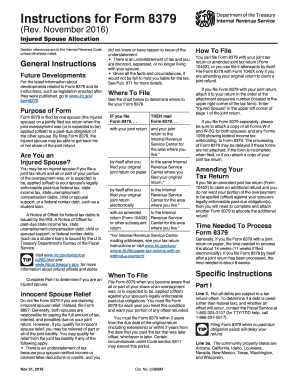
Are not attached, if the form is incomplete when filed, or if you attach a copy of your joint tax return. Visit www.irs.gov/taxtopics/ tc203.html and www.fiscal.treasury.gov, for more information about refund offsets and debts. TIP Where To File See the chart below to determine where to file your Form 8379. IF you file Form 8379. . . THEN mail Form 8379. . . with your joint return and your joint return to the Internal Revenue Service Center for the area where you live.* by itself after.
Open form follow the instructions
Easily sign the form with your finger
Send filled & signed form or save
How to fill out the IRS 8379 Instructions online
Filling out Form 8379, the injured spouse allocation form, may seem daunting, but with careful guidance, it can be a straightforward process. This guide will walk you through the step-by-step instructions on how to fill out this form online, ensuring you understand each section and its requirements.
Follow the steps to accurately complete the IRS 8379 form online.
- Press the ‘Get Form’ button to access the form and open it in your preferred document management tool.
- In Part I, determine your status as an injured spouse. Answer all questions honestly to identify if you qualify based on whether your portion of the tax return was or may be offset.
- Provide information about incomes, deductions, and credits in the appropriate fields in Part II as this information is essential in calculating your refund share.
- Complete Part III to allocate income, adjustments, and credits between you and your spouse. Ensure to follow state-specific community property laws if applicable.
- Enter the required details under the specific lines accurately, such as your total income and the credits claimed. Double-check for accuracy, as errors can delay the processing.
- Review your completed form for any common mistakes. Ensure that you have not included fractions for exemptions and that all allocated items are assigned correctly.
- After verifying all details, save your changes, download, print, or share the form as needed.
Start completing your IRS 8379 form online today to reclaim your portion of the tax refund.
Experience a faster way to fill out and sign forms on the web. Access the most extensive library of templates available.
Related content
Form 8379 is filed by one spouse (the injured spouse) on a jointly filed tax return when...
Jul 4, 2025 — Form 8379 is used to claim the Injured Spouse Allocation, which can help...
Dec 21, 2011 — Instructions for Form 1128 for exceptions. If you qualify for ... 8379...
Get answers to your most pressing questions about US Legal Forms API.
Can the IRS come after my wife for my debt?
Yes, the IRS can pursue your spouse for your tax debt if you file jointly. However, if you believe your spouse is an 'injured spouse,' you may qualify for relief under IRS regulations. Understanding your options is crucial, so using the IRS 8379 Instructions will help clarify how you can protect your spouse's interests and resolve your debt situation.
What requirements must be met when considering filing form 8379?
When filing Form 8379, you need to ensure you filed jointly, that the refund is indeed being withheld for your spouse's debts, and that you have reported proper income. You'll also need to include supporting documents that validate your claims. Refer to the IRS 8379 Instructions for a comprehensive checklist to meet the necessary requirements effectively.
Can I file form 8379 electronically by itself?
You cannot file Form 8379 electronically by itself; it must be filed along with your tax return. You can include it when you submit a joint return electronically or send it by mail with a paper return. Make sure to consult the IRS 8379 Instructions for details on how to file it accurately for a smooth process.
Can an injured spouse be denied?
Yes, an injured spouse can be denied relief if they do not meet specific requirements set by the IRS. Common reasons for denial include not providing sufficient documentation or failing to file Form 8379 correctly. To improve your chances of approval, closely follow the IRS 8379 Instructions and ensure all criteria are met.
What are the four types of innocent spouse relief?
The four types of innocent spouse relief include full relief, partial relief, equitable relief, and separation of liability relief. Each type addresses different scenarios where one spouse can be relieved from tax liability due to the actions of their partner. Understanding the distinctions is key, so refer to the IRS 8379 Instructions to find out which applies to your situation.
Can the IRS come after me for my spouse's taxes?
Yes, the IRS can pursue you for your spouse's tax obligations unless you qualify for relief under the IRS 8379 Instructions. Filing for innocent spouse or injured spouse relief can help protect you from this potential liability. Consider using platforms like USLegalForms to find resources and guidance through this process.
What is the IRS injured spouse rule?
The IRS injured spouse rule protects a spouse from having their refund applied to the other spouse’s tax debts. It allows for a portion of the refund to be returned to the innocent spouse. Understanding this rule, as described in the IRS 8379 Instructions, can be beneficial in safeguarding your finances.
What is the ignorant spouse rule?
The ignorant spouse rule allows for relief from tax liabilities if one spouse was unaware of the other’s tax issues. This rule is rooted in the IRS 8379 Instructions, which provide guidelines on qualifying for this form of relief. If you feel you qualify, gather your documentation and consider applying for innocent spouse relief.
What are the proofs of innocent spouse relief?
To prove eligibility for innocent spouse relief, you must provide documentation showing your lack of knowledge regarding the tax issue. The IRS 8379 Instructions recommend gathering financial records, tax documents, and correspondence with your spouse that demonstrate your unawareness. Clearly presenting these proofs can strengthen your case significantly.
What are the factors for equitable relief for an innocent spouse?
The IRS evaluates several factors when determining eligibility for equitable relief under the IRS 8379 Instructions. These include your marital status, knowledge of the tax debt, and whether it would be unfair to hold you responsible for your spouse's tax liabilities. Reviewing these factors before applying can be crucial for success.
Use professional pre-built templates to fill in and sign documents online faster. Get access to thousands of forms.
If you believe that this page should be taken down, please follow our DMCA take down process here.
This form is available in several versions. Select the version you need from the drop-down list below.