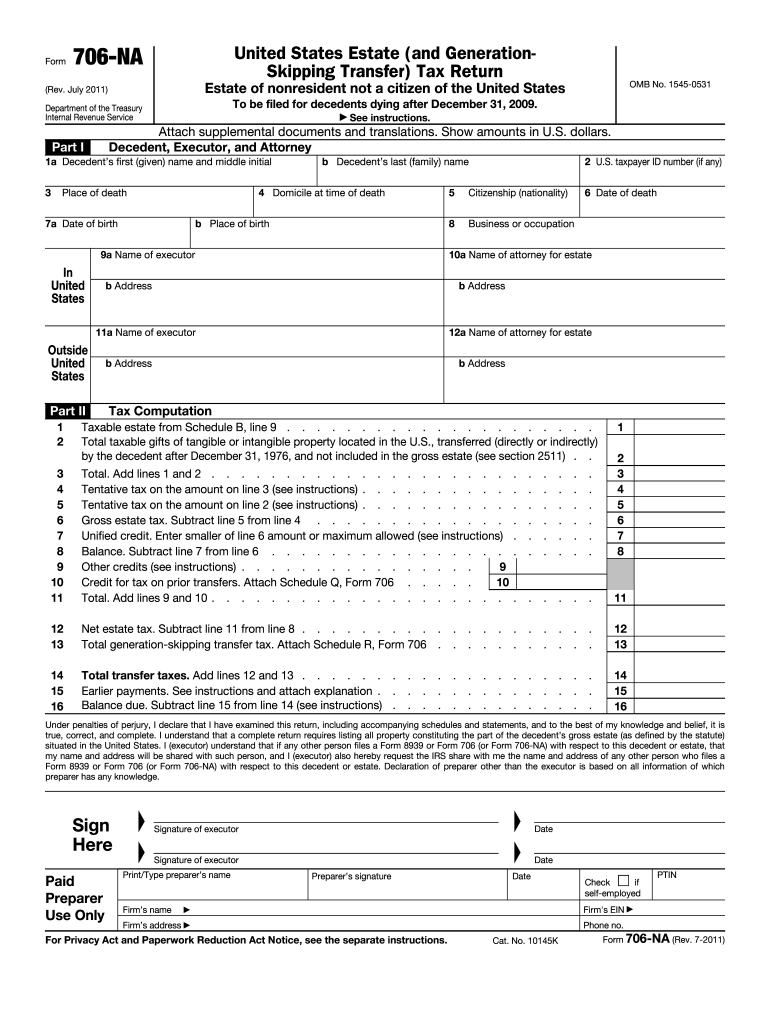
Instructions. Attach supplemental documents and translations. Show amounts in U.S. dollars. Decedent, Executor, and Attorney Part I 1a Decedent s first (given) name and middle initial 3 b Decedent s last (family) name 4 Domicile at time of death Place of death 7a Date of birth In United States 8 b Place of birth Citizenship (nationality) Business or occupation b Address 11a Name of executor Part II 6 Date of death 10a Name of attorney for estate b Address Outside United Sta.
Loading

Open form follow the instructions

Easily sign the form with your finger

Send filled & signed form or save
How to fill out the IRS 706-NA online
The IRS Form 706-NA is a necessary tax return for estates of non-resident aliens that are required to report estate and generation-skipping transfer taxes. This guide will provide clear, step-by-step instructions to assist you in completing the form accurately and efficiently online.
Follow the steps to complete your IRS 706-NA online.
- Click ‘Get Form’ button to obtain the form and open it in the editor.
- Fill in Part I, starting with the decedent's first name, last name, and other identifying information. Provide their address, date of birth, and place of birth, ensuring that all entries are accurate and in U.S. dollars.
- Complete the information regarding the executor and attorney for the estate by providing their names and addresses as required.
- In Part II, enter the date of death and the U.S. taxpayer ID number (if available). Then, include the details for the tax computation section, detailing the taxable estate and any applicable deductions.
- In Part III, respond to general information questions about the decedent's property and any trusts in existence at the time of death. Ensure that all pertinent information is disclosed, as this may affect tax computations.
- Review all entered information for accuracy and completeness. Ensure all necessary supplemental documents and translations are attached, if needed.
- Once all fields are completed and verified, save your changes. You may also opt to download, print, or share the completed form as needed.
Complete your IRS Form 706-NA online to ensure a smooth filing process.
Experience a faster way to fill out and sign forms on the web. Access the most extensive library of templates available.
Related content
May 23, 2025 — Use this form to compute estate and generation-skipping transfer (GST)...
They are allowable as an income tax deduction on Form 1041, U.S. Income Tax Return for...
Form 706 to transfers taking effect at applicable.) If you filed gift tax returns for...
Get answers to your most pressing questions about US Legal Forms API.
How long does it take to process Form 706-Na?
Processing times for IRS 706-NA can vary, generally taking six months or longer, depending on the complexity of the estate. Timely submissions and complete documentation can help expedite this process. Understanding the timeline ensures that beneficiaries are prepared for the eventual outcomes. Using services like uslegalforms can provide an efficient pathway for filing and monitoring these forms.
Who signs a tax return for a deceased person?
A tax return for a deceased individual may be signed by the executor or the personal representative of the estate. If there is no executor, the surviving spouse or a court-appointed representative can sign. Compliance with IRS 706-NA is essential to avoid issues with the IRS. Platforms like uslegalforms provide guidance on who can legally sign in these situations.
Do I have to report the sale of inherited property to the IRS?
Yes, when you sell inherited property, you must report the sale to the IRS. The IRS 706-NA requires transparency regarding asset dispositions. However, you may benefit from a stepped-up basis on the property's value at the time of inheritance, potentially reducing your tax liability. Using tools like uslegalforms can assist you in understanding these reporting requirements clearly.
What happens if there isn't an executor?
Without an executor, the estate may face delays in settling affairs and filing necessary tax documents like the IRS 706-NA. The court may intervene by appointing a personal representative to handle these responsibilities. This appointment is important to maintain control over the estate's financial obligations. Using uslegalforms can simplify the appointment process and ensure everything runs smoothly.
What is the exemption for 706na?
The exemption for IRS 706-NA pertains to the estate tax filing threshold, which varies based on specific criteria. Current exemptions allow estates under a certain value to avoid filing the form altogether. However, understanding the financial implications of the estate is crucial. Uslegalforms can help clarify these exemptions and ensure compliance.
Who signs 706 if there is no executor?
Without an appointed executor, the signed IRS 706-NA needs to be done by a personal representative or a legally authorized individual. If no representative is present, the estate's beneficiaries can take on this responsibility under specific conditions. It is essential to ensure proper representation to avoid delays or fines. Consulting platforms like uslegalforms can provide clarity on who is eligible to sign.
Who signs form 706 if there is no executor?
In cases where no executor exists, the form 706 may be signed by the personal representative appointed by the court. If a personal representative is not available, the beneficiaries may sign the IRS 706-NA with a letter of authorization. This ensures that the required tax filings are submitted accurately and on time. Always consider using a reliable service like uslegalforms to guide you through this process.
What happens if there are no executors?
If there are no executors appointed for the estate, the court may appoint a personal representative to manage the estate. This is crucial for filing the IRS 706-NA, as it allows for the proper handling of estate taxes. The personal representative will take on responsibilities, ensuring that debts are settled and assets are distributed. Taking this step prevents complications and helps in compliance with tax obligations.
What is the purpose of the IRS form 706?
The purpose of IRS form 706 is to allow the IRS to evaluate and collect estate taxes that may be applicable following a decedent's death. It applies to estates above a certain value threshold. By filing this form, the executor can clarify the tax liabilities for the estate. Accessing tools on the US Legal Forms platform can simplify this filing process significantly.
What is IRS form 706 used for?
IRS form 706 is primarily used to report the estate tax owed by an estate upon the death of an individual. It covers the gross estate, deductions, and tax computation. The IRS 706-NA variant is specific to non-resident aliens. Using this form helps heirs understand their tax obligations and responsibilities clearly.
Use professional pre-built templates to fill in and sign documents online faster. Get access to thousands of forms.
If you believe that this page should be taken down, please follow our DMCA take down process here.
This form is available in several versions. Select the version you need from the drop-down list below.