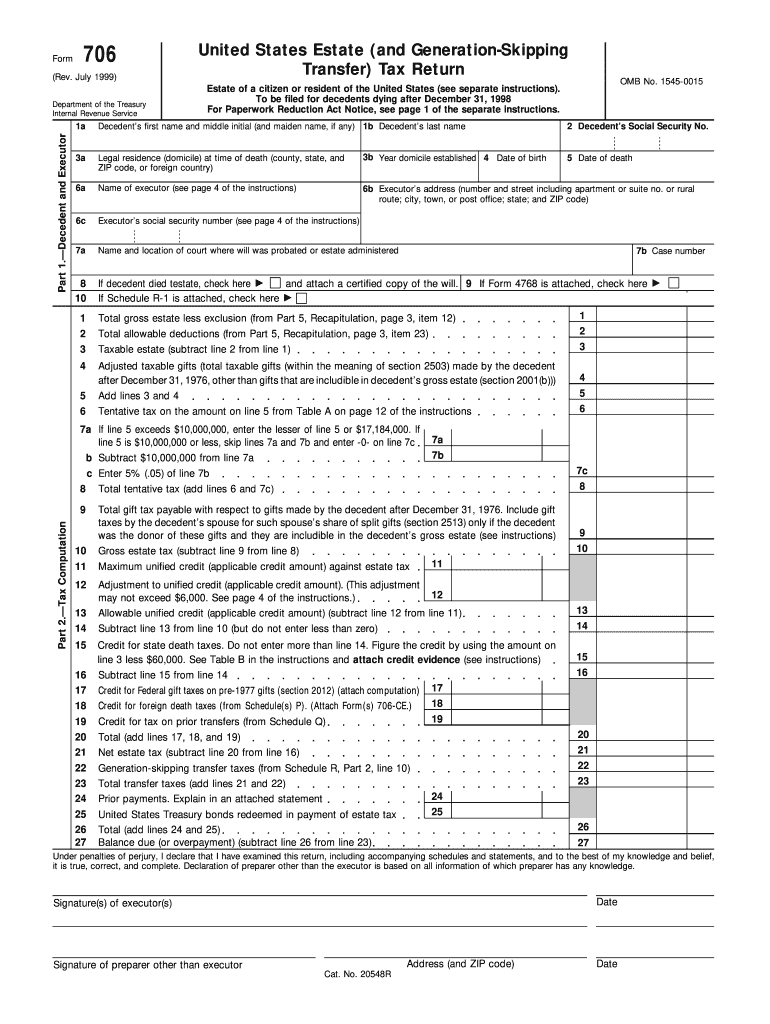
S 21 and 22) Prior payments. Explain in an attached statement 25 26 27 United States Treasury bonds redeemed in payment of estate tax Total (add lines 24 and 25) Balance due (or overpayment) (subtract line 26 from line 23) 18 7b b Subtract $10,000,000 from line 7a Part 2. Tax Computation OMB No. 1545-0015 Estate of a citizen or resident of the United States (see separate instructions). To be filed for decedents dying after December 31, 1998 For Paperwork Reduction Act Notice, see.
Loading

Open form follow the instructions

Easily sign the form with your finger

Send filled & signed form or save
How to fill out the IRS 706 online
Filing Form 706, the United States Estate (and Generation-Skipping Transfer) Tax Return, is a crucial step for the estates of deceased individuals with substantial assets. This guide provides a user-friendly walkthrough to assist you in accurately completing the form online for your estate or that of a deceased loved one.
Follow the steps to accurately complete the IRS 706 online.
- Click 'Get Form' button to obtain the form and open it in the editor.
- Provide details in Part 1 about the decedent, including their first and last name, social security number, legal residence at the time of death, and the name and address of the executor.
- In Part 2, list all financial information regarding the gross estate, such as total gross estate less exclusions, allowable deductions, and taxable estate amounts.
- Complete Part 3 by indicating any elections by the executor regarding alternate valuations or special use valuations.
- In Part 4, provide general information and attach any necessary supplemental documents like the death certificate.
- Proceed to Parts 5 through 7 to report additional details regarding specific assets, deductions, and potential exemption elections.
- Review the entire form for accuracy and completeness, ensuring all necessary documents are attached.
- Once satisfied with the form's accuracy, proceed to save changes, download, print, or share the completed form online.
Complete your IRS 706 form online today to ensure timely and accurate reporting of estate taxes.
Experience a faster way to fill out and sign forms on the web. Access the most extensive library of templates available.
Related content
May 23, 2025 — The executor of a decedent's estate uses Form 706 to figure the estate...
They are allowable as an income tax deduction on Form 1041, U.S. Income Tax Return for...
Form 706 to transfers taking effect at applicable.) If you filed gift tax returns for...
Get answers to your most pressing questions about US Legal Forms API.
Can Form 706 be electronically filed?
Currently, Form 706 cannot be electronically filed; it must be submitted in paper form. The IRS requires certain estate tax returns to be submitted via mail, which ensures proper documentation and processing. However, using proper software or services like US Legal Forms can help you prepare the form efficiently. Always double-check the mailing address and requirements before sending out your Form 706.
How long does it take the IRS to process Form 706?
The IRS typically takes about four to six months to process Form 706, but this timeframe can vary. Factors influencing this duration include the complexity of your estate and whether the IRS requires additional information. Staying organized and submitting all required documents promptly can help expedite the process. For assistance, consider using US Legal Forms to ensure proper completion of your Form 706.
Who must file IRS Form 706?
Any estate valued above the federal exemption limit must file IRS Form 706. This applies to estates that exceed the threshold set by the IRS, ensuring that all applicable taxes are reported. It is crucial for executors to assess the estate's total value to determine the filing obligation accurately. Understanding the requirements can prevent potential issues with the IRS.
Who prepares Form 706?
Typically, Form 706 is prepared by the executor of the estate. Executors are responsible for reporting the value of the deceased's estate to the IRS through the IRS 706. However, hiring a tax professional can simplify this process, ensuring proper compliance and accuracy. Investing in expert assistance can help navigate any complexities in estate tax management.
Does Turbotax include Form 706?
Yes, TurboTax does include Form 706, which is essential for estate tax purposes. By using TurboTax, you gain access to user-friendly tools to help you fill out the IRS 706 accurately. This software guides you through the filing process, ensuring that you capture all necessary details. You can efficiently manage your estate tax obligations with the help of TurboTax.
What amount is exempt from estate tax?
Under current regulations, the amount exempt from estate tax is equivalent to the estate tax exemption limit, which stands at $12.92 million. This means individuals can transfer inheritances under this amount without tax implications. If your estate exceeds this limit, you will need to manage the tax liabilities accordingly. Utilizing expert advice, like from U.S. Legal Forms, can clarify how to optimize your estate planning.
What is the threshold for filing Form 706?
The threshold for filing Form 706 is the exemption amount, which is currently $12.92 million for individuals. If your estate's value exceeds this figure, you are required to file the form. However, even smaller estates may benefit from filing, depending on unique circumstances. Understanding these thresholds will prepare you for estate planning in relation to IRS 706.
What should be attached to form 706?
When filing Form 706, you must include various attachments, such as a complete inventory of the estate's assets and debts. Additionally, any appraisals must accompany asset listings to reflect their fair market value. Tax forms detailing any previous gifts made should also be submitted. Platforms like U.S. Legal Forms can help ensure you gather all necessary documents for a smooth filing process.
What is the federal estate tax exemption amount for 2025?
Currently, the federal estate tax exemption amount for 2025 is uncertain due to projected legislative changes. However, experts anticipate it could adjust due to inflation or new tax laws. It's crucial to consult with a tax professional for the most accurate and up-to-date information. Being informed allows better planning for estate obligations linked to IRS 706.
What are the filing requirements for form 706?
To file Form 706, you need to calculate the gross estate, which includes all assets owned at the time of death. Generally, if your estate exceeds the exemption amount, you must file the form within nine months of death. However, if you expect to owe taxes, you can file for an automatic six-month extension. Utilizing platforms like U.S. Legal Forms can streamline this process and ensure you meet all requirements.
Use professional pre-built templates to fill in and sign documents online faster. Get access to thousands of forms.
If you believe that this page should be taken down, please follow our DMCA take down process here.
This form is available in several versions. Select the version you need from the drop-down list below.