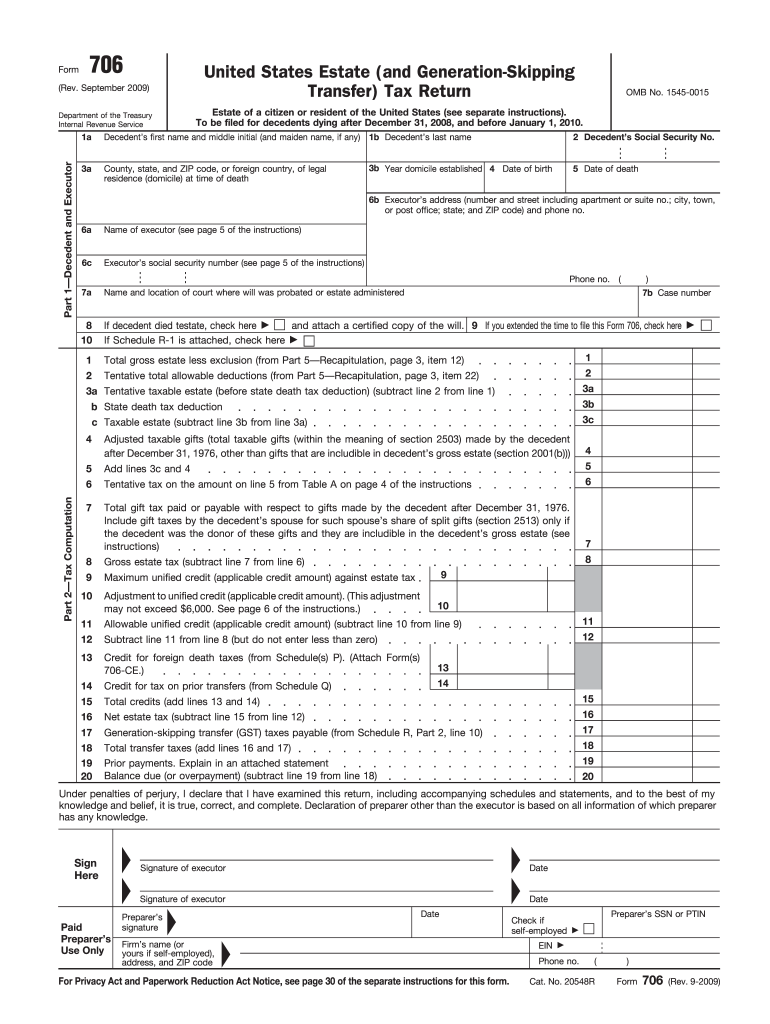
Ract line 19 from line 18) 17 16 18 19 20 Under penalties of perjury, I declare that I have examined this return, including accompanying schedules and statements, and to the best of my knowledge and belief, it is true, correct, and complete. Declaration of preparer other than the executor is based on all information of which preparer has any knowledge. Sign Here Paid Preparer s Use Only Signature of executor Signature of executor Preparer s signature Firm s.

Open form follow the instructions

Easily sign the form with your finger

Send filled & signed form or save
How to fill out the IRS 706 online
Filing the IRS Form 706, the United States Estate (and Generation-Skipping Transfer) Tax Return, can feel overwhelming. This guide provides a step-by-step approach to assist you in accurately completing the form online, ensuring compliance with tax regulations while keeping the process user-friendly.
Follow the steps to efficiently complete the IRS Form 706 online.
- Click ‘Get Form’ button to obtain the form and open it in the editor.
- Begin filling in Part 1—Decedent and Executor. Provide the decedent’s first and last names, Social Security number, date of birth, and date of death. Fill in the executor's information, including their name and address.
- Continue to detail the decedent’s legal domicile and the court where the will was probated or estate administered, if applicable.
- In Part 2—Tax Computation, calculate the total gross estate, including all assets and deductions. Complete each related line by entering accurate monetary amounts.
- In Part 3, check the appropriate boxes regarding elections by the executor, as applicable.
- Provide the necessary details in Part 4—General Information, including the death certificate and documentation to authorize the estate’s representative.
- Proceed through Parts 5 through 10, filling out the required schedules for various asset types and deductions accordingly.
- Finalize the process by saving your changes, downloading the completed form, and keeping a copy for your records. You may also print or share the form as needed.
Ready to complete your IRS Form 706 online? Start now to ensure timely and accurate filing.
Experience a faster way to fill out and sign forms on the web. Access the most extensive library of templates available.
Related content
May 23, 2025 — The executor of a decedent's estate uses Form 706 to figure the estate...
They are allowable as an income tax deduction on Form 1041, U.S. Income Tax Return for...
Form 706 to transfers taking effect at applicable.) If you filed gift tax returns for...
Get answers to your most pressing questions about US Legal Forms API.
Does TurboTax include Form 706?
TurboTax does not typically support IRS Form 706 for estate tax filing. This can be a drawback if you are dependent on TurboTax for your other tax needs. For proper assistance with Form 706, consider using dedicated platforms like Uslegalforms that specialize in estate-related tax forms and can ensure you meet all requirements.
Who prepares Form 706?
Form 706 can be prepared by the executor of the estate or by a qualified tax professional. If you feel overwhelmed, seeking help from a tax advisor or using a platform like Uslegalforms can simplify the preparation process. They offer guidance and templates to ensure you file accurately and efficiently.
Who must file IRS Form 706?
IRS Form 706 is required for estates that exceed the federal estate tax exemption threshold. Generally, if the value of the deceased's assets surpasses this limit, the executor must file Form 706. It’s crucial to determine if your estate qualifies to avoid penalties. Consulting with Uslegalforms can provide clarity on your filing obligations.
How long does it take the IRS to process Form 706?
The IRS usually takes about six to eight months to process Form 706. However, processing times can vary based on their workload. It’s important to ensure that your form is complete and submitted correctly to avoid unnecessary delays. Using a reliable service like Uslegalforms can help streamline this process.
What is the difference between a 706 and 709 return?
A 706 return is focused on estate taxes, while a 709 return addresses gift taxes. The 706 form is completed after a person’s death to report the estate's value and any taxes owed. In contrast, a 709 return is filed for gifts made during an individual's lifetime that exceed the annual exclusion amount. Utilizing USLegalForms can help clarify these distinctions and streamline your filing process.
What is IRS form 706 used for?
IRS Form 706 is primarily used to report the estate tax liability of an estate that exceeds the federal exemption threshold upon an individual’s death. This form helps determine if estate tax is owed and how much may be required. Completing this form correctly is crucial to avoid penalties, and services like USLegalForms can simplify this complex task.
What is the difference between IRS form 706 and 709?
IRS Form 706 is used to report estate taxes, while IRS Form 709 handles gift taxes. Specifically, Form 706 focuses on the value of an estate that exceeds the exemption limit after someone's passing. On the other hand, Form 709 deals with gifts exceeding a certain amount made during an individual’s lifetime. For thorough understanding and compliance, consider using resources provided by USLegalForms.
What does code 706 mean on an IRS transcript?
Code 706 on an IRS transcript indicates that a Form 706 has been filed for the estate of a deceased individual. This code is part of the IRS’s method of tracking various forms and transactions. Understanding these codes can help you monitor your tax obligations effectively. If you have questions about your transcript, USLegalForms can guide you through the process.
What documents are needed to file an estate tax return?
To successfully file an estate tax return using form IRS 706, you need a variety of documents, such as the decedent's death certificate, inventory of assets, and any prior tax returns. You'll also require appraisals and legal documents related to the estate's holdings. Collecting these documents ahead of time can simplify the filing process and help ensure compliance. US Legal Forms can assist you in gathering and organizing the necessary paperwork for a smooth filing.
What are exhibits to form 706?
Exhibits to form IRS 706 serve as supporting documentation that detail the specific assets and their values included in the estate. This includes schedules that provide further information on real estate holdings, business interests, and other relevant properties. Accurate and thorough exhibits help illustrate the estate's composition clearly to the IRS. You can use US Legal Forms to help prepare these exhibits effectively.
Use professional pre-built templates to fill in and sign documents online faster. Get access to thousands of forms.
If you believe that this page should be taken down, please follow our DMCA take down process here.
This form is available in several versions. Select the version you need from the drop-down list below.