Loading
Get Irs 5305-simple 2012-2026
This website is not affiliated with IRS
How it works
-

Open form follow the instructions
-

Easily sign the form with your finger
-

Send filled & signed form or save
How to fill out the IRS 5305-SIMPLE online
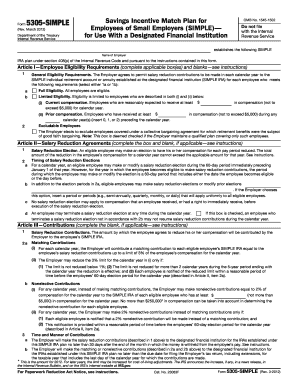
Filling out the IRS 5305-SIMPLE form is a vital step for establishing a Savings Incentive Match Plan for Employees of Small Employers (SIMPLE). This guide provides clear, step-by-step instructions to assist users in completing the form correctly and efficiently online.
Follow the steps to fill out the IRS 5305-SIMPLE form online
- Click ‘Get Form’ button to obtain the form and open it in the editor.
- Identify the 'Name of Employer' section at the top of the form. Enter the legal name of the employer establishing the SIMPLE IRA plan.
- Proceed to 'Article I—Employee Eligibility Requirements.' Select either 'Full Eligibility' or 'Limited Eligibility.' If selecting 'Limited Eligibility,' provide the applicable compensation figures and the number of prior calendar years.
- In 'Article II—Salary Reduction Agreements,' complete the required boxes regarding salary reduction elections. Specify the timing and circumstances under which eligible employees can modify their contributions.
- Now, navigate to 'Article III—Contributions.' Fill out details about salary reduction contributions and match or nonelective contributions, indicating the percentage or dollar amount as specified in the relevant sections.
- In 'Article IV—Other Requirements and Provisions,' confirm understanding of the basic provisions such as contribution limits and restrictions.
- Complete 'Article VII—Effective Date' by inserting the desired effective date of the SIMPLE IRA plan.
- Finally, review all filled sections thoroughly, ensure accuracy, and save changes. You can download, print, or share the completed form as necessary.
Ensure you complete the IRS 5305-SIMPLE form online to establish your SIMPLE IRA plan.
The type of contribution allocation used on IRS Form 5305 SEP must be uniform across all eligible employees. Employers must allocate contributions consistently based on each employee's compensation. By adhering to this allocation method, employers comply with the IRS guidelines and optimize their retirement offerings.