T interest expense from 2011. Allocation of Interest Expense If you paid or accrued interest on a loan and used the loan proceeds for more than one purpose, you may have to allocate the interest. This is necessary because different rules apply to investment interest, personal interest, trade or business interest, home mortgage interest, and passive activity interest. See Pub. 535, Business Expenses. Specific Instructions Part I Total Investment Interest Expense Line 1 Enter the investment in.
Loading

Open form follow the instructions

Easily sign the form with your finger

Send filled & signed form or save
How to fill out the IRS 4952 online
Filling out the IRS 4952 form can seem daunting, but understanding its components will help you accurately report your investment interest expense deduction. This guide provides clear, step-by-step instructions on how to complete the form online, ensuring you maximize your deductions.
Follow the steps to complete your IRS 4952 form online.
- Click ‘Get Form’ button to access the IRS 4952 form and open it in the available online editor.
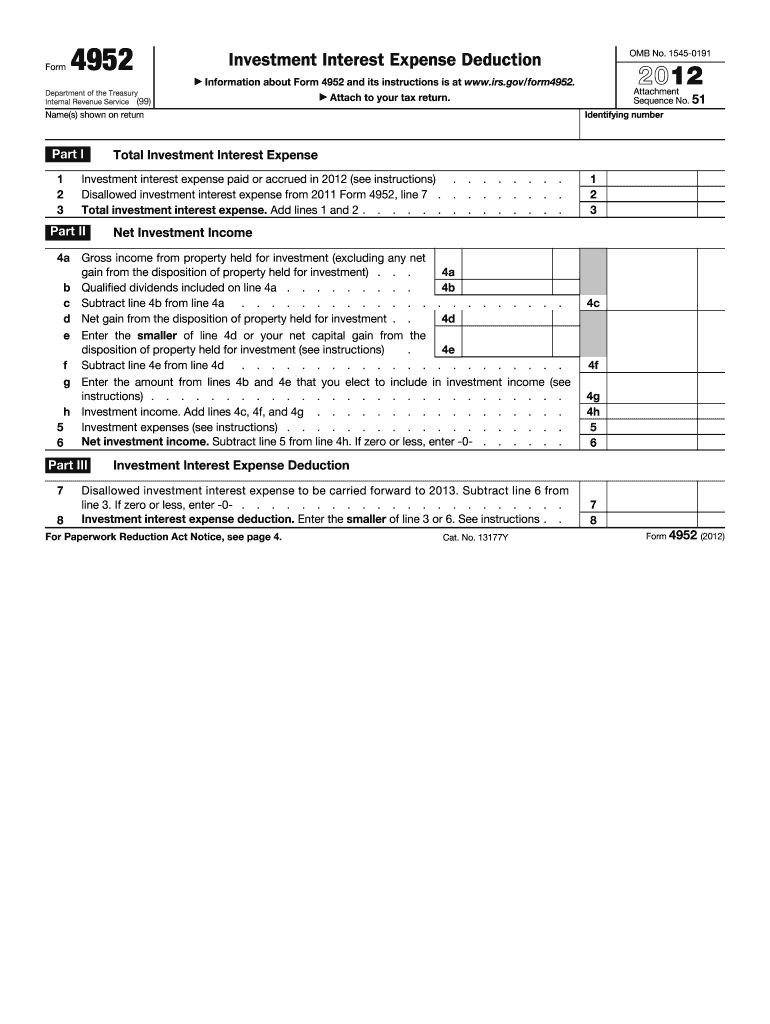
- In Part I, enter your total investment interest expense paid or accrued for the tax year in line 1. This includes any relevant figures you may have received from partnerships or S corporations.
- Next, proceed to line 2 and add any disallowed investment interest expense from the previous year’s Form 4952. Then, sum lines 1 and 2 in line 3 to calculate your total investment interest expense.
- In Part II, begin with line 4a by entering your gross income from investment property, excluding any net gain from property disposals. Move to line 4b to include qualified dividends.
- For line 4c, subtract line 4b from line 4a, and then complete line 4d by inputting any net gains from dispositions of investment property.
- In line 4e, report the smallest amount between line 4d and your net capital gain from property dispositions.
- On line 4g, enter any amount you choose to include from lines 4b and 4e for investment income. Finally, calculate your investment income in line 4h by summing lines 4c, 4f, and 4g.
- Proceed to line 5 to note any investment expenses excluding interest expense. In line 6, subtract line 5 from line 4h to determine your net investment income.
- In Part III, line 8 requires you to write the smaller of line 3 or 6 as your investment interest expense deduction. Follow the relevant instructions for reporting any portion of this deduction, if necessary.
- Once you have completed the IRS 4952 form, save your changes and download a copy for your records. You can also print the form or share it as needed.
Complete your IRS forms online today for an efficient filing experience!
Experience a faster way to fill out and sign forms on the web. Access the most extensive library of templates available.
Related content
Feb 19, 2025 — Use this form to figure the amount of investment interest expense you can...
Section 4952 contains provisions that generally correspond to provisions of section 4945...
Mar 1, 2017 — Publication 505 covers tax withholding and estimated tax, including how to...
Get answers to your most pressing questions about US Legal Forms API.
Can I deduct interest expense from an investment property?
You can generally deduct interest from loans taken out for investment properties, but it depends on how you manage the property. Under IRS 4952, if your investment property generates taxable income, you can write off the associated interest expenses on your tax return. Ensure you keep comprehensive records to substantiate your claims when filing.
How do you write off investment income?
Writing off investment income typically involves deducting any applicable expenses like commissions and interest on borrowed funds. Under IRS 4952, you can only offset investment income with investment interest expense, allowing you to lower your taxable income. Using tools or platforms like uslegalforms can help you navigate these tax considerations efficiently.
Is investment interest expense above the line?
Investment interest expense is not considered an above-the-line deduction on your tax return. Instead, it is classified as an itemized deduction, falling under deductions that must be detailed on Schedule A. Understanding this distinction helps you accurately prepare your taxes and ensure correct filing under IRS 4952 guidelines.
What is the IRS limit on mortgage interest?
The IRS generally allows taxpayers to deduct mortgage interest on loans up to $750,000 if incurred after December 15, 2017. If your mortgage is older, a higher limit may apply. To navigate the complicated rules of mortgage deductions, utilizing the right forms, such as IRS Form 4952, can help clarify your deductions.
Who is subject to investment income tax?
Individuals with investment income that exceeds certain thresholds are subject to the investment income tax. This generally applies to high-income earners, so it is vital to familiarize yourself with these rules. By using IRS Form 4952, you can identify your tax responsibilities and manage them effectively.
What tax form do I need for investments?
For reporting investment income, gains, and losses, you typically use Form 1040 along with various associated schedules. However, if you have investment interest expense to deduct, you will also need IRS Form 4952. By understanding these requirements, you can ensure you're prepared when tax season arrives.
Who is required to file form 4952?
Any taxpayer who owes investment interest expense and wishes to claim a deduction must file Form 4952. This includes individuals, estates, and trusts that have investment interest or capital gains. Knowing when to file this form ensures compliance with IRS regulations and can help simplify your tax process.
Can unused investment interest expense be carried forward?
Yes, unused investment interest expenses can be carried forward to future tax years. This provision allows taxpayers to benefit from their investment deductions even if they cannot fully utilize them in the current year. Tracking these expenses accurately with tools like IRS Form 4952 can optimize your financial strategy.
What happens to excess business interest expense?
Excess business interest expense typically cannot be used to offset other types of income in the current tax year. Instead, it can generally be carried forward to future years, providing a potential benefit when your business income rises. To navigate this complexity, utilizing IRS Form 4952 can provide clarity on how to manage these expenses.
Can you write off investment interest expenses?
Yes, you can write off investment interest expenses, but there are specific rules that apply. This deduction is limited to your net investment income and must be reported using IRS Form 4952. By using this form, you can correctly calculate and claim your deduction, thereby reducing your taxable income.
Use professional pre-built templates to fill in and sign documents online faster. Get access to thousands of forms.
If you believe that this page should be taken down, please follow our DMCA take down process here.
This form is available in several versions. Select the version you need from the drop-down list below.