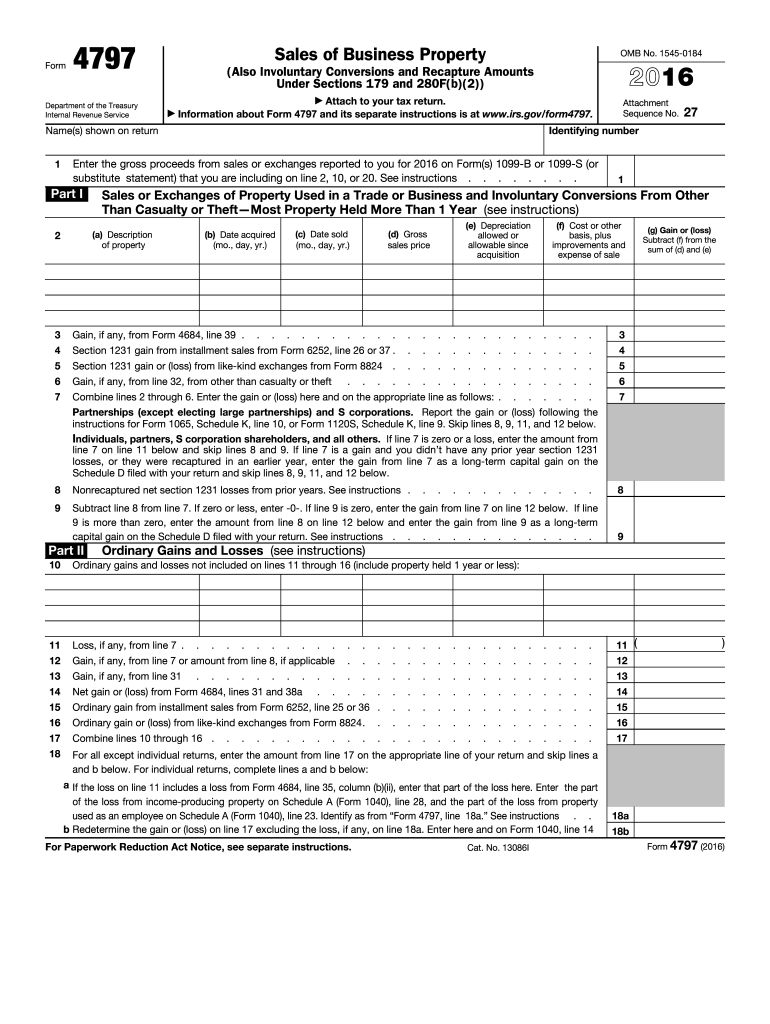
Form Department of the Treasury Internal Revenue Service Sales of Business Property OMB No. 1545-0184 Also Involuntary Conversions and Recapture Amounts Under Sections 179 and 280F b 2 Attach to your tax return. Information about Form 4797 and its separate instructions is at www.irs.gov/form4797. Enter the gross proceeds from sales or exchanges reported to you for 2014 on Form s 1099-B or 1099-S or substitute statement that you are including on l.
Loading

Open form follow the instructions

Easily sign the form with your finger

Send filled & signed form or save
How to fill out the IRS 4797 online
The IRS 4797 form is essential for reporting the sale of business property. This guide will provide you with clear, step-by-step instructions to help you fill out this form accurately online, ensuring you meet your tax obligations.
Follow the steps to complete the IRS 4797 online
- Click ‘Get Form’ button to access the IRS 4797 and open it in your chosen editor.
- Begin by entering your personal information, including your name, address, and taxpayer identification number.
- In the 'Part I' section, report any property you sold or exchanged. Include the description of the property, the date sold, and the gross sales price.
- Move to 'Part II' if you need to report the sale of section 1245 property. Fill in the relevant details about the property, including adjustments and gains or losses.
- If applicable, complete 'Part III' for section 1250 property transactions and provide the necessary information.
- Final review: Ensure all fields are completed accurately, and check for any calculations that need to be verified.
- Once you have filled out all sections, you can save your changes, download, print, or share the form as needed.
Complete your IRS 4797 and ensure your filings are in order by following these steps online.
Experience a faster way to fill out and sign forms on the web. Access the most extensive library of templates available.
Related content
Apr 29, 2025 — Use Form 4797 to report: The sale or exchange of property. The...
Form 4797 is for sales of business property, involuntary conversions, and recapture...
SECTION A—Personal Use Property (Use this section to report casualties and thefts of...
Get answers to your most pressing questions about US Legal Forms API.
Do I use Schedule D or form 4797?
The decision to use Schedule D or IRS 4797 depends on the type of asset you are reporting. Use IRS 4797 for business property sales, whereas Schedule D is for reporting capital gains and losses on personal investments. Knowing the right form can simplify your tax return process significantly. If you're in doubt, consulting a tax professional or utilizing US Legal Forms can provide clarity.
What does 4797 mean?
IRS 4797 is a tax form designed to report the sale or exchange of business property. It covers transactions involving Section 1231 assets, including depreciable business property and real estate. By understanding this form, you can accurately report gains or losses on your tax return. Don't hesitate to seek expert advice if you're unsure about any aspect of this form.
How do I report the sale of business assets on my tax return?
To report the sale of business assets, use IRS 4797 to disclose both gains and losses. This form allows you to calculate depreciation recapture and section 1231 gains if applicable. Document all related transaction details, and keep your records organized for easy reference. Consider utilizing platforms like US Legal Forms for guidance on your specific situation.
Should I use form 8949 or 4797?
Choosing between IRS 8949 and 4797 depends on the type of asset you are reporting. If you're dealing with business property or Section 1231 assets, use IRS 4797. For capital assets, such as stocks or personal property, IRS 8949 is your go-to form. Ensure you understand the nature of your assets to select the correct form.
Who must report the sale of real property to the IRS?
Anyone selling real property, including personal and investment properties, typically needs to report the sale to the IRS. If the property was used for business, you will likely use IRS 4797. It's important to identify the type of property and any applicable tax rules surrounding your sale. Be diligent in maintaining records that substantiate your claims.
Who is required to file form 8949?
Taxpayers who sell or exchange capital assets must file IRS 8949. This form is used to report capital gains and losses from these transactions. If you have transactions involving stocks, bonds, or real estate, you might find yourself completing this form. Remember, accurately reporting these transactions is crucial for your tax return.
Who fills out form 4797?
Individuals and businesses that sell or exchange business property fill out IRS 4797. This form is necessary if you have a gain or loss from the sale or exchange of Section 1231 assets. These assets include depreciable property and real estate used in a trade or business. Make sure to gather all relevant documentation before completing this form.
What is 475 F mark-to-market?
Section 475(f) refers to the mark-to-market election that allows traders to treat their trading gains and losses as ordinary income or loss. This election can simplify the tax consequences of trading activities and provides more favorable treatment, as gains are not subject to capital gains tax. Many traders applying IRS 4797 will find this election beneficial for tax strategy.
What is the difference between form 4797 and form 8949?
The primary difference between form 4797 and form 8949 lies in their intended use: form 4797 deals specifically with the sale of business property, while form 8949 reports capital gains from the sale of other types of assets. If your activities involve mark-to-market accounting, you will focus on IRS 4797 for accurate reporting. Understanding these distinctions helps ensure compliance with tax regulations.
What is the IRS form for mark to market?
The IRS form for mark to market is form 4797, which is specifically tailored for reporting gains and losses from the sale of business property. This form allows you to report your assets' fair market value at year-end, streamlining the tax process. If you are involved in trading or business activities, understanding this form is crucial for accurate reporting.
Use professional pre-built templates to fill in and sign documents online faster. Get access to thousands of forms.
If you believe that this page should be taken down, please follow our DMCA take down process here.
This form is available in several versions. Select the version you need from the drop-down list below.