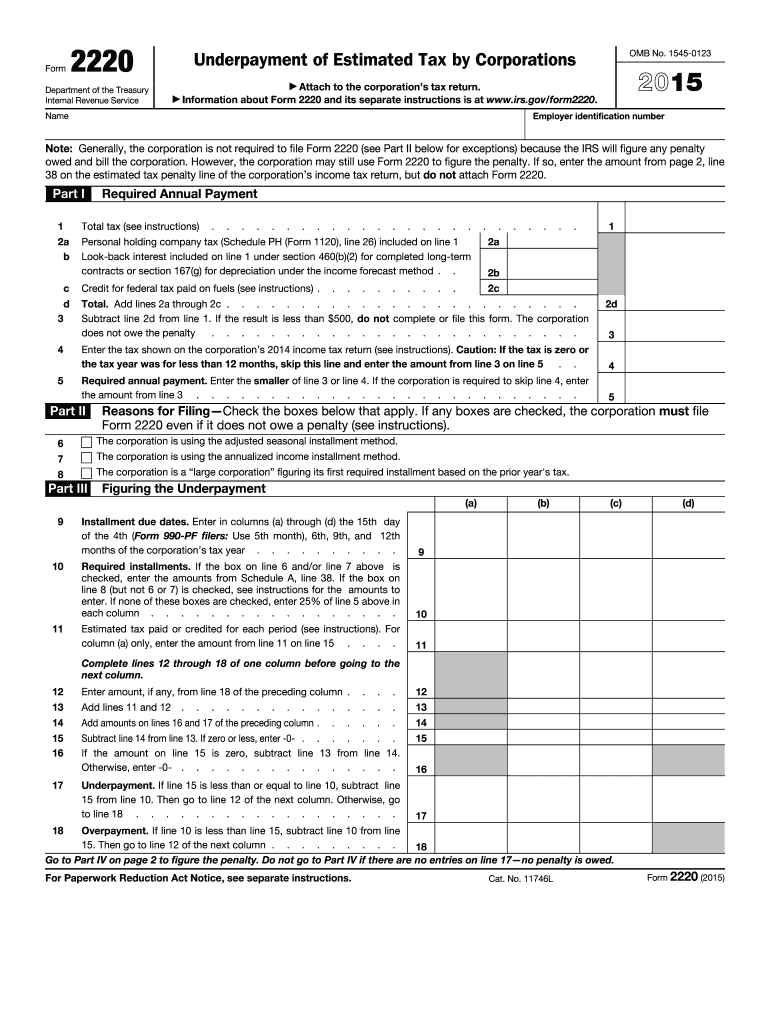
Unt, if any, from line 18 of the preceding column . . . . 12 13 Add lines 11 and 12 . . . 13 14 15 16 Add amounts on lines 16 and 17 of the preceding column Subtract line 14 from line 13. If zero or less, enter -0- . If the amount on line 15 is zero, subtract line Otherwise, enter -0- . . . . . . . . . 17 Underpayment. If line 15 is less than or equal to line 10, subtract line 15 from line 10. Then go to line 12 of the next column. Otherwise, go to line 18 . . . . . . . . . . . . .
Loading

Open form follow the instructions

Easily sign the form with your finger

Send filled & signed form or save
How to fill out the IRS 2220 online
IRS Form 2220 is used for calculating the underpayment of estimated tax by corporations. This guide provides a clear, step-by-step process to help users accurately complete the form online.
Follow the steps to effectively complete IRS Form 2220 online.
- Click ‘Get Form’ button to access the form and open it in the editor.
- Begin with Part I, where you need to enter the corporation's total tax as shown in the appropriate field. If applying any special tax considerations, include those amounts in the designated sections.
- Complete lines 2a through 2d by inputting figures such as any personal holding company tax, look-back interest, and federal tax credit amounts. Sum these amounts as directed.
- Line 4 requires the tax amount from the corporation's prior year income tax return. If the tax was zero or the tax year was shorter than 12 months, skip this line and proceed as instructed.
- On line 5, enter the lesser amount obtained from previous calculations in line 3 or line 4 as the required annual payment.
- Proceed to Part II and check the applicable boxes for reasons for filing, which lets the IRS know your specific circumstances and justifies filling out this form.
- In Part III, fill in the installment due dates in columns for the respective months of the corporation's tax year as instructed.
- Enter all required installments, which depend on previous selections. This might involve transferring information from Schedule A if applicable.
- Continue completing calculations through to line 18 in Part III, determining both underpayment and any overpayment as per the given instructions.
- Final steps involve checking Part IV for figuring any penalties associated with underpayment, using the information cataloged in previous lines.
- After completing all sections, review the form thoroughly. Users can then save changes, download, print, or share the completed form as needed.
Complete your IRS Form 2220 online easily by following these comprehensive steps.
Experience a faster way to fill out and sign forms on the web. Access the most extensive library of templates available.
Related content
Nov 26, 2024 — Information about Form 2220, Underpayment of Estimated Tax By...
The IRS will figure any penalty owed and bill the corporation. If the corporation does not...
Jan 31, 2012 — If Form 2220 is attached, check the box worksheet to figure the tax...
Get answers to your most pressing questions about US Legal Forms API.
How do I get my underpayment penalty waived?
To have your underpayment penalty waived, you must demonstrate reasonable cause for not meeting your tax payment requirements. This includes providing documentation showcasing your financial hardships. Using IRS Form 2220, you can apply for a waiver, presenting a clear case to the IRS. Support from platforms like uslegalforms can make this process easier and more efficient.
How do I get my IRS debt forgiven?
To seek IRS debt forgiveness, taxpayers should explore various relief options available through the IRS. Programs exist for individuals experiencing financial hardship, and the proper documentation is crucial. Additionally, utilizing IRS Form 2220 can aid in assessing your eligibility for penalty relief. For effective guidance, consider using services like uslegalforms.
What is IRS Form 2220?
IRS Form 2220 is a document used to calculate and request a waiver of the underpayment penalty. This form helps taxpayers determine if they qualified for reduced penalties due to special circumstances. Filing this form accurately is essential, as it can open doors to further relief. Resources such as uslegalforms can provide support in completing this important form.
Who is eligible for the IRS hardship program?
Eligibility for the IRS hardship program generally includes individuals who are unable to make payments due to financial difficulties. Factors like unemployment, medical expenses, or other significant hardships can qualify you. It's crucial to document your situation properly, as the IRS usually reviews your financial status. Resources like uslegalforms can provide guidance through this process.
Does the IRS offer a one-time forgiveness program?
Yes, the IRS provides options that may allow for one-time forgiveness under certain conditions. This initiative helps taxpayers who face exceptional circumstances. By using IRS Form 2220, you can apply for penalty relief if you experienced a challenging financial situation. Stay informed about eligibility and see if you qualify.
Who must file form 2220?
Form 2220 must be filed by individuals and corporations that owe an underpayment penalty due to inadequate estimated tax payments. If you meet the underpayment criteria defined by the IRS, this form informs the IRS of your calculations. Understanding your obligations can prevent unnecessary penalties associated with estimated tax payments. The resources available from uslegalforms can assist in navigating this process.
How do I calculate my IRS penalties and interest?
To calculate your IRS penalties and interest, begin by determining your unpaid tax amount and the duration of the delay. The IRS provides specific guidelines and interest rates that apply to unpaid taxes. Utilizing IRS 2220 can support your calculations and help you understand any penalties. Consider consulting a tax professional for a thorough review and accurate calculations.
Who must file federal estate tax return?
You must file a federal estate tax return if the total value of the estate exceeds a specific threshold set by the IRS. This return is crucial for calculating any estate taxes owed to the federal government. Knowing the limits and requirements associated with estate filing ensures compliance. Engaging with resources like uslegalforms might simplify the filing process.
How to calculate late filing penalty in IRS?
To determine the late filing penalty imposed by the IRS, you can use a simple formula based on the amount of tax owed and the duration of the delay. The IRS generally charges a percentage of the unpaid taxes for each month that your return is late, up to a maximum amount. Using IRS 2220 can help you navigate through any penalties related to underpayment. Always file your returns on time to avoid additional costs.
How is the penalty calculated for income tax?
The penalty for income tax is typically calculated based on the amount of tax you underpaid and the length of time the payment is overdue. The IRS calculates this penalty using interest rates that may vary over time. Familiarizing yourself with IRS 2220 can clarify how this penalty applies to your situation. Keeping accurate records and timely payments helps avoid the hassle.
Use professional pre-built templates to fill in and sign documents online faster. Get access to thousands of forms.
If you believe that this page should be taken down, please follow our DMCA take down process here.
This form is available in several versions. Select the version you need from the drop-down list below.