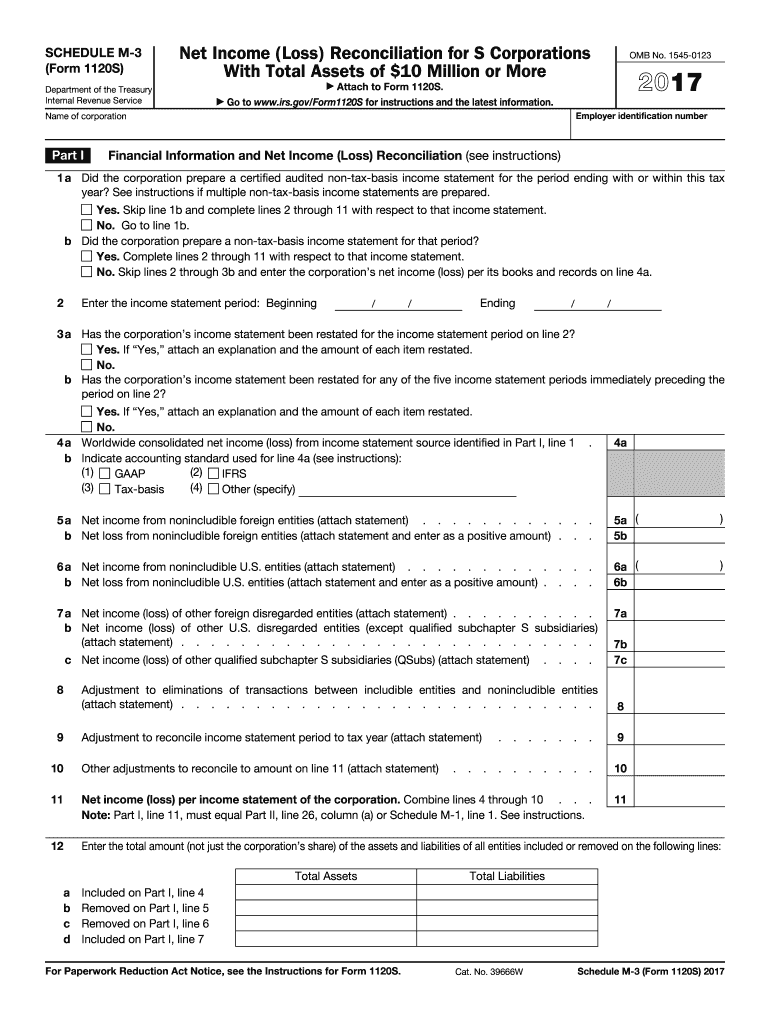
Assets and liabilities of all entities included or removed on the following lines: Total Assets a b c d . . . Total Liabilities Included on Part I, line 4 Removed on Part I, line 5 Removed on Part I, line 6 Included on Part I, line 7 For Paperwork Reduction Act Notice, see the Instructions for Form 1120S. Cat. No. 39666W Schedule M-3 (Form 1120S) 2017 Schedule M-3 (Form 1120S) 2017 Page Part II Reconciliation of Net Income (Loss) per Income Statement of the Corporation With Total I.
Loading

Open form follow the instructions

Easily sign the form with your finger

Send filled & signed form or save
How to fill out the IRS 1120S - Schedule M-3 online
Filling out the IRS 1120S - Schedule M-3 is an essential task for S corporations with total assets of $10 million or more. This guide provides structured, step-by-step instructions to facilitate the online completion of this form, ensuring accurate reporting of financial information and net income reconciliation.
Follow the steps to fill out the IRS 1120S - Schedule M-3 online.
- Press the ‘Get Form’ button to obtain the IRS 1120S - Schedule M-3 form and open it in your browser.
- Begin by entering the employer identification number and the name of your corporation at the top of the form.
- In Part I, respond to whether a certified audited non-tax-basis income statement was prepared. If 'Yes,' skip to lines 2 through 11. If 'No,' proceed to line 1b.
- Next, if a non-tax-basis income statement was prepared, complete lines 2 through 11 with the relevant details. Provide the income statement period dates.
- For lines 4 through 10, report worldwide consolidated net income (loss) and other specified figures, attaching any necessary statements.
- In line 11, combine the amounts from lines 4 through 10 to report the net income (loss) per the corporation’s income statement.
- Proceed to Part II. Here, reconcile the net income (loss) from the income statement with the total income (loss) reported on the return. Fill out the appropriate lines detailing income items.
- In Part III, reconcile the net income (loss) per the income statement with total income (loss) per the return through expense and deduction items. Complete all necessary columns.
- After reviewing all entries for accuracy, save your changes, and choose to download, print, or safely share the completed IRS 1120S - Schedule M-3 form.
Begin completing your IRS 1120S - Schedule M-3 online today.
Experience a faster way to fill out and sign forms on the web. Access the most extensive library of templates available.
Related content
Part I. Financial Information and Net Income (Loss) Reconciliation (see instructions). 1a...
Dec 12, 2012 — No Schedule M-3 is required for taxpayers filing Form 1120-REIT, U.S...
Jan 31, 2012 — (Form 1120S) instead of Schedule M-1. Taxed. Return. See the separate...
Get answers to your most pressing questions about US Legal Forms API.
What is Schedule M-1?
Schedule M-1 is a form used to reconcile the income reported on financial statements with the income reported on IRS 1120S - Schedule M-3. It is less detailed compared to M-3 and offers a straightforward approach for smaller businesses. By filing M-1 accurately, you increase the clarity of your tax position and help avoid discrepancies.
What is the difference between Schedule M-1 and M-3?
Schedule M-1 summarizes basic income and deductions, while IRS 1120S - Schedule M-3 goes further by detailing a comprehensive reconciliation for larger entities. M-3 requires work to categorize various items, thus providing essential transparency for the IRS. Properly differentiating between these schedules helps ensure accurate reporting and compliance.
Who must file Schedule M-3 Part II?
Entities that exceed specific asset thresholds and require a detailed reconciliation must file Part II of IRS 1120S - Schedule M-3. This part is focused on providing more insight into the various itemized income and loss components. Filing correctly ensures compliance while avoiding potential penalties from the IRS.
What is a temporary difference in M-3?
A temporary difference in IRS 1120S - Schedule M-3 occurs when there is a discrepancy between the book income and taxable income due to timing. These differences may arise from situations where income or expenses are recognized at different times for accounting purposes versus tax purposes. Understanding these differences is crucial for accurate tax reporting and planning.
What is Schedule M-3 on 1120 L?
Schedule M-3 for IRS 1120 L is designed for life insurance companies and requires detailed reporting similar to that of M-3 for corporations. This schedule helps clarify the differences between book income and taxable income, focusing on specific areas relevant to life insurance. It enhances transparency and aligns financial reporting with IRS requirements.
What is the difference between Schedule 1 and Schedule 3 tax forms?
Schedule 1 and Schedule 3 serve different purposes in tax reporting. While Schedule 1 pertains to additional income and adjustments for IRS 1120S - Schedule M-3, Schedule 3 relates to nonrefundable credits. Understanding these distinctions helps you prepare your tax documents accurately, minimizing errors that may lead to issues with the IRS.
What is the difference between Schedule M-1 and Schedule M-3?
The main difference between Schedule M-1 and IRS 1120S - Schedule M-3 lies in their complexity and reporting requirements. Schedule M-1 is simpler and reconciles the book income to taxable income, while Schedule M-3 requires greater detail for larger entities, breaking down income, deductions, and tax credits. Choosing the right form ensures accuracy and compliance with tax regulations.
What is a reportable entity for M-3?
A reportable entity for IRS 1120S - Schedule M-3 includes corporations and partnerships that must disclose their financial information fully. These entities typically exceed a certain threshold in total assets, which is essential for transparency in financial reporting. Reporting accurately helps the IRS assess tax liabilities appropriately, making understanding M-3 critical for compliance.
What is the purpose of Schedule M-3?
The purpose of Schedule M-3 is to provide a detailed reconciliation of book income to taxable income for larger corporations. This schedule aims to enhance transparency in financial reporting to the IRS. By doing so, it helps taxpayers accurately report their financial situation and reduces the risk of discrepancies.
Who is required to file M-3 1120S?
Taxpayers filing IRS 1120S with total assets of $10 million or more are required to file Schedule M-3. This requirement is part of the IRS’s initiative to gain comprehensive insights into corporate financial activities. Entities that meet this asset threshold must ensure they complete this schedule along with their tax return.
Use professional pre-built templates to fill in and sign documents online faster. Get access to thousands of forms.
If you believe that this page should be taken down, please follow our DMCA take down process here.
This form is available in several versions. Select the version you need from the drop-down list below.