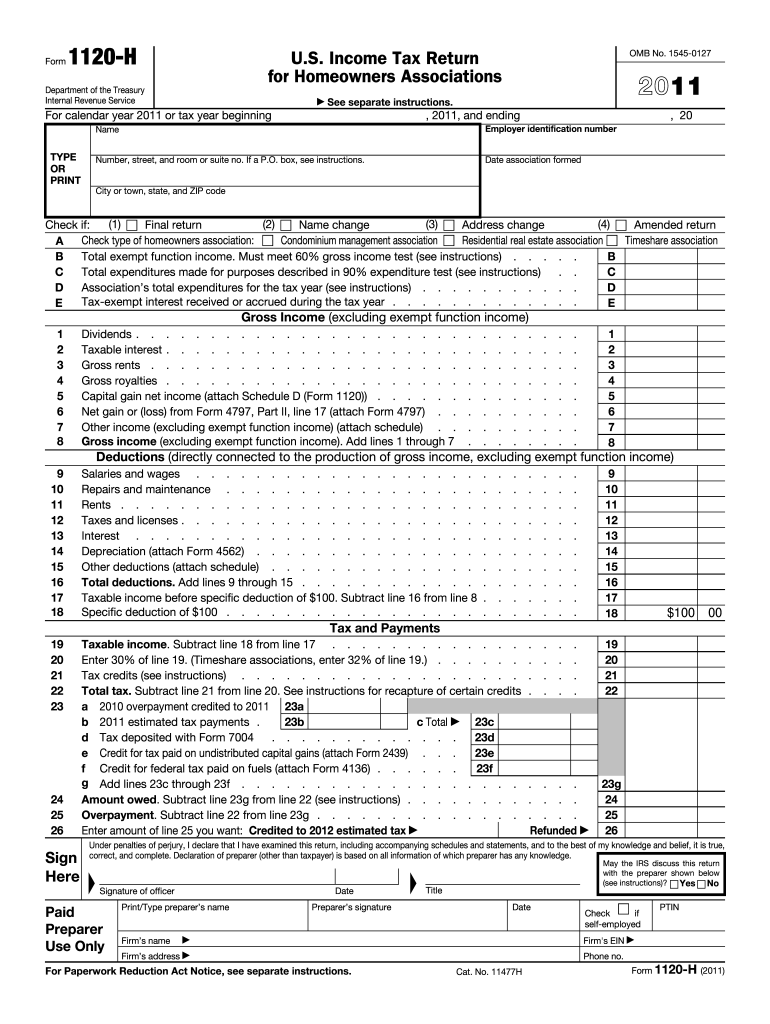
D Preparer Use Only Print/Type preparer s name Firm s name Preparer s signature Sign Here Taxable income. Subtract line 18 from line 17 . . . . . . . . . . . . . Enter 30% of line 19. (Timeshare associations, enter 32% of line 19.) . . . . . . Tax credits (see instructions) . . . . . . . . . . . . . . . . . . . Total tax. Subtract line 21 from line 20. See instructions for recapture of certain credits a 2010 overpayment credited to 2011 23a b 2011 estimated tax payments . 23.
Loading

Open form follow the instructions

Easily sign the form with your finger

Send filled & signed form or save
How to fill out the IRS 1120-H online
Filing the IRS 1120-H is essential for homeowners associations to declare their tax information. This guide provides clear, step-by-step instructions tailored for users at any experience level, ensuring a smooth process for completing your tax return online.
Follow the steps to fill out the form efficiently.
- Click ‘Get Form’ button to obtain the IRS 1120-H form and open it in your preferred editing tool.
- Enter the name of the homeowners association in the designated field. Be sure to type or print clearly.
- Input the Employer Identification Number (EIN) accurately to avoid processing issues.
- Fill in the association's address, including the street, city, state, and ZIP code. If applicable, refer to the instructions for P.O. box information.
- Indicate the date the association was formed.
- Check the appropriate box if this is a final return, name change, address change, or amended return.
- Select the type of homeowners association by marking the relevant box: condominium management association, residential real estate association, or timeshare association.
- Complete line B with total exempt function income, ensuring it meets the 60% gross income test as per the instructions.
- Fill in line C with the total expenditures that qualify under the 90% expenditure test.
- Provide the total expenditures for the tax year in line D.
- Detail any tax-exempt interest received or accrued during the tax year in line E.
- On the gross income section, list out any income sources and their totals, including dividends, taxable interest, gross rents, and other specified income.
- In the deductions section, report all directly connected expenses related to gross income, such as salaries, repairs, taxes, etc.
- Calculate taxable income by subtracting total deductions from gross income, noting the specific deduction of $100.
- Enter the calculated taxable income and follow the directions for tax and payments, including any credits.
- Complete the declaration section, ensuring it is signed and dated by an authorized officer.
- Finally, once all fields are filled and reviewed, save changes, download, print, or share the completed form as needed.
Start completing your IRS 1120-H form online now for a seamless filing experience.
Experience a faster way to fill out and sign forms on the web. Access the most extensive library of templates available.
Related content
Jan 21, 2025 — A homeowners association files this form as its income tax return to take...
The return must be filed on or before the fifteenth day of the third month following the...
Form 4466 is a corporation's application for a quick refund of overpaid estimated tax, if...
Get answers to your most pressing questions about US Legal Forms API.
What is the IRS ruling on HOA?
The IRS ruling on Homeowners Associations (HOAs) allows them to report their income and expenses using IRS 1120-H, offering a streamlined process for tax compliance. This ruling recognizes the unique structure of HOAs, allowing them to file taxes on non-member income only. This tax classification can significantly benefit your HOA, simplifying financial reporting. For detailed guidance and to ensure accurate compliance, consider using uslegalforms as a reliable resource.
What happens if a corporation does not file a tax return?
If a corporation does not file a tax return, it risks facing serious repercussions from the IRS. Not only can the IRS levy fines and penalties, but it may also lead to a loss of business licenses and good standing. The corporation may become subject to audits and further scrutiny. Consequently, ensuring compliance by filing the appropriate forms, including IRS 1120-H, is crucial.
What is the penalty for not filing a corporate tax return?
The penalty for not filing a corporate tax return can be quite serious. Corporations may face a penalty of $210 per month for each month the return is late, up to a maximum of 12 months. Not filing can also bring about further legal and financial complications. To avoid these consequences, it is advisable to ensure timely filing, such as IRS 1120-H for relevant entities.
What is the deadline for filing form 1120-H?
The deadline for filing IRS 1120-H is typically on the 15th day of the fourth month following the end of your tax year. If your tax year ends on December 31, for example, the due date for submission would be April 15 of the following year. Filing on time is vital to avoid penalties and maintain good standing for your HOA. Always check for any updates or extensions that may apply.
What is IRS 1120-H?
IRS 1120-H is a tax form designed specifically for Homeowners Associations (HOAs) to report their income and expenses. This form allows qualifying HOAs to benefit from a simpler tax structure, paying taxes only on non-member income. Using IRS 1120-H helps you file your taxes efficiently while ensuring compliance with IRS regulations. Understanding this form can help manage your HOA's financial responsibilities effectively.
What happens if you don't file form 1120?
If you do not file form 1120, your corporation may face serious consequences. The IRS can impose penalties and interest on unpaid taxes, leading to financial strain. Additionally, failing to file can result in the loss of your business's good standing. Therefore, it is essential to adhere to filing deadlines, including IRS 1120-H.
What is the penalty for not filing 1120-H?
The penalty for not filing IRS 1120-H can be significant. If you fail to file by the due date, you may incur a penalty of $205 per month, up to a maximum of five months. This penalty can quickly add up, impacting your financial standing. It is crucial to file your IRS 1120-H to avoid these unnecessary costs.
Can I submit form 1120 online?
Yes, you can submit IRS 1120 online through various e-filing options. E-filing offers a convenient and efficient way to file taxes, reducing the chance of errors and ensuring timely submission. Various tax software solutions can facilitate this process for you. Take advantage of available technologies, such as uslegalforms, to ease your online submission experience.
What is the difference between filing 1120 and 1120H?
The main difference between filing IRS 1120 and IRS 1120-H lies in their purposes. IRS 1120 is for C Corporations, while IRS 1120-H is specifically designed for homeowners associations. Understanding which form applies to your situation is crucial for compliance. If you are uncertain, uslegalforms can assist in identifying the correct form for your business needs.
Can I file my C Corp with my personal taxes?
No, you cannot file your C Corp taxes alongside your personal taxes. C Corporations, including those filing IRS 1120, have separate tax obligations and must be filed independently. This separation helps maintain clear boundaries between corporate and personal finances. Using platforms like uslegalforms can help ensure that you meet all requirements and file correctly.
Use professional pre-built templates to fill in and sign documents online faster. Get access to thousands of forms.
If you believe that this page should be taken down, please follow our DMCA take down process here.
This form is available in several versions. Select the version you need from the drop-down list below.