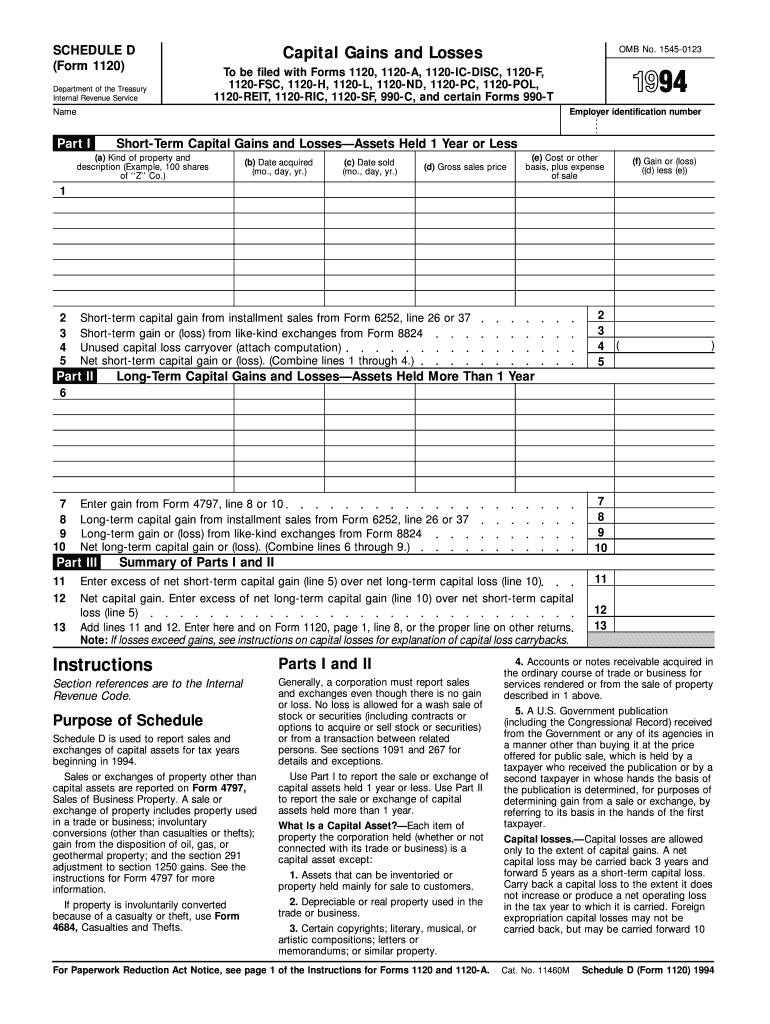
Carry back a capital loss to the extent it does not increase or produce a net operating loss in the tax year to which it is carried. Foreign expropriation capital losses may not be carried back but may be carried forward 10 Cat. No. 11460M Schedule D Form 1120 1994 Page years.

Open form follow the instructions

Easily sign the form with your finger

Send filled & signed form or save
How to fill out the IRS 1120 - Schedule D online
Filling out the IRS 1120 - Schedule D is an essential task for corporations reporting capital gains and losses. This guide provides a clear and comprehensive overview of each component of the form, helping users navigate the process online with confidence.
Follow the steps to fill out the form accurately and efficiently.
- Click the ‘Get Form’ button to obtain the IRS 1120 - Schedule D and open it in your editor.
- Enter the corporation's name and employer identification number at the top of the form.
- In Part I, list short-term capital gains and losses for assets held for one year or less. Fill in the columns with the kind of property, date acquired, date sold, gross sales price, cost or other basis, and calculate the gain or loss.
- Complete the lines for any short-term capital gain from installment sales and unused capital loss carryover.
- In Part II, report long-term capital gains and losses for assets held for more than one year in a similar manner as Part I. Include necessary details for lines related to assets sold.
- In the Summary section, compute the excess of net short-term capital gain over net long-term capital loss and determine the net capital gain.
- Review all entries to ensure accuracy, making sure to add all lines as instructed.
- Once completed, you can save changes, download the form, print, or share it as needed.
Start filling out your IRS 1120 - Schedule D online today for a smoother tax filing experience!
Experience a faster way to fill out and sign forms on the web. Access the most extensive library of templates available.
Related content
See instructions for how to figure the amounts to enter on the lines below. This form may...
Schedule D should be used by a taxpayer who files either Forms 1120, 1120-A...
Jan 31, 2012 — However, you may want to complete certain Form 1120 schedules, such as...
Get answers to your most pressing questions about US Legal Forms API.
Who sends Schedule D?
Typically, the entity required to file IRS 1120 - Schedule D is the corporation itself. It is important that the corporation submits this form along with its annual tax return to the IRS. If you're looking for guidance on how to submit it, you can rely on platforms like Uslegalforms for resources and templates.
What is the Schedule D of 1120?
The IRS 1120 - Schedule D is a tax form used by corporations to report capital gains and losses. This schedule plays an essential role in calculating taxes owed on these transactions. Corporations must complete Schedule D to ensure compliance with IRS regulations related to their investments.
Which TurboTax has Schedule D?
Most versions of TurboTax, including Deluxe, Premier, and Self-Employed, include IRS 1120 - Schedule D. This means you can file your taxes accurately, whether you have capital gains, losses, or other investment-related transactions. You can choose the version that best fits your financial situation.
How do I get to Schedule D on TurboTax?
To access IRS 1120 - Schedule D on TurboTax, start your tax return and navigate to the 'Investment Income' section. TurboTax will guide you through the process and prompt you to complete the necessary forms. You will find Schedule D integrated alongside other essential forms for your convenience.
Who completes Schedule E?
Schedule E is typically completed by individuals who receive supplemental income, such as rental income or royalties. This form is not specifically related to IRS 1120 - Schedule D, but it is important for reporting various types of income. If you have rental properties or similar income streams, you will need to complete Schedule E.
What is the difference between Schedule D and form 8949?
IRS 1120 - Schedule D summarizes capital gains and losses, while Form 8949 provides a detailed breakdown of each transaction. Essentially, you use Form 8949 first to report individual sales, and then transfer the totals to Schedule D. This process helps ensure accurate tax reporting.
Do I have to file a Schedule D if I sold my house?
If you sold your house and realized a capital gain, you might need to file IRS 1120 - Schedule D. However, if you qualify for the home sale exclusion, you may not need to report the sale. It's best to review your situation or consult a tax professional to determine your filing requirements.
Where do I get my Schedule D?
You can obtain your IRS 1120 - Schedule D from the official IRS website. Simply visit the IRS forms section and search for 'Schedule D.' Additionally, many tax preparation software programs, like TurboTax, provide easy access to this form.
What is the difference between Schedule D and 4797?
Schedule D and Form 4797 serve different purposes within the IRS forms framework. IRS 1120 - Schedule D focuses on capital gains and losses, while Form 4797 is for reporting sales of business property. Understanding these distinctions helps you use the right form to report your transactions accurately. If you're unsure, uslegalforms can provide guidance to help you choose correctly.
Can I file 1120 myself?
Yes, you can file IRS 1120 yourself, but it’s crucial to understand the complexities involved. If your business has numerous transactions or unique deductions, consider using a professional or a reliable platform like uslegalforms. This approach can help prevent errors and save time. By utilizing the right resources, you can confidently manage your filing process.
Use professional pre-built templates to fill in and sign documents online faster. Get access to thousands of forms.
If you believe that this page should be taken down, please follow our DMCA take down process here.
This form is available in several versions. Select the version you need from the drop-down list below.