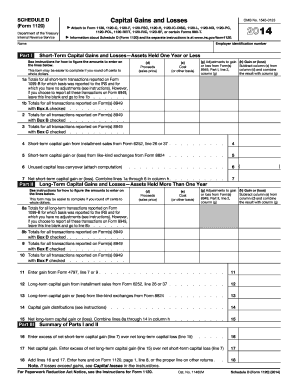
Get Irs 1120 - Schedule D 2014
How it works
-

Open form follow the instructions
-

Easily sign the form with your finger
-

Send filled & signed form or save
How to fill out the IRS 1120 - Schedule D online
This guide provides a step-by-step approach to completing the IRS 1120 - Schedule D form online. Whether you are new to tax filing or have prior experience, this comprehensive overview aims to support users in accurately reporting their capital gains and losses.
Follow the steps to fill out the IRS 1120 - Schedule D form online.
- Click ‘Get Form’ button to obtain the IRS 1120 - Schedule D form and open it for editing.
- Begin by entering your employer identification number (EIN) and the name of your entity at the top of the form.
- Proceed to Part I, where you will report short-term capital gains and losses for assets held one year or less. Enter the proceeds (sales price) in column (d) and the cost (or other basis) in column (e).
- In column (g), include any adjustments to gain or loss from Form(s) 8949, Part I, line 2, column (g). Calculate the gain or loss and record it in column (h) by subtracting the cost from the proceeds, and combining it with any adjustments from column (g).
- Continue filling out lines 1a, 1b, 2, and 3 as applicable, ensuring you follow the instructions for reporting transactions based on Forms 1099-B or 8949.
- Move on to Part II for long-term capital gains and losses, entering your information in the same manner as in Part I. Make sure to check the appropriate boxes based on your transaction types.
- In Part III, calculate the summary of your results from Parts I and II, recording any net capital gains in the specified fields.
- Finally, review your completed form for accuracy. Once satisfied, you can save changes, download, print, or share your completed IRS 1120 - Schedule D form.
Complete your IRS 1120 - Schedule D form online today to ensure accurate reporting of your capital gains and losses.
Get form
Related links form
If you sold your house and it was not used in your business, you typically do not need to file a Schedule D for your personal tax return. However, if your sale results in capital gains, you might need to report this using different forms depending on your situation. It's best to consult with a tax professional or use a reliable platform like uslegalforms to ensure you're meeting the necessary requirements.