Step 7: 16 Income tax paid to another state while an Illinois resident. Attach Schedule CR. 16 Tax After 17 Property tax and K-12 education expense credit amount from Non Schedule ICR. Attach Schedule ICR. 17 refundable 18 Credit amount from Schedule 1299-C. Attach Schedule 1299-C. 18 Credits 19 Add Lines 16, 17, and 18. This is the total of your credits. Cannot exceed the tax amount on Line 15. 20 Tax after nonrefundable credits. Subtract Line 19 from Line 15. IL.
Open form follow the instructions
Easily sign the form with your finger
Send filled & signed form or save
How to fill out the IL DoR IL-1040 online
Filing your individual income tax return online using the IL DoR IL-1040 can be a straightforward process. This guide aims to support you through each section and field of the form with clear and detailed instructions.
Follow the steps to successfully complete your IL-1040 online.
- Click ‘Get Form’ button to obtain the form and open it in the editor.
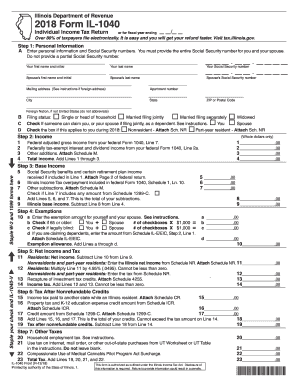
- Begin by entering your personal information in Step 1. This includes your name, Social Security number, and mailing address. Ensure to provide complete Social Security numbers for both yourself and your spouse if applicable. Indicate your filing status by selecting one of the provided options.
- For Step 2, focus on your income. Begin with your federal adjusted gross income as reported on your federal Form 1040. Additionally, report any federally tax-exempt interest and other additions that apply to you by following the prompts.
- In Step 3, calculate your base income. Subtract any allowed subtractions from your total income. According to the instructions, this includes specific retirement incomes and Illinois Income Tax overpayments.
- Proceed to Step 4 to enter your exemptions. Assess whether you are eligible for exemptions for yourself, your spouse, or any dependents, and input the corresponding amounts.
- In Step 5, calculate your net income and corresponding tax. Ensure you multiply your net income by the applicable tax rate as instructed.
- For Step 6, keep track of any tax credits that may apply to you. Input any amounts for credits that can reduce your tax liability.
- Next, complete Step 7 which accounts for any other taxes owed such as household employment tax or use tax for out-of-state purchases.
- Move to Step 8 to report payments and refundable credits. Sum all applicable payments from various sources.
- In Step 9, if you have payments greater than total tax owed, calculate your potential refund by subtracting the total tax from your payments. Conversely, if total tax is higher, denote the amount owed.
- Finalize your return by completing any signature fields required in Step 13, specifically if you are filing jointly. Ensure to accurately fill out your and your spouse's signature, along with identification information.
- Once all steps are completed, you can save your changes, download, print, or share the form as needed.
Start your online filing today to ensure timely submission and faster refunds.
Experience a faster way to fill out and sign forms on the web. Access the most extensive library of templates available.
Related content
New in 2024! You can now use the IRS Direct File Program. Eligible Illinois taxpayers can...
If you are an employee, you must complete this form so your employer can withhold the...
Histórico da Literatura O manual descreve a instalação, operação e manutenção das...
Get answers to your most pressing questions about US Legal Forms API.
Who is exempt from filing 1040?
Certain individuals may be exempt from filing the IL DoR IL-1040, such as those whose income is below the established threshold, or individuals who do not have Illinois-sourced income. However, it’s crucial to confirm your exemption status based on current tax laws. Consulting a tax professional can provide clarity if you're unsure about your filing requirements.
Who is required to file an IL 1040?
Anyone who earns income within Illinois is generally required to file an IL DoR IL-1040, depending on the income benchmarks set by the state. This requirement applies to residents and non-residents who meet the income criteria. Make sure to stay updated on these thresholds each tax season to avoid any tax complications.
What is the difference between IL 1040 and IL 505?
The IL 1040 is the standard income tax form for individuals, while the IL 505 is specifically for those who may qualify for a simplified version of the personal income tax return. Typically, IL 505 is for those with straightforward tax situations, enabling a quicker filing process. Review your financial situation to choose the most suitable form.
How do I get my IL 1040?
You can obtain your IL DoR IL-1040 form directly from the Illinois Department of Revenue's website. Additionally, various tax preparation services, including uslegalforms, provide downloadable versions of this form. This accessibility makes it easy for you to prepare your taxes accurately and on time.
Who must file IL 1040?
Residents and non-residents who earn income in Illinois must often file the IL DoR IL-1040. If your income surpasses the state’s minimum threshold set by the Illinois Department of Revenue, you will need to file. It’s essential to review your income sources and stay compliant with state tax regulations.
Which 1040 tax form to use?
The standard Form 1040 is suitable for most taxpayers, including those filing the IL DoR IL-1040. However, if you have a more complicated tax situation, you might need to consider the 1040-SR for seniors, or perhaps another variant. Choosing the correct form is important to ensure accurate reporting of your income and deductions.
What are the 3 types of taxes in Illinois?
In Illinois, the three main types of taxes include income tax, sales tax, and property tax. The income tax is based on what you earn, while sales tax applies to most purchases. Property tax is assessed on real estate values. Understanding these taxes can guide you in managing your financial responsibilities effectively.
Who is required to use Form 1040?
Individuals who earn a certain income level must use Form 1040 to file their taxes. In many cases, this includes residents of Illinois who receive income from jobs, investments, or other sources. Using the IL DoR IL-1040 ensures you meet state requirements and avoid penalties. To determine your obligation, consider your overall income and filing status.
What should I attach to my IL-1040?
When filing your IL-1040, you should attach relevant documentation that supports your reported income and deductions. This can include W-2s, 1099 forms, and any schedules required by the Illinois Department of Revenue. Including all necessary attachments helps expedite processing and reduce chances of errors. To simplify the process, you might want to explore resources available on USLegalForms.
Do you want to report use tax on your IL 1040 meaning?
Reporting use tax on your IL 1040 means disclosing items you bought without paying sales tax. This is important to fulfill your tax obligations in Illinois. By including this information on your IL DoR IL-1040, you can avoid later complications with tax authorities. Consider getting professional help if you’re unsure how to report or calculate your use tax.
Use professional pre-built templates to fill in and sign documents online faster. Get access to thousands of forms.
If you believe that this page should be taken down, please follow our DMCA take down process here.
This form is available in several versions. Select the version you need from the drop-down list below.