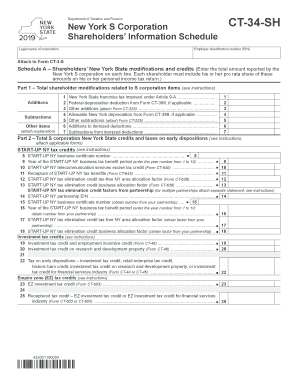
17 18 START-UP NY tax elimination credit business allocation factor (obtain factor from your partnership) ... 18 Investment tax credits (see instructions) 19 Investment tax credit and employment incentive credit (Form CT-46) ...................................................... 19 20 Investment tax credit on research and development property (Form CT-46) ..................................... 20 21 22 T.
Open form follow the instructions
Easily sign the form with your finger
Send filled & signed form or save
How to use or fill out the NY DTF CT-34-SH online
Filling out the NY DTF CT-34-SH form online can streamline the process of reporting shareholder information for S corporations in New York. This guide provides a step-by-step approach to ensure accurate completion.
Follow the steps to complete the NY DTF CT-34-SH form online.
- Press the ‘Get Form’ button to access the CT-34-SH form and open it in your preferred editor.
- Begin by entering the legal name of the corporation at the top of the form. This should match your registered corporation name and be filled in clearly.
- Next, input the employer identification number (EIN) assigned to your corporation. This nine-digit number is essential for tax reporting.
- Proceed to Schedule A, where you will detail modifications and credits. For each shareholder, you must report their pro rata share of the amounts provided by the S corporation on their individual tax returns.
- In Part 1, record total shareholder modifications related to S corporation items. Separate your entries into additions and subtractions as specified.
- In Part 2, report total New York State credits and taxes on early dispositions. Follow the provided instructions carefully and ensure all required forms are attached.
- Complete Schedule B for identifying information of shareholders. Photocopy if necessary, and ensure each entry is legible, particularly the identifying number and percentage of ownership.
- Once all sections are filled, review your entries for accuracy. Make sure to review instructions for any additional forms that may need to be attached.
- Finally, you can save your changes, download, print, or share the completed form as required.
Complete your documents online effortlessly today!
Experience a faster way to fill out and sign forms on the web. Access the most extensive library of templates available.
Related content
Form CT-34-SH is a New York S Corporation Shareholders' Information Schedule for 2024...
Mar 28, 2019 — NYS DTF to ascertain whether any tax liability has been incurred and, if...
McGrath, Christian J. Review of formulations for processes affecting the subsurface...
Get answers to your most pressing questions about US Legal Forms API.
Who is responsible for filing a trust tax return?
The responsibility for filing a trust tax return falls on the trustee or the person managing the trust. This individual must ensure that all income and deductions are accurately reported to comply with tax regulations. When dealing with trusts, forms like the NY DTF CT-34-SH must be correctly utilized to reflect any state tax obligations as well. It is vital to remain diligent to keep the trust compliant.
Who must file a 1041 tax return?
The 1041 tax return is typically filed by the fiduciary of a trust or estate that has gross income exceeding a specified threshold. This includes revocable trusts that have generated income or estates with taxable earnings. Filing helps ensure that all tax liabilities are met according to federal and state guidelines. For managing these types of returns, the NY DTF CT-34-SH can be necessary to navigate New York state-specific obligations.
What does I received nonresident income from New York sources mean?
Receiving nonresident income from New York sources indicates that you earned income within New York while living elsewhere. This situation often requires you to file a nonresident tax return with the state. The NY DTF CT-34-SH is particularly important in this context, as it may dictate your filing obligations. It's advisable to understand your responsibilities to avoid penalties.
Does a tax return need to be filed for a revocable trust?
Even though revocable trusts generally do not require separate tax returns, the income generated may still be taxable to the grantor. Therefore, it’s crucial to report income when filing personal tax returns. Since the trust is revocable, the grantor retains control, which impacts how taxes are reported. Utilizing resources like US Legal Forms can guide you in understanding when and how to file relevant forms, such as the NY DTF CT-34-SH.
What is CT 34 SH?
CT 34 SH refers to the New York State Department of Taxation and Finance form used to report tax obligations for trusts. This form ensures the proper taxation of trusts and allows them to comply with state tax laws. By submitting the CT 34 SH, trust administrators can manage tax responsibilities and facilitate smoother financial oversight. It's essential to be familiar with this form when handling trust-related taxes.
What is NY pass through entity tax?
NY pass through entity tax is a taxation method applied to certain entities where the income is passed through directly to the owners or beneficiaries. As a result, this tax structure avoids double taxation on corporate income. By filing the necessary forms, including the NY DTF CT-34-SH, entities help their owners understand their individual tax obligations while benefiting from the state’s simplified tax process. Many find this system advantageous for its clarity and efficiency.
Who must file a NY trust return?
Individuals or entities that manage or administer a trust in New York must file a NY trust return. This is necessary if the trust has any income that exceeds the state’s minimum filing requirements. Trusts also need to file if they generate taxable income or have distributions that require reporting. If you're using tools like US Legal Forms, you can easily access the NY DTF CT-34-SH to ensure you complete this process correctly.
What is the capital base tax rate in NY?
The capital base tax rate in New York typically varies based on your business's net worth and income. For most corporations, the capital base tax helps ensure that large businesses contribute fairly to the state’s revenue. Understanding this tax and how it applies can support your business’s financial health.
Are small business taxpayers eligible for 0 capital base tax rate in NY?
Yes, small business taxpayers may be eligible for a capital base tax rate of 0% under certain conditions in New York. To qualify, your business must meet specific criteria detailed by the NY DTF. This provides significant benefits, as it can lead to reduced tax liabilities for eligible small businesses.
What is the capital gains tax rate in New York State?
New York State taxes capital gains as regular income at your personal income tax rate. This means that the capital gains tax rate could range from 4% to 10.9%, depending on your total income. Make sure to consider this when reviewing the implications of your investments.
Use professional pre-built templates to fill in and sign documents online faster. Get access to thousands of forms.
If you believe that this page should be taken down, please follow our DMCA take down process here.
This form is available in several versions. Select the version you need from the drop-down list below.