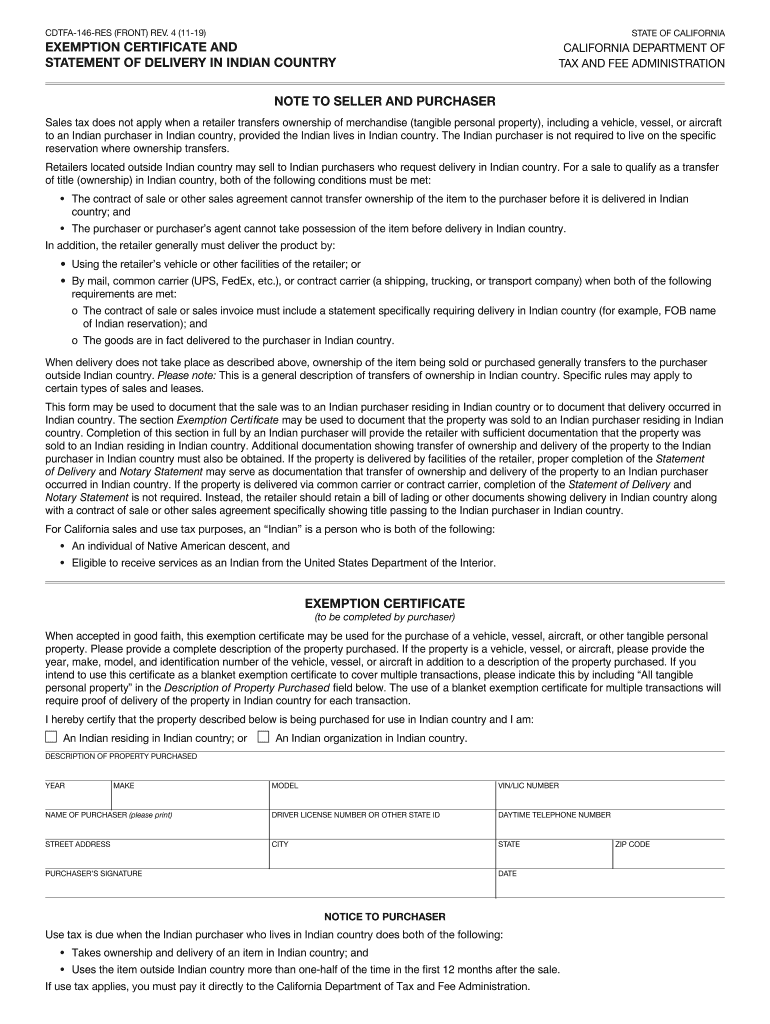
HASER Sales tax does not apply when a retailer transfers ownership of merchandise (tangible personal property), including a vehicle, vessel, or aircraft to an Indian purchaser in Indian country, provided the Indian lives in Indian country. The Indian purchaser is not required to live on the specific reservation where ownership transfers. Retailers located outside Indian country may sell to Indian purchasers who request delivery in Indian country. For a sale to qualify as a transfer of title (own.
Loading

Open form follow the instructions

Easily sign the form with your finger

Send filled & signed form or save
How to use or fill out the CA CDTFA-146-RES (Formerly BOE-146-RES) online
Filling out the CA CDTFA-146-RES form online can simplify the process of documenting sales transactions involving Indian purchasers in California. This guide provides clear and sequential instructions to ensure users complete the form accurately and effectively.
Follow the steps to complete the CA CDTFA-146-RES form online.
- Click ‘Get Form’ button to access the CA CDTFA-146-RES form and open it in the editor.
- Begin by reading the instructions provided with the form, which outline the necessary conditions for tax exemption when transferring ownership to an Indian purchaser in Indian country.
- Complete the Exemption Certificate section. Provide a full description of the property purchased, including year, make, model, and identification number if applicable. If this form is being used as a blanket exemption, indicate 'All tangible personal property' in the Description of Property Purchased field.
- In the Purchaser’s section, print the name of the person making the purchase, along with their driver license number or state ID, daytime telephone number, street address, city, state, and ZIP code.
- The purchaser must sign and date the form to certify that the information is accurate and that they are either an Indian residing in Indian country or an Indian organization in Indian country.
- Next, navigate to the Statement of Delivery section. Enter the type of merchandise along with the year, make, model, and VIN/license number if applicable.
- Provide the name of the reservation, the address, including street, city, and ZIP code, where the delivery occurred, as well as the date of delivery.
- The seller must complete their section by providing their name, seller’s permit number, daytime telephone number, and address.
- Have the seller sign and date the form, certifying that the property was delivered to the purchaser in Indian country.
- If applicable, complete the Notary Statement section to verify the identity of the individual signing the document. This is typically done by a California notary public or authorized tribal representative.
- Once all sections are completed, review the form for accuracy. Users can then save their changes, download the completed form, print it for their records, or share it as necessary.
Start filling out the CA CDTFA-146-RES form online today to streamline your documentation process.
Experience a faster way to fill out and sign forms on the web. Access the most extensive library of templates available.
Related content
• CDTFA-146-RES, Exemption Certificate and Statement of Delivery in Indian Country. •...
... CDTFA") as of July 1, 2017. The previous administrator was the State Board of...
Get answers to your most pressing questions about US Legal Forms API.
Who qualifies for sales tax exemption in California?
In California, certain organizations and types of sales qualify for sales tax exemption, such as non-profit organizations, government entities, and specific items like food and prescription drugs. To apply for exemption, you'll need to complete the appropriate paperwork, often including forms like the CA CDTFA-146-RES (Formerly BOE-146-RES). Resources from USLegalForms can assist you in understanding the requirements and processes involved.
Is CDTFA the same as BOE?
No, the CA CDTFA is not the same as the Board of Equalization (BOE). The BOE was dissolved in 2017, and its responsibilities were transferred to the CDTFA. This change aimed to streamline tax administration in California, making it easier to manage sales and use taxes. Understanding this transition helps clarify your obligations under the CA CDTFA-146-RES (Formerly BOE-146-RES).
How far back can CDTFA audit?
The CA CDTFA can audit your tax records for up to four years from the date your tax return was due. This timeframe includes both sales tax and use tax. If they find any significant discrepancies, they may extend the audit period, which means it’s essential to maintain accurate records. Using tools like USLegalForms can help ensure your documentation is complete and organized, minimizing audit issues.
What is CDTFA 146 RES exemption certificate and statement of delivery in Indian country?
The CDTFA 146 RES exemption certificate is a form used to claim sales tax exemption for purchases made in Indian country. It outlines the seller’s information and certifies that the goods are for resale or are exempt under specific laws. Understanding this certificate is vital for businesses operating in or with Native American tribes, ensuring compliance with tax regulations.
How to fill California resale certificate form?
Filling out the California resale certificate form involves completing the CA CDTFA-146-RES (Formerly BOE-146-RES). You need to provide your business name, address, and seller's permit number, along with the name and address of your supplier. Clearly specify the items for which you are claiming resale. This form is an important tool to ensure proper tax exemptions on qualifying purchases.
How to fill out California resale certificate?
To fill out a California resale certificate, start by obtaining the CA CDTFA-146-RES (Formerly BOE-146-RES) form. You must provide details about the seller and buyer, including business names, addresses, and seller’s permit numbers. Ensure that you indicate the specific goods being purchased for resale. Once complete, share the certificate with your supplier to avoid paying sales tax on eligible items.
When did BOE change to CDTFA?
The transition from BOE to CDTFA took place on July 1, 2017. This change was part of a broader effort to improve the efficiency and effectiveness of California's tax administration. As a result, forms like the CA CDTFA-146-RES (Formerly BOE-146-RES) were introduced to align with the new department's objectives.
What is the CDTFA 146 RES exemption certificate and statement of delivery in Indian country?
The CDTFA 146 RES exemption certificate allows for sales tax exemptions in specific transactions within Indian country. This certificate ensures compliance with state laws while respecting tribal sovereignty. For those looking to understand or use the CA CDTFA-146-RES (Formerly BOE-146-RES), it's essential to familiarize yourself with its stipulations and benefits.
How to fill out a sales tax exempt form?
Filling out a sales tax exempt form requires careful attention to detail. Start by accurately providing your name, address, and the reason for tax exemption. For further assistance, you can refer to the CA CDTFA-146-RES (Formerly BOE-146-RES) guidelines and consider uslegalforms for templates to streamline the process.
How do I submit a power of attorney to CDTFA?
To submit a power of attorney to the CDTFA, you can either mail or fax the completed Power of Attorney form (CDTFA-401) to the office. Ensure that the form includes all required signatures to avoid delays. Utilizing resources from uslegalforms can help you easily navigate this process and ensure your CA CDTFA-146-RES (Formerly BOE-146-RES) submissions are correctly handled.
Use professional pre-built templates to fill in and sign documents online faster. Get access to thousands of forms.
If you believe that this page should be taken down, please follow our DMCA take down process here.
This form is available in several versions. Select the version you need from the drop-down list below.