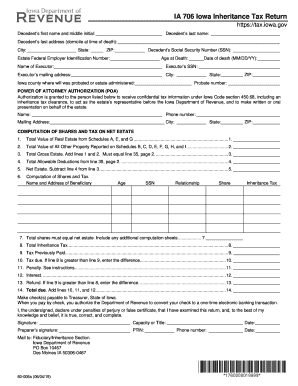
Erjury, I declare that I have examined this return, including accompanying schedules and statements, and to the best of my knowledge and belief, it is true, correct, and complete. Declaration of preparer other than the executor is based on all information of which preparer has any knowledge. I/We grant power of attorney to the person designated above for the purpose indicated. Signature Capacity or Title Preparer s Signature PTIN Mail to: Fiduciary/Inheritance Section Iowa Department of Re.

How it works
  • Open form

    Open form follow the instructions

  • Easily sign form

    Easily sign the form with your finger

  • Share form

    Send filled & signed form or save

How to fill out the IA DoR 706 online

The IA DoR 706 form is essential for reporting Iowa inheritance tax. This guide provides a clear and step-by-step approach to help users complete the form online with confidence.

Follow the steps to effectively fill out the IA DoR 706

  1. Click ‘Get Form’ button to obtain the IA DoR 706 form and open it in your preferred online editor.
  2. Begin by entering the decedent’s first name, middle initial, last name, and their last address at the time of death. Make sure to also fill in their city, state, ZIP code, Social Security Number, and Estate Federal Employer Identification Number.
  3. Next, provide the age at death and the date of death in the required format (MM/DD/YY). Fill in the executor’s name and Social Security Number, followed by their mailing address including city, state, and ZIP code.
  4. Record the Iowa county where the will was probated or the estate administered and the corresponding probate number.
  5. Complete the Power of Attorney Authorization section by entering the name, phone number, and mailing address of the person authorized to receive confidential tax information.
  6. Proceed to the computation of shares and tax on the net estate, starting with total values from the necessary schedules. Fill in lines 1, 2, and 3 accurately, and include any additional computation sheets if needed.
  7. Continue filling out the computation for shares and tax, specifying each beneficiary's details, including name, address, age, relationship to the decedent, share, and inheritance tax for each beneficiary.
  8. Complete the remaining lines regarding total shares, inheritance tax, taxes previously paid, penalty, interest, and total due.
  9. After you have entered all the necessary information, ensure to declare under penalties of perjury that the form is true and complete. Sign in the designated spots.
  10. Review all entered information for accuracy before saving your changes. You can then download, print, or share the completed form as needed.

Complete your IA DoR 706 form online today for a hassle-free filing experience.

Get form

Experience a faster way to fill out and sign forms on the web. Access the most extensive library of templates available.

Related content

IA 706 Iowa Inheritance Tax Return, 60-008

Make checks payable to Iowa Department of Revenue and mail to Fiduciary/Inheritance...

Learn more
Estudo dos efeitos auditivos e extra- ...

by M Fernandes · 2002 · Cited by 136 — queixas de saúde e achados audiológicos de...

Learn more
Orion® IntelliScope™ Computerized Object...

The controller's user-friendly keypad combined with its database of more than 14,000...

Learn more
Questions & Answers

Get answers to your most pressing questions about US Legal Forms API.

Contact support

What triggers a form 706?

A form 706 is triggered when an estate exceeds the federal estate tax exemption amount, requiring the filing of the IA DoR 706. This form assesses the total value of the deceased person's estate for tax purposes. If you are unsure whether you need to file, consulting a legal expert can clarify your responsibilities. Utilizing services that offer comprehensive legal resources can further assist in managing your estate obligations.

To obtain a closing letter for the IA DoR 706, you typically need to wait for the IRS to process the form after filing. Once approved, the IRS will send a closing letter confirming that the estate tax return has been accepted. It's vital to maintain proper records during this process to facilitate any necessary communications with the IRS. Using established resources like uslegalforms can guide you through these steps.

In absence of an executor, a family member or someone with a vested interest in the estate may sign IA DoR 706. However, they must demonstrate their authority to represent the estate effectively. It's essential to have the proper documentation to avoid complications. Consulting a platform that specializes in legal forms can help ensure the process is followed correctly.

If an executor is not named or is unavailable, the estate may face significant delays. An interested party can petition the court to appoint an administrator, who can then take the necessary steps to file the IA DoR 706. The process can be complex, but knowing your options can ease the journey. Legal platforms like uslegalforms provide the resources you need to navigate this situation.

For a deceased person, the executor or administrator usually signs the tax return. If there is no appointed executor, a close relative can sign as long as they can prove their authority to act on behalf of the deceased. This ensures the IRS receives the necessary documentation to process the IA DoR 706 properly. Always check with a tax professional to cover all bases.

When there are no executors available, the court may appoint an administrator to handle the estate. This person takes on the responsibility of managing estate affairs, which includes properly filing the IA DoR 706 form. Without an executor, it can become more complicated, but the process remains manageable with the right guidance. Using services like uslegalforms can simplify your journey through these challenging waters.

If there is no executor, a close relative or friend may step in to sign the IA DoR 706 form. Typically, this could be an heir, administrator, or someone who has significant knowledge of the estate. It’s crucial that the person signing has the authority to act on behalf of the estate. Always consider consulting a legal professional to ensure compliance.

Iowa’s inheritance laws outline how estates are distributed after someone passes away, considering factors like marital status and the presence of children. Knowing these laws can help you understand your rights and responsibilities regarding inheritances. Staying well-informed about the IA DoR 706 and how it applies to your situation will empower you during estate planning and inheritance processes.

Yes, when you sell inherited property, you typically need to report the sale to the IRS, but you may benefit from a stepped-up basis on the property’s value. This means you could potentially owe less in capital gains taxes. For comprehensive information about reporting and how the IA DoR 706 interacts with these transactions, consulting a tax professional is advisable.

To avoid inheritance tax in Iowa, it is beneficial to consider gifting assets before death or establishing trusts that minimize tax implications. Additionally, staying informed about the current laws surrounding IA DoR 706 can help you make strategic decisions. Utilizing estate planning tools effectively can provide substantial savings on inheritance taxes.

Get This Form Now!

Use professional pre-built templates to fill in and sign documents online faster. Get access to thousands of forms.

If you believe that this page should be taken down, please follow our DMCA take down process here.

IA DoR 706 Form

This form is available in several versions. Select the version you need from the drop-down list below.

Get IA DoR 706