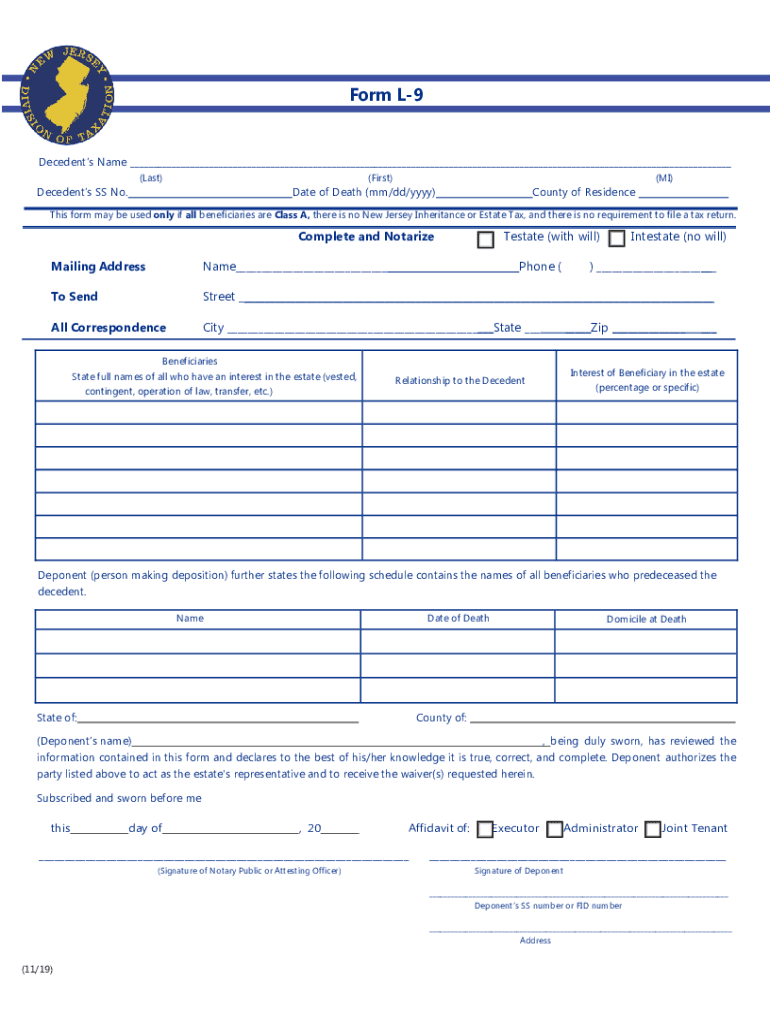
Iciaries State full names of all who have an interest in the estate (vested, contingent, operation of law, transfer, etc.) Relationship to the Decedent ) Zip Interest of Beneficiary in the estate (percentage or specific) Deponent (person making deposition) further states the following schedule contains the names of all beneficiaries who predeceased the decedent. Date of Death Name State of: Domicile at Death County of: (Deponent s name.
Loading

Open form follow the instructions

Easily sign the form with your finger

Send filled & signed form or save
How to fill out the NJ DoT L-9 online
The NJ DoT L-9 form, also known as the Affidavit for Real Property Tax Waiver: Resident Decedent, is essential for beneficiaries seeking a tax waiver after the death of a loved one. This guide provides a straightforward approach to completing the L-9 form online, ensuring that users can effectively navigate through each section.
Follow the steps to complete the form accurately.
- Press the ‘Get Form’ button to access the form and open it in an online editor.
- In the first section, enter the decedent’s name, including last name, first name, and middle initial. Additionally, include the decedent’s Social Security number and date of death (formatted mm/dd/yyyy). Specify the county of residence.
- Indicate whether the decedent had a will (testate) or did not have a will (intestate). Complete the section accordingly and ensure you notarize the form.
- Fill in the mailing address for correspondence, including street, city, state, and zip code.
- List all beneficiaries of the estate by providing their full names, relationship to the decedent, and their respective interest in the estate as either a percentage or a specific amount.
- Complete the schedule for beneficiaries who predeceased the decedent by stating their names and dates of death.
- Affirm the accuracy of the information by having the deponent (the person making the declaration) sign the form and provide their Social Security number or Federal Identification number.
- List the New Jersey real estate involved, specifying the county, street address, lot, block, municipality, and documenting any fractional ownership by the record owners.
- Ensure all required documents are attached, including the decedent’s will, deed, certificate of the executor or administrator, and death certificate.
- Once the form is thoroughly completed, you can either save changes, download, print, or share the form as necessary.
Complete your NJ DoT L-9 form online today for a smooth process.
Experience a faster way to fill out and sign forms on the web. Access the most extensive library of templates available.
Related content
This form may be used only if all beneficiaries are Class A, there is no New Jersey...
If the work and shadow vehicles cannot pull over to allow vehicular traffic to pass...
This report analyzes the field of view needed to avoid backover crashes and the minimum...
Get answers to your most pressing questions about US Legal Forms API.
What is an L-9 form in NJ?
The L-9 form in New Jersey is used for reporting income or property received from an estate. This form aids in determining tax-related obligations associated with inherited assets. Understanding the L-9 form is essential to minimize potential tax liabilities. For guidance on completing this form correctly, visit US Legal Forms for expert insights and tips.
How to fill out L-9 form?
Filling out the L-9 form requires you to provide personal identification details, such as your name and Social Security Number. Complete the sections related to your estate or inheritance, ensuring that all information is accurate. This form is essential for tax reporting purposes in New Jersey. Utilize US Legal Forms for clear instructions and templates to help you.
How do I avoid inheritance tax in NJ?
To avoid inheritance tax in NJ, consider planning strategies such as making use of tax exemptions for direct heirs. Gifts made during your lifetime can also help reduce taxable amounts. Working with a financial advisor who understands New Jersey's laws will provide you with tailored advice for your situation. Resources available on US Legal Forms can assist you in managing inheritance tax matters.
How to fill out Employee Withholding Certificate form?
To complete the Employee Withholding Certificate form, begin with your personal information, including your name, address, and Social Security Number. Next, specify your filing status, and claim any exemptions you qualify for. Remember to sign and date the form before submitting it to your employer, as this ensures proper withholding of your taxes. Consider using resources from US Legal Forms to make this process easier.
How much does an estate have to be worth to go to probate in NJ?
In New Jersey, estates valued at more than $50,000 must typically go through the probate process. However, certain types of assets may not require probate regardless of the estate's value. It's essential to understand New Jersey probate laws to ensure compliance and protect your interests. For further assistance, explore options provided by US Legal Forms.
Who must file a NJ inheritance tax return?
In New Jersey, anyone who inherits assets from a deceased individual must file a NJ inheritance tax return if the estate is taxable. This generally includes all beneficiaries, regardless of the amount inherited. The rules vary based on the relationship to the deceased and the type of assets inherited. For detailed information, you can refer to guides available on US Legal Forms.
How do I keep my inheritance from being taxed?
To keep your inheritance from being taxed, consider consulting with a tax advisor who can provide specific strategies tailored to your situation. One common method is to explore trusts or gifts that may be exempt from taxes. Additionally, understanding state-specific laws, such as those in New Jersey, can help you strategize effectively. Resources on US Legal Forms can guide you through various options.
How to fill out a W 9 form for a business?
To fill out a W 9 form for a business, first, enter the business name and address at the top of the form. Then, provide the Taxpayer Identification Number (TIN), which is typically either your Social Security Number or your Employer Identification Number. Completing this form accurately is crucial to ensure that the IRS has the correct information. You can find additional guidance and resources on platforms like US Legal Forms.
What is the form for inheritance tax payment?
The form required for making inheritance tax payments in NJ is the Inheritance Tax Return, or Form IT-R. If applicable, you may also need to attach the NJ DoT L-9 form to document additional tax-related information. It is crucial to complete these forms accurately to avoid complications with the state tax authority. Consult with professionals if you need assistance with these forms.
How do you get a tax waiver in NJ?
To obtain a tax waiver in NJ, you must first submit an application along with the required documentation, such as proof of your tax status. Utilizing the NJ DoT L-9 form can streamline your application process. After you submit, be sure to monitor the status of your request to avoid any delays. This proactive approach can make getting your waiver smoother.
Use professional pre-built templates to fill in and sign documents online faster. Get access to thousands of forms.
If you believe that this page should be taken down, please follow our DMCA take down process here.