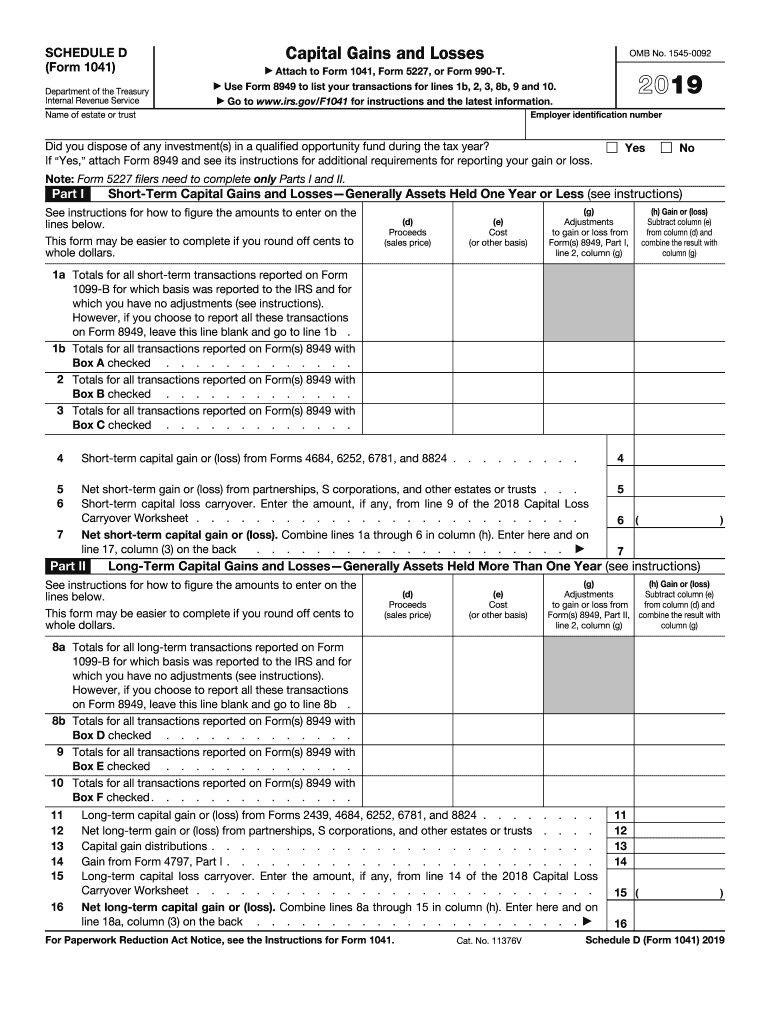
949 with Box E checked . . . . . . . . . . . . . 10 Totals for all transactions reported on Form(s) 8949 with Box F checked . . . . . . . . . . . . . . 11 Long-term capital gain or (loss) from Forms 2439, 4684, 6252, 6781, and 8824 . . . . 11 12 Net long-term gain or (loss) from partnerships, S corporations, and other estates or trusts . . . 12 13 Capital gain distributions . . . 13 14 15 Gain from Form 4797, Part I . . . . . . . . . . . . . . . . . . . . . . . . Long-term capit.
Loading

Open form follow the instructions

Easily sign the form with your finger

Send filled & signed form or save
How to fill out the IRS 1041 - Schedule D online
The IRS 1041 - Schedule D form is essential for reporting capital gains and losses for estates and trusts. This guide provides clear, step-by-step instructions to help users complete this form effectively online.
Follow the steps to complete your IRS 1041 - Schedule D online.
- Select the ‘Get Form’ button to access the IRS 1041 - Schedule D form and open it in your preferred digital editor.
- Fill in your employer identification number at the top of the form. Next, enter the name of the estate or trust. Ensure you have all necessary documentation at hand for accurate reporting.
- Indicate whether you disposed of any investments in a qualified opportunity fund by selecting ‘Yes’ or ‘No’. If ‘Yes’, remember to attach Form 8949 and consult its instructions for any additional requirements.
- Complete Part I to report short-term capital gains and losses. Provide information about proceeds, costs, and any adjustments for each transaction. This part is for assets held for one year or less.
- Continue filling out Part II for long-term capital gains and losses, which pertains to assets held for more than one year. Just like Part I, input the required information on proceeds, costs, and adjustments.
- Move to Part III to summarize the results from Parts I and II. Here you will enter details about net short-term and long-term gains or losses and determine total net gain or loss.
- Access Part IV to detail any capital loss limitations. This section helps you determine the lesser amount to report as a loss if applicable.
- Finally, proceed to Part V to calculate taxes using the maximum capital gains rates if necessary. Gather taxable income and any relevant amounts before proceeding with the calculations.
- Review the completed form carefully to ensure all fields are filled accurately. Once confirmed, you may save your changes, download, print, or share the form as needed.
Complete your documents online to ensure accuracy and efficiency.
Experience a faster way to fill out and sign forms on the web. Access the most extensive library of templates available.
Related content
Use Schedule D to report the following. • The overall capital gains and losses from...
Internal Revenue Service. Reproducible copies of federal tax forms and instructions.
19. Enter the loss, if any, from line 21 of your 2017 Schedule D (Form 1040). (Estates and...
Get answers to your most pressing questions about US Legal Forms API.
Who is required to fill out Schedule D?
Any estate or trust that has sold capital assets must fill out IRS 1041 - Schedule D as part of its tax filing. This requirement includes transactions resulting in capital gains or losses within the tax year. If your entity meets these criteria, ensuring that you complete Schedule D accurately will help you stay compliant and avoid penalties.
What is the $3000 capital loss rule?
The $3000 capital loss rule allows taxpayers to deduct up to $3000 in net capital losses against ordinary income each tax year. If your capital losses exceed this amount, you can carry the excess loss to subsequent years to offset future capital gains. Utilizing IRS 1041 - Schedule D is essential for accurately reporting these losses and understanding how they affect your overall tax situation.
What is the difference between Schedule D and 4797?
IRS 1041 - Schedule D is specifically for reporting capital gains and losses from assets held in a trust or estate. In contrast, Form 4797 is used to report the sale of business property. Understanding these differences is important for ensuring each transaction is reported accurately according to the type of asset sold.
What is the Schedule D on a 1041?
Schedule D on IRS Form 1041 is used to report capital gains and losses for estates and trusts. It summarizes the results of transactions handled by the estate or trust throughout the year. This form helps calculate the overall capital gain or loss which is crucial for determining tax obligations.
Who needs to file Schedule D?
Individuals and entities that have sold capital assets must file IRS 1041 - Schedule D to report their gains and losses. This includes estates and trusts that have transactions resulting in capital gains or losses. If the entity has a requirement to file a Form 1041, then Schedule D is likely necessary to ensure accurate reporting.
Can I skip Schedule D?
You cannot skip IRS 1041 - Schedule D if you have sold capital assets that need reporting. If there are no capital transactions during the year, you may not need to file Schedule D at all. However, if there were any applicable transactions, completing Schedule D is essential to meet compliance requirements.
Do I have to file a Schedule D if I sold my house?
If you sold your house as part of a trust or estate, you will likely need to file IRS 1041 - Schedule D to report any capital gains or losses. Depending on your specific situation, you may qualify for exclusions that can minimize or eliminate the gain. However, if the house was your primary residence and you qualify for the home sale exclusion, it might not be necessary to report that sale on Schedule D.
When should I use Schedule D or Form 8949?
You should use IRS 1041 - Schedule D when you need to report capital gains and losses from the sale of assets held in a trust or estate. If you sold any stocks, bonds, or other capital assets during the tax year, you'll typically need to complete Schedule D and may also need Form 8949 to provide more detail about each transaction. This allows you to summarize your transactions and calculate your overall capital gain or loss.
What is line 13 on taxes?
Line 13 on your tax forms could refer to multiple contexts, often depending on whether it's related to W2s, 1099s, or other forms. When dealing with IRS 1041 - Schedule D, it's essential to understand how different lines might refer to income or losses. A clear comprehension across different forms allows for more effective tax preparation. Leveraging uslegalforms can provide clarity in navigating these complexities.
What is line 13 on Schedule D instructions?
Line 13 on IRS 1041 - Schedule D instructions pertains to the section where you summarize your total capital gains or losses. It's vital to understand this information, as it directly impacts your tax filing. Ensuring accuracy here helps you avoid mistakes that could lead to audits or penalties. When in doubt about the instructions, consider referring to uslegalforms for detailed guidance.
Use professional pre-built templates to fill in and sign documents online faster. Get access to thousands of forms.
If you believe that this page should be taken down, please follow our DMCA take down process here.
This form is available in several versions. Select the version you need from the drop-down list below.