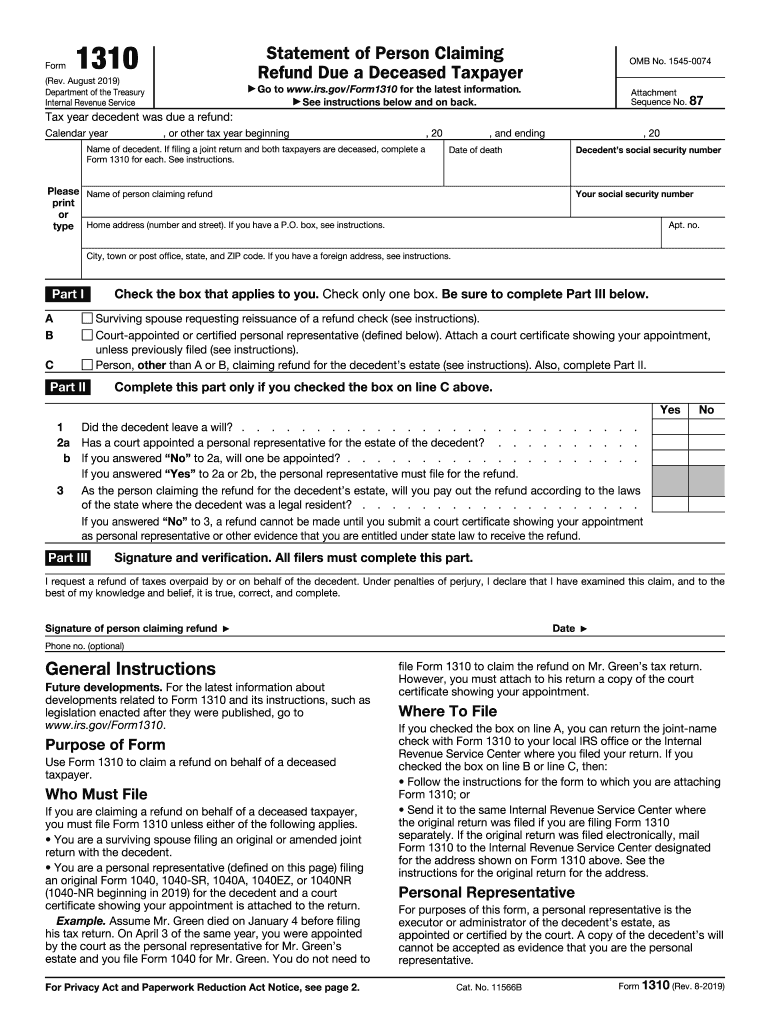
You do not need to file Form 1310 to claim the refund on Mr. Green s For Privacy Act and Paperwork Reduction Act Notice, see page 2. Date tax return. However, you must attach to his return a copy of the court certificate showing your appointment. Where To File If you checked the box on line A, you can return the joint-name check with Form 1310 to your local IRS office or the Internal Revenue Service Center where you filed your return. If you checked the box on line B or line C, then:.
Loading

Open form follow the instructions

Easily sign the form with your finger

Send filled & signed form or save
How to fill out the IRS 1310 online
Completing the IRS 1310 form online can seem daunting, especially when dealing with the loss of a loved one. This guide aims to provide you with clear and concise instructions, ensuring that you accurately fill out the form to claim a refund on behalf of a deceased taxpayer.
Follow the steps to complete the IRS 1310 form with ease.
- Click ‘Get Form’ button to access the IRS 1310 form, allowing you to fill it out electronically.
- Begin by entering the tax year for which the decedent was due a refund. Indicate whether it is a calendar year or specify a tax year.
- Fill in the name of the decedent and their social security number, along with the date of death.
- Provide the name and social security number of the person claiming the refund, as well as their home address including city, state, and ZIP code.
- In Part I, select the appropriate box corresponding to your relationship to the decedent: surviving spouse, court-appointed representative, or other (complete Part II if other).
- If you checked line C in Part I, complete Part II by answering the questions regarding the decedent's will and the appointment of a personal representative.
- In Part III, sign and date the form, confirming that the information provided is accurate to the best of your knowledge. Include a contact phone number if desired.
- After reviewing the form for accuracy, save your changes and choose to download or print the completed form for your records or submission.
Take the next step in managing your documents by completing the IRS 1310 online today.
Experience a faster way to fill out and sign forms on the web. Access the most extensive library of templates available.
Related content
Use Form 1310 to claim a refund on behalf of a deceased taxpayer. Who Must File. You must...
Form 1310, statement of person claiming refund due a deceased taxpayer.
Feb 20, 2018 — Step 4: Provide Form 1310, if required. Form 1310,. Statement of Person...
Get answers to your most pressing questions about US Legal Forms API.
How long does it take the IRS to process a 1310 form?
The processing time for IRS Form 1310 can vary, but it typically takes around 8 to 12 weeks. Delays can occur if the form is incomplete or if there are discrepancies in the submitted documentation. To ensure the smoothest experience possible, double-check all forms and documents before submission. Knowing how the IRS handles the 1310 form can help set your expectations.
How do I claim a refund on behalf of a deceased taxpayer?
To claim a refund on behalf of a deceased taxpayer, file IRS Form 1310 along with the appropriate tax return for the deceased. You will need to provide documentation, such as a death certificate and any supporting probate documents. Ensure that you report the correct tax year to avoid delays in processing. Using US Legal Forms can help you navigate this requirement efficiently.
How do I endorse a check made out to a deceased person?
To endorse a check made out to a deceased person, write 'For Deposit Only' on the back of the check. Next, sign the deceased person’s name followed by your name, indicating that you are acting as a beneficiary or executor. You might need a death certificate or proof of your relationship, so keep these documents handy. Taking these steps ensures compliance and streamlines the IRS 1310 process.
Can I file IRS Form 1310 electronically?
Yes, you can file IRS Form 1310 electronically, but certain conditions apply. If you are filing a tax return using tax software, it will typically include the option to submit Form 1310 along with your return. Ensure that you correctly provide all necessary information to facilitate processing. This electronic filing can expedite your claim, making the IRS 1310 process smoother.
Who must file an IRS form 1310?
An IRS 1310 form must be filed by someone claiming a tax refund on behalf of a deceased taxpayer. This applies to beneficiaries or personal representatives handling the deceased's estate. It's essential to fill out this form if the refund is payable to the deceased or if it affects the tax return filing. Filing the IRS 1310 helps clarify the claim process to the IRS.
How to endorse a tax refund check for a deceased person?
To endorse a tax refund check for a deceased person, you first need to write 'For Deposit Only' on the back of the check. Then, sign the deceased person's name, followed by 'by' and your name as the beneficiary or executor. Ensure you have the appropriate documentation, such as a death certificate or a court appointment, to support your claim. Keep in mind that understanding the IRS 1310 form may simplify this process.
Who is the check made out to on form 1310?
The check made out on form 1310 is usually addressed to the personal representative if they are claiming the refund. If there are multiple heirs, it may also be made out to the estate. Referencing IRS 1310 will help you understand how to manage these nuances effectively.
Who do I make the IRS check out to?
When you are receiving a tax refund for a deceased person, the IRS check will typically be made out to the estate or the person authorized to claim the refund. It's essential to follow the guidelines provided by IRS 1310 to ensure the check is issued correctly.
What circumstances will the personal representative need to file form 1310?
The personal representative needs to file form 1310 when they are claiming a tax refund on behalf of a deceased taxpayer. It is essential if the refund check is to be issued to the personal representative, instead of the deceased. If you navigate these requirements with IRS 1310, you're on the right path.
How do I submit form 1310 to the IRS?
You can submit form 1310 to the IRS by mailing it along with the deceased person's tax return. Ensure that all forms are properly filled out and signed. If you’re unsure about the process, consider using US Legal Forms to find resources and templates to guide your submission.
Use professional pre-built templates to fill in and sign documents online faster. Get access to thousands of forms.
If you believe that this page should be taken down, please follow our DMCA take down process here.
This form is available in several versions. Select the version you need from the drop-down list below.