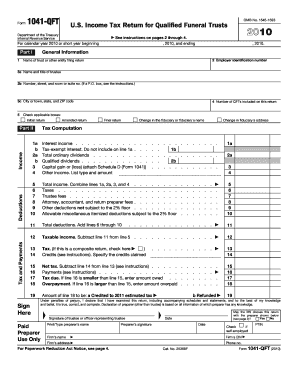
593 2010 See instructions on pages 2 through 4. , 2010, and ending , 2010. General Information 2 Employer identification number Name of trust or other entity filing return 3a Name and title of trustee 3b Number, street, and room or suite no. (If a P.O. box, see the instructions.) 3c City or town, state, and ZIP code 5 4 Number of QFTs included on this return Check applicable boxes: Initial return Part II 1a b 2a b 3 4 Amended return Final return Change in the fiduciary or fiduciary.
Open form follow the instructions
Easily sign the form with your finger
Send filled & signed form or save
How to use or fill out the IRS 1041-QFT online
Filling out the IRS 1041-QFT form can be a daunting task, especially for those unfamiliar with tax processes. This guide provides clear and concise instructions, ensuring that users can efficiently complete the form online, regardless of their prior experience with tax forms.
Follow the steps to fill out the IRS 1041-QFT online effectively.
- Click ‘Get Form’ button to obtain the IRS 1041-QFT form and open it in your preferred online editor.
- In Part I, enter the general information about the trust, including the employer identification number, name of the trust, and the trustee's details. Ensure to accurately represent the entity's information.
- Specify the number of Qualified Funeral Trusts (QFTs) included in this return, checking any applicable boxes for the return type – initial, amended, or final.
- Complete Part II by calculating the tax computation. Begin by gathering total income from lines 1a through 4, and document all taxable income.
- List deductions in lines 6 through 10, including trustee fees, legal fees, and any other allowable deductions. Make sure to document the total on line 11.
- Calculate the taxable income by subtracting total deductions from the total income and record it on line 12.
- Determine the tax on line 13 according to the tax computation methods discussed. If applicable, include credits on lines 14.
- Calculate net tax and payments while ensuring you reflect any amounts due or overpaid on lines 15 through 18.
- Ensure the trustee or authorized representative signs the form, entering their name, title, and date.
- Once completed, save changes, download the form for your records, print it, or share it as necessary.
Complete and file your IRS 1041-QFT online today for a smoother tax process.
Experience a faster way to fill out and sign forms on the web. Access the most extensive library of templates available.
Related content
Feb 20, 2025 — The trustee of a trust that has elected to be taxed as a qualified...
A trustee may file a single, composite. Form 1041-QFT for some or all QFTs of which he or...
Feb 1, 2018 — Form 7004 is used to request an automatic extension of time to file...
Get answers to your most pressing questions about US Legal Forms API.
How do I know if I need to file a 1041?
You need to file a 1041 if the estate or trust has any taxable income, or if it has gross income of $600 or more. To determine your specific situation, evaluate the financial activity of the estate or trust you are involved with. Resources like US Legal Forms can guide you in understanding your filing obligations regarding IRS 1041-QFT.
Do I have to file a 1041 as a beneficiary?
As a beneficiary, you do not typically need to file a 1041 unless you receive distributions from a trust or estate that require income to be reported on your personal tax return. Any distributions you receive may need to be reported on your own tax forms. Clarifying your obligations related to IRS 1041-QFT can help you manage your tax responsibilities efficiently.
Where do I report beneficiary distributions on 1041?
You report beneficiary distributions on Schedule B of the IRS 1041 form. This section details the distributions made to the beneficiaries and their respective amounts. It is important to provide accurate reporting to avoid potential issues with the IRS.
What is a 1041 QFT?
A 1041 QFT, or Qualified Funeral Trust, is specifically designed to manage funds set aside for funeral expenses. This type of trust allows for income to be accumulated without immediate taxation, allowing the funds to be used efficiently when needed. Understanding IRS 1041-QFT can help families ensure that funeral costs are covered without impacting their overall financial strategy.
How to elect fiscal year for estate 1041?
To elect a fiscal year for an estate on IRS 1041, you must file a statement with your tax return. The election needs to be made by the due date for the return, and it usually requires securing IRS approval. If you have questions about the process or need assistance, US Legal Forms can provide valuable resources.
Can an IRS form 1041 be filed electronically?
Yes, the IRS allows for electronic filing of the 1041 tax return through approved software programs. Filing electronically can expedite the process and ensure more accuracy, reducing the chances of errors. Consider using platforms like US Legal Forms to simplify your electronic filing experience.
Who has to file a 1041 tax return?
Typically, an estate or trust must file a 1041 tax return if it has gross income of $600 or more during the tax year, or if any beneficiary is a non-resident alien. This requirement also applies to complex trusts that need to report income distributions. Understanding these guidelines is essential, especially when dealing with IRS 1041-QFT regulations.
What is a 1041 tax form used for?
The IRS 1041 tax form is used to report income generated by an estate or trust. It tracks the earnings, deductions, and ultimately, the tax liability of an estate for a particular tax year. Filing this form is crucial for complying with tax regulations and ensuring proper transparency in financial matters.
How do you elect a fiscal year for an estate?
To elect a fiscal year for an estate while filing the IRS 1041-QFT, you must ensure that the choice aligns with the income production period of the estate. Submit Form 5213 to request IRS approval for this election, and include the reason for the desire to operate on a fiscal year basis. This decision may influence tax reporting and should be made with informed consideration.
How to fill out a 1041 estate tax return?
Filling out the IRS 1041 tax return requires accurate and complete information about the estate’s income and deductions. Begin by gathering financial documents and identifying the estate's income sources. Follow the instructions that accompany the form carefully to avoid mistakes. Utilizing US Legal Forms can provide you with structured guidance to ensure all sections are filled out properly.
Use professional pre-built templates to fill in and sign documents online faster. Get access to thousands of forms.
If you believe that this page should be taken down, please follow our DMCA take down process here.
This form is available in several versions. Select the version you need from the drop-down list below.