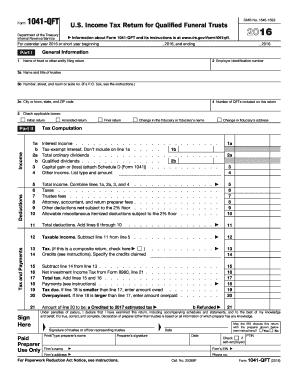
(loss) (attach Schedule D (Form 1041)) Other income. List type and amount May the IRS discuss this return with the preparer shown below (see instructions)? Yes No Date Date Check if self-employed Firm s name Firm s EIN Firm s address PTIN Phone no. For Paperwork Reduction Act Notice, see instructions. Cat. No. 25368F Form 1041-QFT (2016) Form 1041-QFT (2016) General Instructions Section references are to the Internal Revenue Code. Future Developments For the.
Open form follow the instructions
Easily sign the form with your finger
Send filled & signed form or save
How to fill out the IRS 1041-QFT online
Filing Form 1041-QFT is essential for trustees of qualified funeral trusts to report income, deductions, and tax liabilities. This guide provides straightforward, step-by-step instructions on completing this form online, ensuring clarity and support for all users, regardless of their legal experience.
Follow the steps to complete the IRS 1041-QFT online.
- Press the ‘Get Form’ button to access and open the IRS 1041-QFT document in your preferred editing tool.
- Fill in the general information in Part I, including the name of the trust, employer identification number (EIN), and the name and title of the trustee.
- Indicate the type of return you are filing by checking the appropriate boxes such as 'Initial return' or 'Final return.'
- In Part II, complete the Tax Computation section, beginning with total income reported from lines 1a through 4.
- Enter all applicable deductions, including trustee fees and other deductions not subject to the 2% floor, in the designated fields.
- Calculate the taxable income by subtracting the total deductions from the total income.
- Complete the tax section, including any applicable credits and the net investment income tax.
- In the Payments section, report any estimated tax payments made and determine if you owe any additional taxes.
- Review the completed form for accuracy and ensure all necessary signatures are included.
- You can now save your changes, download, print, or share the completed form as needed.
Complete your IRS 1041-QFT and other required documents online to ensure timely and accurate filing.
Experience a faster way to fill out and sign forms on the web. Access the most extensive library of templates available.
Related content
Feb 20, 2025 — The trustee of a trust that has elected to be taxed as a qualified...
A trustee may file a single, composite. Form 1041-QFT for some or all QFTs of which he or...
Feb 1, 2018 — Form 7004 is used to request an automatic extension of time to file...
Get answers to your most pressing questions about US Legal Forms API.
Who is required to file form 1041?
Form 1041 must be filed by estates and trusts that have earned income during the tax year. This includes any trusts using the IRS 1041-QFT for proper income tax reporting. If the estate or trust has gross income of $600 or more, or if a beneficiary is a non-resident alien, the filing is necessary. Be sure to seek guidance from a tax professional to determine your specific obligation.
What is the IRS form 1041 for dummies?
The IRS form 1041 serves as the income tax return for estates and trusts. For those unfamiliar with tax regulations, it can be beneficial to view it as a tool for reporting financial activities. The IRS 1041-QFT addresses unique circumstances for trusts, making it simpler to manage tax obligations efficiently. Using user-friendly platforms like US Legal Forms can also help clarify any uncertainties.
What is the IRS position on a deferred sales trust?
The IRS has specific guidelines regarding deferred sales trusts, which can impact how you utilize the IRS 1041-QFT. Essentially, these trusts allow for tax deferral on the sale of assets. However, the IRS scrutinizes these arrangements to prevent abuse, so it’s vital to structure them properly. Consulting a tax expert can help you navigate these regulations.
What is 1041 QFT?
The IRS 1041-QFT is a specific form designed for Qualified Funeral Trusts. This form allows individuals to manage funds set aside for funeral expenses without being taxed until they are used. It provides several benefits, including income and estate tax advantages. Understanding the details of the IRS 1041-QFT can enhance your financial planning.
What is a 1041 for dummies?
A 1041 is a tax form used to report income, deductions, and credits for estates and trusts. It's important for anyone managing a trust or estate to understand this form, especially with the IRS 1041-QFT provisions. While it can seem complex, breaking it down into sections can make it easier to manage. Consider resources from US Legal Forms to simplify the process.
Do I have to file a 1041 for an estate with no income?
Similar to a trust, if the estate has no income, you typically do not need to file a 1041. The IRS 1041-QFT caters to estates that generate income, so it's essential to evaluate your specific situation. However, always verify your state requirements and consult a tax advisor for clarity on your responsibilities.
Do I have to file a 1041 for a trust with no income?
Generally, you are not required to file a 1041 for a trust with no income. The IRS 1041-QFT form specifically addresses tax obligations when there is no income generated. However, it's crucial to check state laws, as some states may have different requirements. Always consult a tax professional to ensure compliance.
How do you elect a fiscal year for an estate?
To elect a fiscal year for an estate, you must indicate your choice on the IRS 1041-QFT when filing for the first time. The election must be made by the due date of the return for the year you wish to make the switch. Consulting a tax professional can ensure you follow the correct procedures.
How do I know if I need to file a 1041?
You need to file an IRS 1041-QFT if the estate has any gross income of $600 or more during the tax year, or if it is a non-resident alien estate. Keeping track of income and expenses will help determine the need for filing. Using platforms like US Legal Forms makes tracking and compliance simpler.
Who has to file a 1041 tax return?
Typically, the executor of an estate must file an IRS 1041-QFT tax return if the estate generates income, or if the gross income exceeds $600. Understanding who is responsible for this filing is crucial to comply with IRS regulations. Seeking assistance from a tax professional can provide clarity on individual cases.
Use professional pre-built templates to fill in and sign documents online faster. Get access to thousands of forms.
If you believe that this page should be taken down, please follow our DMCA take down process here.
This form is available in several versions. Select the version you need from the drop-down list below.