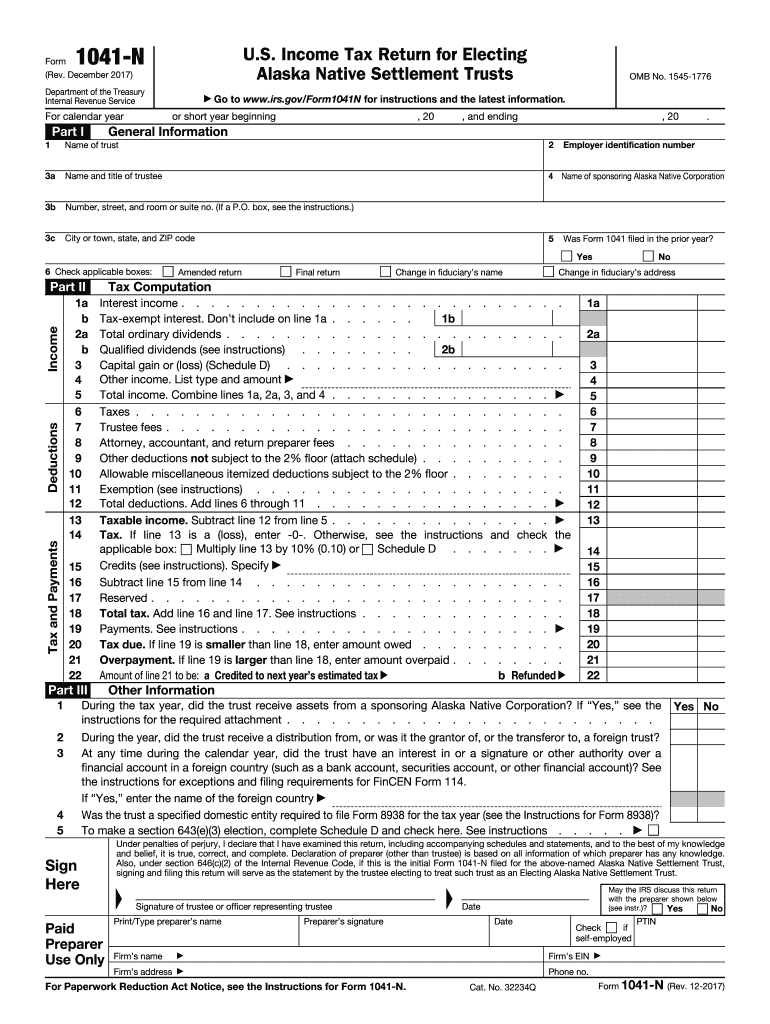
Www.irs.gov/Form1041N for instructions and the latest information. or short year beginning , 20 , and ending , 20 . General Information 1 Name of trust 2 3a Name and title of trustee 4 Name of sponsoring Alaska Native Corporation 3b Number, street, and room or suite no. (If a P.O. box, see the instructions.) 3c City or town, state, and ZIP code 5 Employer identification number Was Form 1041 filed in the prior year? Yes 6 Check applicable boxes: Tax and Payments Deductions.

Open form follow the instructions

Easily sign the form with your finger

Send filled & signed form or save
How to fill out the IRS 1041-N online
This guide provides clear, step-by-step instructions for filling out the IRS 1041-N form, designed for electing Alaska Native Settlement Trusts. By following these guidelines, users can efficiently complete the form online, ensuring compliance with the IRS requirements.
Follow the steps to complete the IRS 1041-N form online.
- Click ‘Get Form’ button to access the IRS 1041-N form and open it in the editor.
- Enter the name of the trust in the appropriate field, ensuring accuracy as this identifies the entity that will be filing.
- In the next section, provide the name and title of the trustee. This is important for the IRS to verify who is responsible for the trust’s filings.
- Input the name of the sponsoring Alaska Native Corporation. This links the trust to the appropriate corporation.
- Complete the address section with the street number, city, state, and ZIP code.
- Provide the employer identification number (EIN) associated with the trust, which is critical for tax identification purposes.
- Indicate whether Form 1041 was filed in the previous year by checking 'Yes' or 'No'. If applicable, check any relevant boxes regarding changes in fiduciary name or address.
- Proceed to Part II to input income details. Report interest income, dividends, capital gains or losses, and any other income the trust has received.
- List deductions such as trustee fees and any legal or accounting fees in the designated areas to accurately reflect the trust's expenses.
- Calculate the taxable income by subtracting total deductions from total income.
- Sum the taxes owed, check applicable credits, and calculate any overpayments or amounts due.
- Fill out Part III regarding any foreign financial interests or distributions received.
- Once all sections are completed, review the information for accuracy.
- Users can then save changes, download their completed form, or print it for their records.
Complete your IRS 1041-N form online today to ensure timely filing and compliance.
Experience a faster way to fill out and sign forms on the web. Access the most extensive library of templates available.
Related content
Jan 28, 2025 — This one-time election is made by filing Form 1041-N and the form is used...
This section applies to applications for an automatic extension of time to file an estate...
Feb 1, 2018 — An estate (other than a bankruptcy estate) and a trust filing Form 1041...
Get answers to your most pressing questions about US Legal Forms API.
Do I have to file a 1041 for an estate with no income?
If your estate has no income, you typically are not required to file the IRS form 1041. However, it is wise to evaluate the specific circumstances of your estate. Consulting uslegalforms can provide additional guidance and ensure you meet all legal obligations regarding estate management.
What IRS forms cannot be filed electronically?
Certain IRS forms, such as some 1040-denominated forms, cannot be filed electronically. It is crucial to review the IRS guidelines to identify which forms must be submitted via mail. Understanding these limitations helps taxpayers avoid delays and ensures compliance with IRS regulations.
What is the IRS form 1041 N?
The IRS form 1041-N is utilized for filing income tax returns for estates and trusts. This form serves as an essential tool for reporting income and distributions for the tax year. Understanding how to fill out the 1041-N correctly can help minimize any potential tax liabilities associated with trust management.
Can I file an estate tax return electronically?
You can file an estate tax return electronically if you meet certain criteria set by the IRS. It is important to check if your estate qualifies for e-filing and to use compatible software. Filing electronically can simplify the process and help you submit your forms promptly.
Can I file the IRS form 1041 electronically?
Yes, filing the IRS form 1041 electronically is permitted. The IRS encourages this method for its speed and accuracy. Utilizing online platforms or accounting software can help you complete the filing process with ease, taking the stress out of tax season.
How to close a trust with the IRS?
To close a trust with the IRS, you must first settle all assets and obligations. After that, file the IRS form 1041, indicating that it is the final return for the trust. By ensuring all income and distributions are reported correctly, you can effectively close a trust without future tax issues.
Can an IL 1041 be filed electronically?
Yes, Illinois allows filers to submit the IL 1041 electronically. E-filing makes it easier to manage your tax obligations and ensures timely submission. Be sure to use the appropriate software that supports IL 1041 e-filing to streamline your experience.
Can an IRS form 1041 be filed electronically?
Yes, you can file IRS form 1041 electronically. The IRS allows specific taxpayers to submit their returns through approved e-filing software. Using the e-filing option helps you expedite the process and ensures that your return is submitted accurately.
Do I need to file a 1041 with no income?
Filing a Form 1041 with no income depends on specific circumstances, such as whether there's an estate tax obligation or other financial activities. Generally, if the estate does not produce income, you may not need to file. Nevertheless, platforms like US Legal Forms provide clarity and assistance in navigating through such situations, ensuring you’re informed about IRS 1041-N requirements.
Do I have to file an estate tax return if no income?
If an estate does not generate income, filing an estate tax return is typically not required. However, certain thresholds might require you to file even in absence of income. It's wise to consult tax resources or professionals to assess your specific situation when dealing with IRS 1041-N.
Use professional pre-built templates to fill in and sign documents online faster. Get access to thousands of forms.
If you believe that this page should be taken down, please follow our DMCA take down process here.
This form is available in several versions. Select the version you need from the drop-down list below.