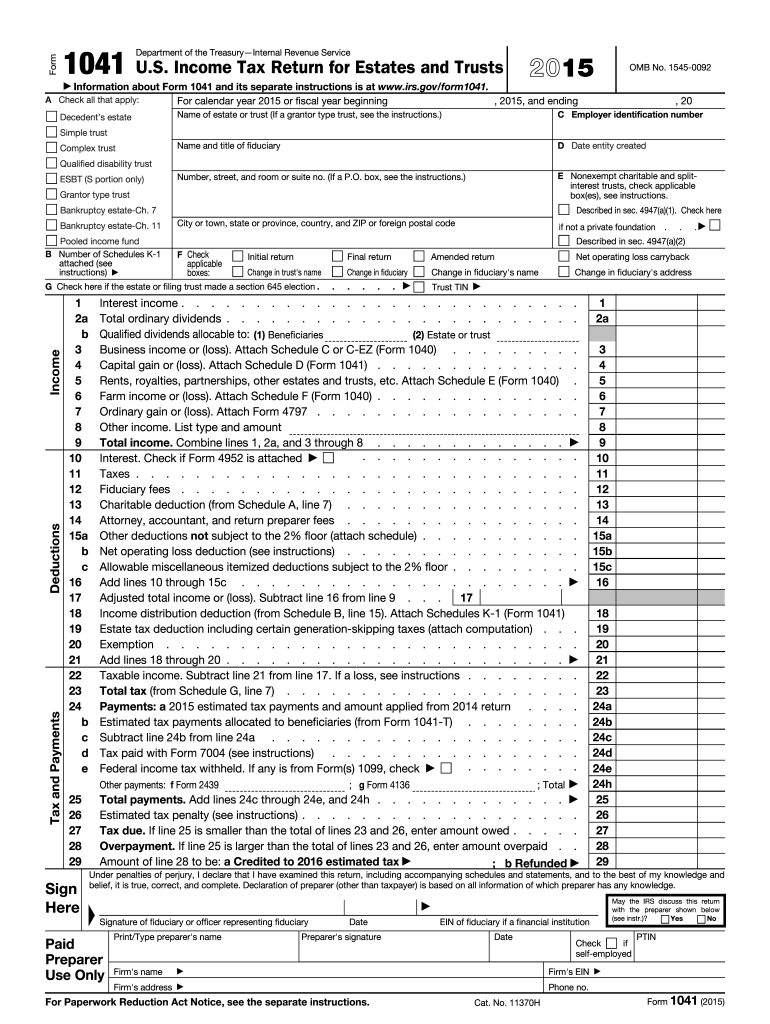
. . . . . . . . . . . . . . . . . Interest. Check if Form 4952 is attached Taxes . . . . . . . . . . . . . . . . . . . . . . . . . . . . . Fiduciary fees . . . . . . . . . . . . . . . . . . . . . . . . . . Charitable deduction (from Schedule A, line 7) . . . . . . . . . . . . . . . Attorney, accountant, and return preparer fees . . . . . . . . . . . . . . . Other deductions not subject to the 2% floor (attach schedule) . . . . . . . . . . Net operating loss deduction (see instructions) .

Open form follow the instructions

Easily sign the form with your finger

Send filled & signed form or save
How to fill out the IRS 1041 online
Filling out the IRS 1041 form for estates and trusts can seem daunting, but with a clear guide, you can navigate the process with confidence. This guide will provide step-by-step instructions to help you accurately complete the form online.
Follow the steps to complete the IRS 1041 form effectively.
- Click ‘Get Form’ button to obtain the IRS 1041 form and open it in your preferred editor.
- Enter the calendar year or fiscal year for which the return is being filed. Ensure that the decedent's estate or trust name is correctly filled out along with the employer identification number (EIN).
- Indicate the type of trust or estate by checking all applicable boxes, such as 'simple trust', 'complex trust', or 'nonexempt charitable trust'.
- Complete the fiduciary section by providing the name and title of the fiduciary, along with the creation date of the entity.
- Fill in the address details, including the street number, city or town, state, country, and ZIP code. Use appropriate details as required.
- Proceed to the income section by entering various types of income as detailed in the form, including interest income, business income, and capital gains. Ensure you attach necessary schedules if applicable.
- Complete the deductions section where you will identify allowable deductions including fiduciary fees and charitable contributions. Enter the total deductions clearly.
- Calculate the taxable income by subtracting deductions from the total income. Ensure accuracy in these calculations to reflect the correct taxable amount.
- Review the payments section and record any estimated tax payments, tax withheld, or payments made with the extension request if applicable.
- Carefully read and complete the signature area. Ensure that the fiduciary or authorized officer signs and dates the form to certify its truthfulness.
- Once finalized, you can save your changes, download or print the form, or opt to share it as needed.
Start filling out your IRS 1041 form online today to ensure timely and accurate submission.
Experience a faster way to fill out and sign forms on the web. Access the most extensive library of templates available.
Related content
Feb 19, 2025 — Use Schedule D (Form 1041) to report gains and losses from the sale or...
26 U.S. Code § 1041 - Transfers of property between spouses or incident to divorce ; (a)...
Jan 4, 2017 — Otherwise, include the amount from line 7 in the total on Form 1040, line...
Get answers to your most pressing questions about US Legal Forms API.
How do I know if I need to file a 1041?
To determine if you need to file a 1041, assess whether the estate or trust had any taxable income or if it meets specific thresholds set by the IRS. If in doubt, consider consulting a tax professional or using resources like US Legal Forms, which can provide clarity on the filing requirements for your IRS 1041.
Who must file a 1041 form?
A 1041 form must be filed by estates and trusts that have earned income during the tax year. This includes cases where the gross income is $600 or more, or if there are any beneficiaries who are non-resident aliens. Seeking assistance from US Legal Forms can help clarify your obligation to file IRS 1041, tailored to your specific situation.
Can I use TurboTax to file form 1041?
Yes, TurboTax offers the capability to file Form 1041 electronically, making it easier for you to manage your tax responsibilities. The software provides step-by-step guidance to ensure accuracy in reporting income and deductions. By using TurboTax for your IRS 1041 filing, you can take advantage of its features to streamline the process.
Can I file IRS Form 1041 electronically?
Yes, you can file IRS Form 1041 electronically if you use software that supports this functionality. Electronic filing usually leads to fewer errors and quicker processing times. US Legal Forms can guide you through the electronic filing process, ensuring that your IRS 1041 is submitted accurately and on time.
Can an IL 1041 be filed electronically?
Yes, the IL 1041 can be filed electronically, as long as you have the proper software that accommodates electronic submissions. This convenience allows for quicker processing and faster refunds. Be sure to check that your filing software supports IRS 1041 and other related forms to ensure a smooth experience.
Can form 1041-A be filed electronically?
Unfortunately, Form 1041-A cannot be filed electronically. This form serves as a short form for trusts that meet specific criteria, but it still requires paper submission. To ensure accuracy and compliance, consider utilizing the resources provided by US Legal Forms when preparing your IRS 1041 forms.
What IRS forms cannot be filed electronically?
Certain IRS forms cannot be filed electronically, including some traditional paper forms and specific types of amendments. However, many taxpayers prefer electronic filing for its convenience and speed. It's crucial to check the IRS website for the most current information regarding electronic filing limitations for forms related to IRS 1041.
Who prepares Form 1041?
Form 1041 is usually prepared by the fiduciary of the estate or trust, which can include an executor, administrator, or trustee. They must ensure the form accurately reflects income, deductions, and distributions for the tax year. If you need assistance, US Legal Forms offers resources and templates to streamline this process and simplify filing your IRS 1041.
What is the IRS Rule 1041?
The IRS Rule 1041 governs the filing requirements for income tax returns for estates and trusts. This rule outlines who must file, what income is reportable, and deadlines for submission. Understanding IRS Rule 1041 is vital for fiduciaries managing estates and trusts.
Who must file an IRS form 1041?
Any estate or trust that generates income must file the IRS form 1041. If the estate or trust has gross income of $600 or more during the tax year, the filing is mandatory. Staying informed about these requirements is crucial for fiduciaries.
Use professional pre-built templates to fill in and sign documents online faster. Get access to thousands of forms.
If you believe that this page should be taken down, please follow our DMCA take down process here.
This form is available in several versions. Select the version you need from the drop-down list below.