Loading
Form preview
  • US Legal Forms
  • Form Library
  • Tax Forms
  • Executive Department Treasury IRS Forms
  • Irs 1041 2016

Get Irs 1041 2016

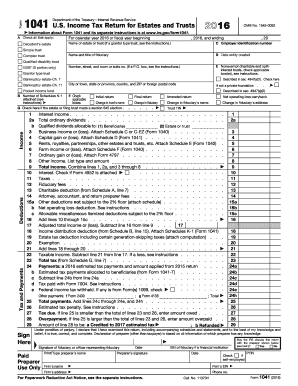
. . . . . . . . . . . . . . . . . . . . . Interest. Check if Form 4952 is attached Taxes . . . . . . . . . . . . . . . . . . . . . . . . . . . . . Fiduciary fees . . . . . . . . . . . . . . . . . . . . . . . . . . Charitable deduction (from Schedule A, line 7) . . . . . . . . . . . . . . . Attorney, accountant, and return preparer fees . . . . . . . . . . . . . . . Other deductions not subject to the 2% floor (attach schedule) . . . . . . . . . . Net operating loss deduction. See instructi.

This website is not affiliated with IRS

How it works

  1. Open form

    Open form follow the instructions

  2. Easily sign form

    Easily sign the form with your finger

  3. Share form

    Send filled & signed form or save

How to fill out the IRS 1041 online

Filing the IRS 1041 form, also known as the U.S. Income Tax Return for Estates and Trusts, can be a crucial task for fiduciaries managing the financial matters of estates or trusts. This guide provides clear and step-by-step instructions to assist you in completing the form online.

Follow the steps to fill out the IRS 1041 accurately and efficiently.

  1. Click ‘Get Form’ button to obtain the form and open it in the editor.
  2. Begin by providing the name of the estate or trust, and the employer identification number. Select the type of entity by checking the appropriate boxes for decedent’s estate or other qualifications.
  3. Fill in the fiduciary's name and title, along with the date the entity was created and the address information, ensuring to include city, state, and ZIP code.
  4. Indicate the applicable boxes for the type of trust (e.g., simple trust, complex trust, etc.) and specify if there are any Schedules K-1 attached.
  5. Select whether this is an initial, final, or amended return and provide any changes to the fiduciary's name or address, if applicable.
  6. Move to the income section and enter the necessary amounts, including interest, dividends, and any business income. Make sure to follow the provided line instructions carefully.
  7. Input the deductions in the designated section, including fiduciary fees, charitable deductions, and any other applicable costs.
  8. Calculate the taxable income and total tax owed by completing the tax computation fields as instructed.
  9. Complete the payment section by listing any estimated taxes, withholdings, and payments made, resulting in a final amount due or overpayment.
  10. Once you have accurately filled out all sections, review the form for any errors or omissions before proceeding to submit.
  11. Save any completed changes, and choose to download, print, or share the form as needed for your records.

Start filling out your IRS 1041 form online today for timely and correct submission.

Get form

Experience a faster way to fill out and sign forms on the web. Access the most extensive library of templates available.

Related content

About Form 1041, U.S. Income Tax Return for...
Feb 19, 2025 — Use Schedule D (Form 1041) to report gains and losses from the sale or...
Learn more
26 U.S. Code § 1041 - Transfers of property...
26 U.S. Code § 1041 - Transfers of property between spouses or incident to divorce ; (a)...
Learn more
2016 Publication 575
Jan 4, 2017 — Otherwise, include the amount from line 7 in the total on Form 1040, line...
Learn more

Related links form

IRS 5329 2013 IRS 5329 2010 IRS 5329 2008 IRS 5330 2013

Questions & Answers

Get answers to your most pressing questions about US Legal Forms API.

Contact support

To calculate tax due on Form 1041, begin by determining the net income of the estate or trust. Next, apply the relevant tax rates to this income, factoring in any allowable deductions or credits. This calculation will yield the tax liability you must report. U.S. Legal Forms provides tools and guidance to assist in accurate calculations.

The tax rate on IRS 1041 varies based on the trust or estate's taxable income, following the graduated rates similar to individual tax brackets. Generally, the rates can range from 10% to 37%. As income increases, higher rates apply, making it essential to calculate income accurately. Resources from U.S. Legal Forms can assist in navigating this complex tax structure.

Calculating tentative tax on the estate tax base requires you to determine the gross estate's value and apply the appropriate estate tax rates. You will subtract any allowable deductions to arrive at the taxable estate. This amount is then subject to estate tax calculations, potentially reported on IRS 1041. Accurate assessment of estate value is critical for this process.

To determine your total tax due, you need to sum all taxable income amounts and apply the corresponding tax brackets defined by the IRS. After calculating your total tax, subtract any credits or deductions you qualify for. The result is your total tax liability, which you report using IRS 1041. Understanding this calculation helps ensure accurate reporting.

Calculating tax on trust income involves assessing the total income earned by the trust and applying the appropriate tax rates. You should identify income sources such as interest, dividends, and rental income, then subtract deductible expenses. The remaining amount represents the taxable income, which you report on IRS 1041. Accurate calculations are crucial to avoid penalties.

To file the IRS 1041 form, you need to report income generated by the estate or trust during the tax year. This includes interest, dividends, rental income, and gains from the sale of assets. If the estate or trust has gross income of $600 or more, a return is generally required. It's essential to keep accurate records to ensure compliance.

IRS Rule 1041 refers to the regulations outlining the filing requirements and procedures for IRS form 1041. This means you need to understand what types of income need to be reported, deadlines for filing, and any applicable deductions. Staying informed about IRS Rule 1041 helps ensure compliance and effective management of estate or trust finances.

The executor of an estate or the trustee of a trust is responsible for filing an IRS form 1041. This applies if the estate or trust generates income exceeding the IRS threshold. Understanding your responsibilities is crucial, as failing to file can lead to serious tax issues.

If you are managing an estate or trust in Illinois, you are typically required to file IL 1041 if the estate or trust produces income. This form is the state's version of the IRS 1041. It's important to stay compliant with both federal and state tax regulations to avoid penalties.

The IRS form 1041 is used to report income, gains, losses, deductions, and credits of an estate or trust. Essentially, it helps the IRS track the financial activity of estates and trusts, ensuring compliance with tax laws. By using IRS 1041, executors or trustees can accurately file tax returns on behalf of the estate or trust.

Get This Form Now!

Use professional pre-built templates to fill in and sign documents online faster. Get access to thousands of forms.
If you believe that this page should be taken down, please follow our DMCA take down processhere.
Get IRS 1041
  • Adoption
  • Bankruptcy
  • Contractors
  • Divorce
  • Home Sales
  • Employment
  • Identity Theft
  • Incorporation
  • Landlord Tenant
  • Living Trust
  • Name Change
  • Personal Planning
  • Small Business
  • Wills & Estates
  • Packages A-Z
  • Affidavits
  • Bankruptcy
  • Bill of Sale
  • Corporate - LLC
  • Divorce
  • Employment
  • Identity Theft
  • Internet Technology
  • Landlord Tenant
  • Living Wills
  • Name Change
  • Power of Attorney
  • Real Estate
  • Small Estates
  • Wills
  • All Forms
  • Forms A-Z
  • Form Library
  • Legal Hub
  • About Us
  • Help Portal
  • Legal Resources
  • Blog
  • Affiliates
  • Contact Us
  • Delete My Account
  • Site Map
  • Industries
  • Forms in Spanish
  • Localized Forms
  • State-specific Forms
  • Forms Kit
  • Real Estate Handbook
  • All Guides
  • Notarize
  • Incorporation services
  • For Consumers
  • For Small Business
  • For Attorneys
  • USLegal
  • FormsPass
  • pdfFiller
  • signNow
  • altaFlow
  • DocHub
  • Instapage
Form Packages
  • Adoption
  • Bankruptcy
  • Contractors
  • Divorce
  • Home Sales
  • Employment
  • Identity Theft
  • Incorporation
  • Landlord Tenant
  • Living Trust
  • Name Change
  • Personal Planning
  • Small Business
  • Wills & Estates
  • Packages A-Z
Form Categories
  • Affidavits
  • Bankruptcy
  • Bill of Sale
  • Corporate - LLC
  • Divorce
  • Employment
  • Identity Theft
  • Internet Technology
  • Landlord Tenant
  • Living Wills
  • Name Change
  • Power of Attorney
  • Real Estate
  • Small Estates
  • Wills
  • All Forms
  • Forms A-Z
  • Form Library
Customer Service
  • Legal Hub
  • About Us
  • Help Portal
  • Legal Resources
  • Blog
  • Affiliates
  • Contact Us
  • Delete My Account
  • Site Map
  • Industries
  • Forms in Spanish
  • Localized Forms
  • State-specific Forms
  • Forms Kit
Legal Guides
  • Real Estate Handbook
  • All Guides
Prepared for you
  • Notarize
  • Incorporation services
Our Customers
  • For Consumers
  • For Small Business
  • For Attorneys
Our Sites
  • USLegal
  • FormsPass
  • pdfFiller
  • signNow
  • altaFlow
  • DocHub
  • Instapage
Social Media
Call us now toll free:
+1 833 426 79 33
As seen in:
© Copyright 1999-2026 airSlate Legal Forms, Inc. 3720 Flowood Dr, Flowood, Mississippi 39232
  • Your Privacy Choices
  • Terms of Service
  • Privacy Notice
  • Content Takedown Policy
  • Bug Bounty Program
IRS 1041
This form is available in several versions.
Select the version you need from the drop-down list below.
2020 IRS 1041
Select form
  • 2020 IRS 1041
  • 2019 IRS 1041
  • 2018 IRS 1041
  • 2017 IRS 1041
  • 2016 IRS 1041
  • 2015 IRS 1041
  • 2014 IRS 1041
  • 2013 IRS 1041
  • 2012 IRS 1041
  • 2011 IRS 1041
  • 2010 IRS 1041
  • 1996 IRS 1041
Select form