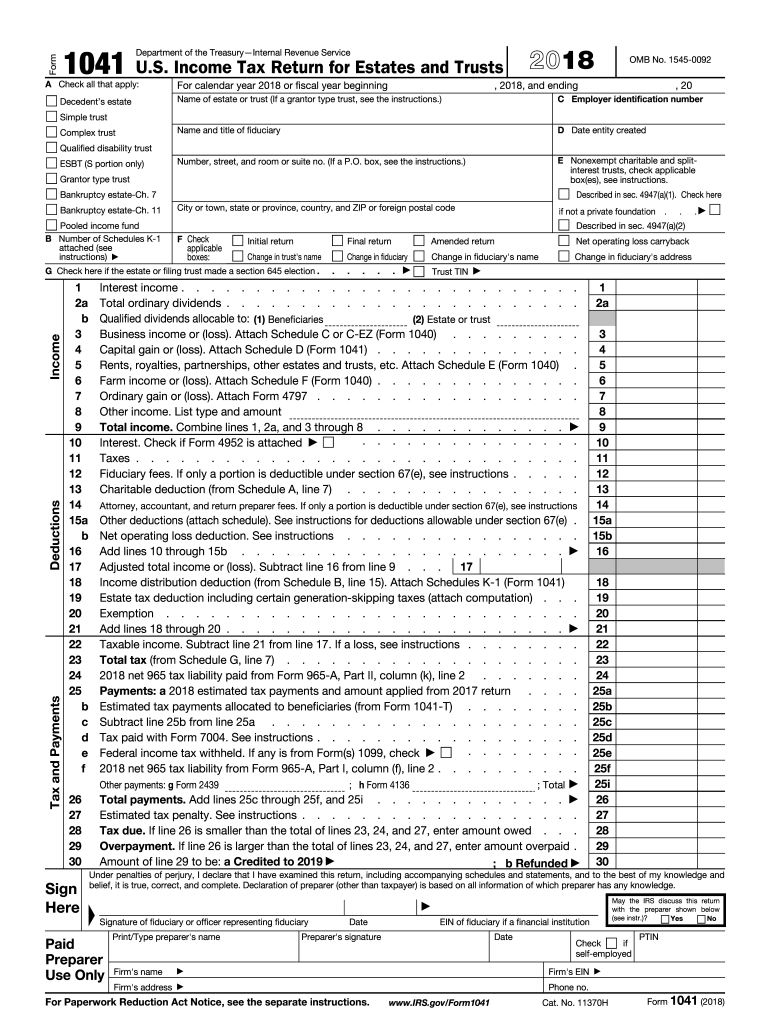
Than the total of lines 23, 24, and 27, enter amount owed . . . Overpayment. If line 26 is larger than the total of lines 23, 24, and 27, enter amount overpaid . Amount of line 29 to be: a Credited to 2019 ; b Refunded . 18 19 20 21 22 23 24 25a 25b 25c 25d 25e 25f 25i 26 27 28 29 30 Under penalties of perjury, I declare that I have examined this return, including accompanying schedules and statements, and to the best of my knowledge and belief, it is true, correct, and complete.

Open form follow the instructions

Easily sign the form with your finger

Send filled & signed form or save
How to fill out the IRS 1041 online
Filling out the IRS 1041 is essential for reporting income, deductions, and tax obligations for estates and trusts. This guide offers clear, step-by-step instructions to help users with varying levels of experience navigate the form easily and accurately.
Follow the steps to complete the IRS 1041 form online.
- Click ‘Get Form’ button to access the IRS 1041 form and open it in the editor.
- Complete the top section by providing information about the decedent's estate or the trust, including the name, employer identification number (EIN), and the date the entity was created.
- Indicate the type of trust or estate by checking the applicable boxes, such as Simple trust, Complex trust, or Grantor type trust.
- Fill in the details of the fiduciary, including their name and title, along with the address information.
- Report the gross income by detailing various income sources, including interest income and business income. Make sure to follow the specific lines and instructions for each type of income.
- Detail necessary deductions, such as fiduciary fees and other allowable deductions. Ensure to attach any required schedules for complete reporting.
- Calculate the taxable income by subtracting total deductions from the adjusted total income. Follow the instructions carefully to ensure accuracy.
- Determine the total tax owed by following the tax computation instructions. Include any payments made and credits applicable.
- Complete the signature section, ensuring that the fiduciary or representative has reviewed the form and signed it.
- Save changes, download a copy of the completed form, and print or share it as needed for submission.
Take the next step and complete your IRS 1041 form online today.
Experience a faster way to fill out and sign forms on the web. Access the most extensive library of templates available.
Related content
Feb 19, 2025 — Use Schedule D (Form 1041) to report gains and losses from the sale or...
26 U.S. Code § 1041 - Transfers of property between spouses or incident to divorce ; (a)...
Jan 4, 2017 — Otherwise, include the amount from line 7 in the total on Form 1040, line...
Get answers to your most pressing questions about US Legal Forms API.
Who must file IL 1041?
The IL 1041 is the Illinois version of the IRS 1041 and must be filed by estates and trusts that earn income in Illinois. Similar to the federal requirement, if the estate or trust generates income above the set limit, filing is necessary. It is vital to recognize state-specific obligations as well. For assistance, UsLegalForms can help streamline the filing process and ensure accuracy.
Who must file an IRS form 1041?
Anyone managing an estate or trust that earns taxable income must file an IRS form 1041. This includes executors, administrators, or trustees responsible for overseeing the estate. Meeting this requirement is essential to comply with federal tax laws. If you're unsure about your responsibilities, consider utilizing resources from UsLegalForms for further guidance.
What is the IRS form 1041 for?
The IRS Form 1041 is for reporting the income, deductions, and tax liability of estates and trusts. This form ensures that the IRS receives accurate information about the income earned by these entities. It serves to maintain transparency in financial reporting and tax obligations. By using UsLegalForms, you can easily access tools to help you complete this form correctly.
Who must file a 1041 tax return?
You must file an IRS 1041 tax return if you manage an estate or trust that has generated taxable income. This includes income exceeding the threshold limits set by the IRS. Moreover, if the estate or trust has more than one beneficiary, you also need to file. It is crucial to stay informed about these obligations to avoid penalties.
How do I know if I need to file a 1041?
You need to file an IRS 1041 if you are the personal representative of an estate or a trust that has generated income. If the estate or trust earned over a certain threshold, typically $600, you must file. Additionally, if you are a beneficiary and received income from the estate or trust, filing may be necessary. To determine your specific requirement, consider consulting a tax professional or using resources like UsLegalForms.
Who must file the IRS form 1041?
Anyone managing an estate or trust that generates income must file the IRS form 1041. This applies to executors, administrators, and trustees who oversee the estate or trust. Understanding this requirement is essential for accurate tax reporting.
Can an IRS form 1041 be filed electronically?
Yes, you can file an IRS 1041 electronically through various tax software programs. Doing so can simplify the filing process, save time, and help you ensure accuracy. If you need assistance, platforms like UsLegalForms offer resources and instructions for electronic filing.
What is the minimum income for Form 1041?
Generally, you must file an IRS 1041 if the estate or trust has gross income of $600 or more during the tax year. If the estate has a beneficiary who is a non-resident alien, you might need to file the form regardless of income. Keeping track of your estate's income will help you determine your filing obligations.
Who is required to file a 1041?
Individuals responsible for managing an estate or trust must file an IRS 1041 if the estate or trust generates income. This includes executors, personal representatives, and trustees. Ensuring you file correctly helps protect you and the estate from potential penalties.
What is the IRS form 1041 for dummies?
The IRS form 1041 is a tax return used for estates and trusts. Simply put, it helps report any income generated by an estate or trust. If you are handling an estate or trust, understanding the basics of IRS 1041 can help ensure you stay compliant with tax regulations.
Use professional pre-built templates to fill in and sign documents online faster. Get access to thousands of forms.
If you believe that this page should be taken down, please follow our DMCA take down process here.
This form is available in several versions. Select the version you need from the drop-down list below.