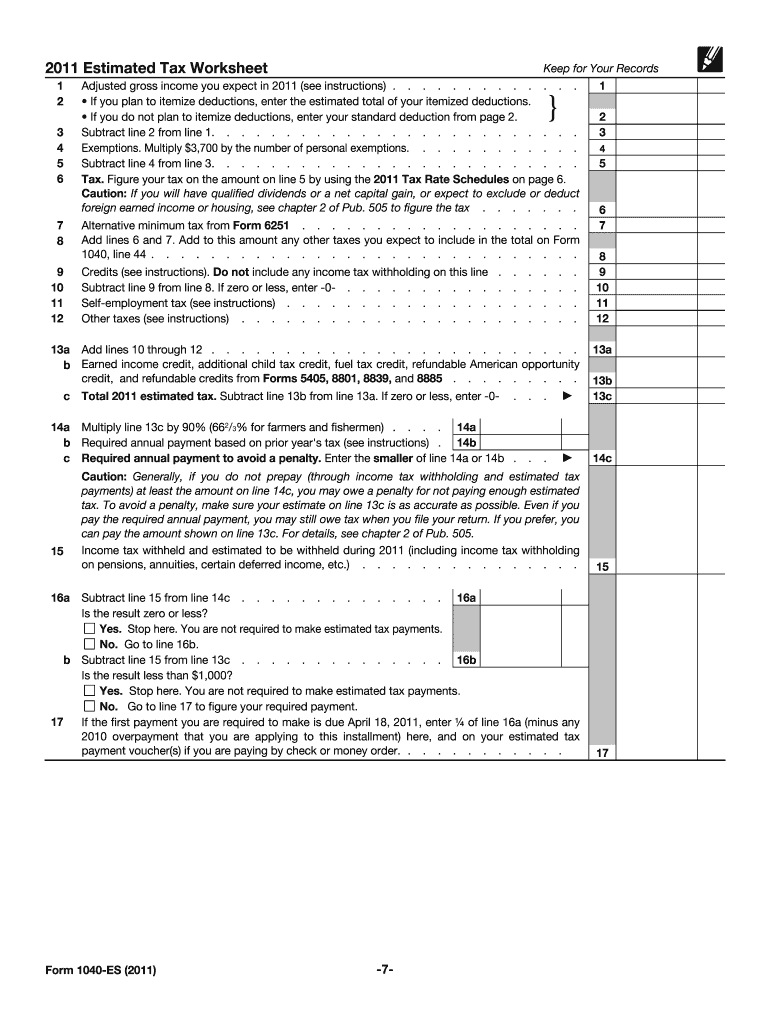
Igure and pay your estimated tax. If you are not required to make estimated tax payments for 2011, you can discard this package. Estimated tax is the method used to pay tax on income that is not subject to withholding (for example, earnings from self-employment, interest, dividends, rents, alimony, etc.). In addition, if you do not elect voluntary withholding, you should make estimated tax payments on other taxable income, such as unemployment compensation and the taxable part of your social sec.

Open form follow the instructions

Easily sign the form with your finger

Send filled & signed form or save
How to fill out the IRS 1040-ES online
The IRS 1040-ES form is used by individuals to estimate and pay their tax owed on income not subject to withholding. This guide provides step-by-step instructions on how to fill out the form online, ensuring you have all the information needed to comply with IRS requirements.
Follow the steps to fill out the IRS 1040-ES accurately.
- Click ‘Get Form’ button to obtain the form and open it in the editor.
- Enter your name and social security number in the designated fields at the top of the form.
- Fill out your expected adjusted gross income for the year. Utilize your last tax return as a reference for accuracy.
- Calculate your expected deductions. If planning to itemize, list all applicable itemized deductions; if not, enter the standard deduction applicable to your filing status.
- Subtract the deductions from your adjusted gross income to derive your taxable income.
- Using the IRS tax rate schedules, determine your estimated tax based on your taxable income.
- Account for any credits you may qualify for, and subtract those from your estimated tax to find your total estimated tax due.
- Divide your total estimated tax by the number of payments you intend to make throughout the year to find the amount due for each payment period.
- If applicable, decide how to apply any overpayments from the previous year towards this year's estimated tax.
- Review all entries for accuracy, then you can save changes, download, print, or share the completed form as required.
Complete your IRS 1040-ES form online today to ensure your estimated tax payments are filed accurately and on time.
Experience a faster way to fill out and sign forms on the web. Access the most extensive library of templates available.
Related content
May 15, 2025 — Use Form 1040-ES to figure and pay your estimated tax. Estimated tax is...
Use Form 1040-ES to figure and pay your estimated tax for 2025. Estimated tax is the...
Mar 1, 2017 — Form 1040 or Form 1040A instructions. If you did not pay estimated tax...
Get answers to your most pressing questions about US Legal Forms API.
How do I file taxes if I am self-employed?
Filing taxes as a self-employed person involves completing the IRS 1040-ES form to calculate your estimated taxes. You'll need to report your total income from self-employment and any applicable deductions. After calculating your liability, file your return by the due date, including any invoices or documentation required. Using a reliable platform, like US Legal Forms, can streamline this process.
Can you get a tax refund if you're self-employed?
Yes, you can receive a tax refund as a self-employed individual. If you've overpaid your estimated taxes through the IRS 1040-ES, filing your tax return can result in a refund. Ensure that you accurately report all income and deductions to calculate your tax liability correctly. Utilizing software or services like US Legal Forms can help simplify this process.
How to file self-employment taxes step by step?
To file self-employment taxes using the IRS 1040-ES, start by gathering your income records and expenses. Next, calculate your net income to determine your estimated tax. Fill out Form 1040-ES, where you will report your estimated tax payments. Finally, submit your payment online or via mail to keep your tax obligations up to date.
Does Schedule E have self-employment tax?
No, Schedule E does not include self-employment tax. This schedule is used primarily for reporting income from rental properties and passive activities. If you are self-employed, you will need to use Schedule C and Schedule SE. This distinction is crucial for proper tax reporting and payment.
Does estimated tax include self-employment tax?
Yes, estimated tax payments do include self-employment tax. When filing your IRS 1040-ES, it’s essential to factor in both your income tax and self-employment tax. This ensures you’re making the correct estimated payments throughout the year. Proper calculations can help you avoid underpayment penalties.
Where does self-employment tax go on a 1040?
On the IRS 1040, self-employment tax is reported on Schedule SE. You will complete this schedule to determine the amount you owe for self-employment tax. Once calculated, the total is transferred to your IRS 1040. This ensures that all your tax obligations are accurately reported.
Is self-employment tax added to income tax?
Yes, self-employment tax is indeed added to your income tax. When you calculate your total tax liability, you must include both your regular income tax and self-employment tax. The IRS 1040-ES helps you estimate these combined taxes effectively. By preparing these estimates accurately, you can avoid potential penalties at tax time.
What is a 1040-ES tax return?
The IRS 1040-ES is a form used for making estimated tax payments throughout the year. It is not a complete tax return but rather a tool designed to facilitate the payment of income taxes as they are incurred. Using this form can help you avoid penalties and stay compliant with your tax obligations.
Who should file a 1040-ES tax form?
Anyone who expects to owe taxes of $1,000 or more when filing their return may need to file a 1040-ES. This includes self-employed individuals, freelancers, and those with rental income. If you fall into these categories, utilizing the IRS 1040-ES form can streamline your payment process and keep you on track with your tax responsibilities.
Why did I receive a Form 1040-ES?
Receiving a Form 1040-ES means the IRS believes you may need to make estimated tax payments. This typically occurs when your income is not fully covered by withholding, such as income from self-employment or interest. It’s a proactive step by the IRS to help you manage your tax obligations effectively.
Use professional pre-built templates to fill in and sign documents online faster. Get access to thousands of forms.
If you believe that this page should be taken down, please follow our DMCA take down process here.
This form is available in several versions. Select the version you need from the drop-down list below.