No. 25513Y Schedule J (Form 1040) 2017 Page 2 Schedule J (Form 1040) 2017 18 Amount from line 17 . 19 If you used Schedule J to figure your tax for: 2016, enter the amount from your 2016 Schedule J, line 12. 2015 but not 2016, enter the amount from your 2015 Schedule J, line 16. 2014 but not 2015 or 2016, enter the amount from your 2014 Schedule J, line 4. Otherwise, enter the tax from your 2014 Form 1040, line 44;* Form 1040A, line 28;* Form 1040EZ, line 10; Form 1040NR, li.
Open form follow the instructions
Easily sign the form with your finger
Send filled & signed form or save
How to fill out the IRS 1040 Schedule J online
Filling out the IRS 1040 Schedule J can seem daunting, especially if you are unsure of what information is required. This guide will provide clear, step-by-step instructions to help you complete this form accurately online.
Follow the steps to complete your IRS 1040 Schedule J.
- Click ‘Get Form’ button to obtain the form and open it for editing.
- Enter your Social Security number (SSN) and the name(s) as they appear on your tax return.
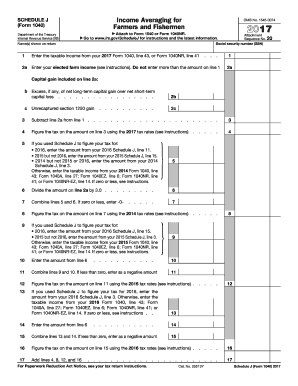
- In line 1, input the taxable income from your 2017 Form 1040, specifically line 43, or from Form 1040NR, line 41.
- For line 2a, report your elected farm income. Ensure that you do not exceed the amount on line 1.
- If applicable, complete line 2b by entering any capital gain included in line 2a.
- Subtract line 2a from line 1 to find the total on line 3.
- Using the 2017 tax rates, calculate the tax for the amount on line 3 and enter it on line 4.
- If you used Schedule J in prior years, complete line 5 by entering the respective amounts from previous years’ Schedule J, otherwise input the taxable income from your 2014 Form 1040.
- In line 6, divide the amount on line 2a by 3.0.
- Combine the values from lines 5 and 6, entering this amount on line 7.
- Calculate the tax using the previous year’s tax rates based on the amount from line 7, as indicated in line 8.
- Repeat the above steps for the tax years 2015 and 2016, as necessary, inputting the values on the corresponding lines.
- In line 17, sum the amounts from lines 4, 8, 12, and 16.
- Consult the previous lines to complete lines 19 through 21 based on your previous year's Schedule J or from the appropriate year's Form 1040.
- Finally, subtract line 22 from line 18 to calculate your total tax, which you will also need to report on Form 1040.
- Once all entries are complete, save your changes, download, print, or share your finished form as needed.
Start filling out your IRS 1040 Schedule J online today for a smoother tax filing experience.
Experience a faster way to fill out and sign forms on the web. Access the most extensive library of templates available.
Related content
Apr 29, 2025 — Use Schedule J (Form 1040) to elect to figure your income tax by...
Sep 11, 2024 — The income which is eligible for averaging includes crop and livestock...
Apr 15, 2015 — Schedule J (Form 1040). If you had income from farming or fishing...
Get answers to your most pressing questions about US Legal Forms API.
What is the Schedule J on the 1040?
The Schedule J on the IRS 1040 form is a tool specifically designed for income averaging for certain agricultural and fishing custodians. This schedule allows individuals in these fields to break down their income over multiple years, providing potential tax relief during profitable years. By understanding the Schedule J, taxpayers can better navigate their finances and tax obligations. For tailored guidance, check out the US Legal Forms platform, which offers forms and resources to help simplify this process.
Who files Schedule J?
Schedule J is typically filed by farmers and fishermen who have income fluctuations throughout the year. These individuals can take advantage of this scheduling to achieve a fairer taxation based on their actual earnings. If you operate in these sectors, using the IRS 1040 Schedule J can significantly impact how you report your income. Always consider consulting a tax professional to ensure compliance and maximize your benefits.
What is the schedule J related to?
The IRS 1040 Schedule J relates to income averaging for farmers and fishermen. This schedule allows them to spread out their income over several years, which can lead to potential tax benefits during high-earning years. By using Schedule J, taxpayers can potentially lower their overall tax burden, making it a valuable tool for those in these industries. Remember, careful calculations and considerations are crucial for maximizing its benefits.
What does j mean in taxes?
In the context of taxes, the letter 'J' typically refers to the special treatment of certain income on the IRS 1040 Schedule J. This can include references to how farmers and fishermen can average their income over multiple years. This averaging helps to minimize tax liabilities in years of high earnings. Understanding this can aid taxpayers in making informed decisions throughout the filing process.
What is Box 12 code J on 1040?
Box 12 code J on the IRS 1040 Schedule J indicates that the taxpayer has received a special salary. This code specifically tracks payments received for services rendered during the tax year. Understanding this box is essential for determining how much tax you owe or what benefits you might be eligible for. Therefore, review your tax forms carefully to ensure accurate reporting.
What is the easiest way to fill out a tax return?
The easiest way to fill out a tax return is by using a reliable online tax platform, like uslegalforms. This platform simplifies the process with intuitive forms and clear guidance. By utilizing resources like IRS 1040 Schedule J, you can accurately submit your return and minimize the stress of tax season.
How to calculate deductible portion of self-employment tax?
To calculate the deductible portion of your self-employment tax, you first need to determine your total self-employment income and the corresponding tax amount. You can then deduct half of the self-employment tax on your IRS 1040 Schedule J, which reflects your contribution to Social Security and Medicare. This deduction can effectively lower your total taxable income.
Why is schedule J so important?
Schedule J is important because it provides a tax averaging method that can help taxpayers reduce their overall tax burden, especially during profitable years. It allows qualifying individuals to smooth out income and tax liabilities over multiple years. For those in farming or fishing, accurately using IRS 1040 Schedule J can lead to significant tax savings.
What is Schedule J on tax return?
Schedule J is a form used by farmers and fishermen to average their annual income to reduce tax liability. By spreading income over three years, Schedule J can lower taxes during years of high income. It's essential to understand how including this form affects your overall IRS 1040 Schedule J process.
How is Schedule J tax calculated?
Schedule J is specifically designed to help farmers and fishermen average their income over a period of years. To calculate your tax using Schedule J, you’ll need to report your income for the current and prior tax years, and then determine your average income. This averaging can lead to lower tax liabilities, making it beneficial for users of the IRS 1040 Schedule J.
Use professional pre-built templates to fill in and sign documents online faster. Get access to thousands of forms.
If you believe that this page should be taken down, please follow our DMCA take down process here.
This form is available in several versions. Select the version you need from the drop-down list below.