No. 25513Y Schedule J (Form 1040) 2018 Page 2 Schedule J (Form 1040) 2018 18 Amount from line 17 . 19 If you used Schedule J to figure your tax for: 2017, enter the amount from your 2017 Schedule J, line 12. 2016 but not 2017, enter the amount from your 2016 Schedule J, line 16. 2015 but not 2016 or 2017, enter the amount from your 2015 Schedule J, line 4. Otherwise, enter the tax from your 2015 Form 1040, line 44;* Form 1040A, line 28;* Form 1040EZ, line 10; Form 1040NR, li.
Loading

Open form follow the instructions

Easily sign the form with your finger

Send filled & signed form or save
How to fill out the IRS 1040 Schedule J online
This guide provides clear instructions on how to complete the IRS 1040 Schedule J, a form used for income averaging by farmers and fishermen. Filling out this form online can streamline the process and ensure accuracy in your tax filings.
Follow the steps to fill out the IRS 1040 Schedule J online:
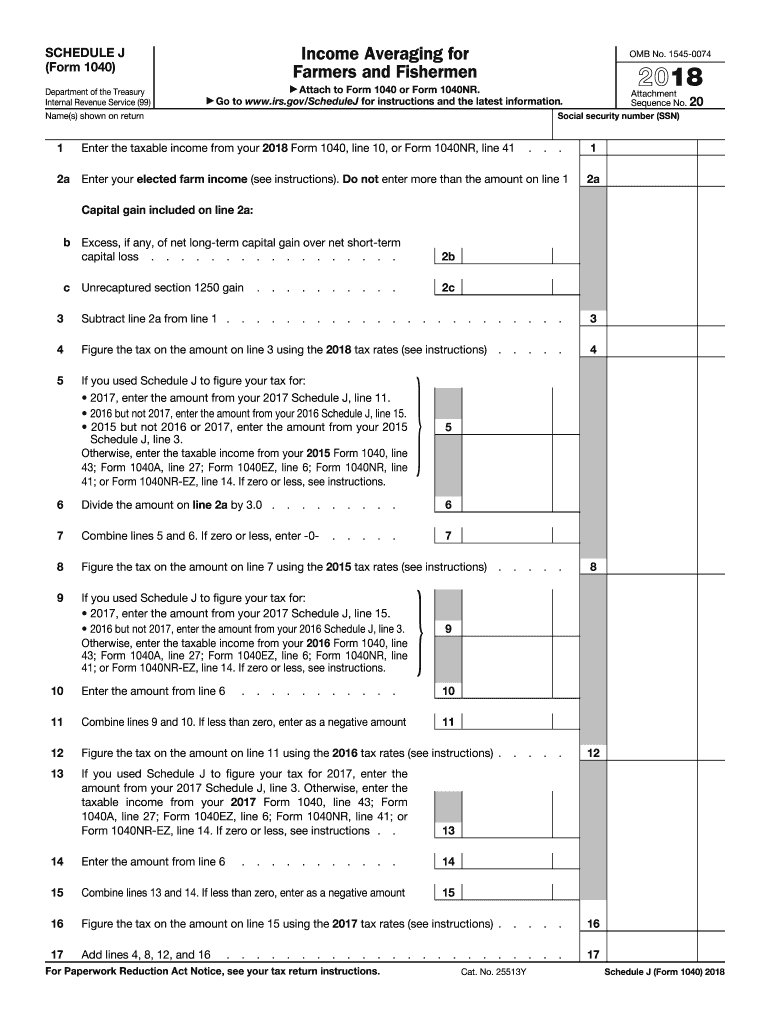
- Press the ‘Get Form’ button to access the IRS 1040 Schedule J form and open it in your preferred digital editor.
- Begin by entering your social security number (SSN) and the names as shown on your tax return.
- In line 1, input the taxable income from your 2018 Form 1040, line 10, or Form 1040NR, line 41.
- For line 2a, enter your elected farm income, ensuring it does not exceed the amount on line 1.
- Complete lines 2b and 2c if applicable, regarding capital gains and unrecaptured section 1250 gains.
- Subtract the amount on line 2a from line 1 to complete line 3.
- Calculate the tax on the amount from line 3 using the appropriate 2018 tax rates, and enter that amount on line 4.
- For line 5, refer back to prior Schedule J forms for values based on years 2015–2017 as specified, or input the required taxable income if not applicable.
- Divide the amount from line 2a by 3 to fill in line 6.
- Combine lines 5 and 6 to complete line 7, ensuring to enter -0- if the result is zero or less.
- Calculate the tax on line 7 using the 2015 tax rates and enter that amount on line 8.
- Repeat steps 8 and 9 for the years 2016 and 2017 as specified on lines 9 to 15, ensuring to calculate the respective taxes.
- Add lines 4, 8, 12, and 16 to find the total tax amount on line 17.
- Complete line 18 by entering the final total from line 17.
- Fill in lines 19 through 21 as per the guidelines, which require information from previous Schedule J forms or current taxable figures.
- Finally, compute the total tax on line 23 by subtracting line 22 from line 18, and include this amount on Form 1040, line 11, or Form 1040NR, line 42.
- After completing the form, ensure to save your changes and print or share the completed Schedule J as needed.
Start filing your IRS 1040 Schedule J online today to ensure accuracy and efficiency in your tax submissions.
Experience a faster way to fill out and sign forms on the web. Access the most extensive library of templates available.
Related content
Apr 29, 2025 — Use Schedule J (Form 1040) to elect to figure your income tax by...
Sep 11, 2024 — The income which is eligible for averaging includes crop and livestock...
Apr 15, 2015 — Schedule J (Form 1040). If you had income from farming or fishing...
Get answers to your most pressing questions about US Legal Forms API.
What is the Schedule J on the 1040?
IRS 1040 Schedule J is a specialized form used by farmers and fishermen for income averaging. It helps you, as a taxpayer in these industries, to report your earnings over a three-year period rather than a single year, providing potential tax advantages. If you need assistance with filling out this form, you can explore US Legal Forms for resources and supporting documentation.
What does J mean in taxes?
In the context of taxes, J refers to IRS 1040 Schedule J, which is specifically designed for farmers and fishermen. The letter J signifies the unique approach to income averaging for these groups, allowing them to report their income more favorably. Understanding what J means can empower you to engage effectively with your tax situation.
Why is schedule J so important?
Schedule J is important because it provides a way for farmers and fishermen to smooth out their income for tax purposes. By averaging income over three years, taxpayers can avoid significant tax spikes in profitable years. This not only offers financial relief but also facilitates better long-term financial planning.
Who files Schedule J?
Farmers and fishermen who receive their income from these industries typically file IRS 1040 Schedule J. If you earn income in these sectors and want to take advantage of income averaging, Schedule J is the form for you. In some cases, even those who have switched from farming or fishing to other types of income may still benefit from filing this schedule.
What is the schedule J related to?
The IRS 1040 Schedule J is specifically related to income averaging for farmers and fishermen. This schedule enables these individuals to average their earnings over three years, which can significantly reduce their tax liability. Utilizing Schedule J can help stabilize tax payments, making it easier to manage finances throughout the year.
What is Box 12 code J on 1040?
Box 12 code J on IRS 1040 Schedule J indicates an election for farmers and fishermen. This code allows taxpayers who earn income from farming or fishing to report their income differently. Understanding this code is crucial for maximizing tax benefits, ensuring that you're taking full advantage of available deductions.
What is Schedule J on the IRS 1040?
Schedule J on the IRS 1040 is a form specifically designed for farmers and fishermen to report income while benefiting from income averaging. This form helps in minimizing total tax liabilities by considering the variability often experienced in these industries. Utilizing Schedule J can lead to a more favorable tax outcome, making it a must-know for eligible taxpayers.
Why is Schedule J important?
Schedule J is important because it facilitates the management of fluctuating income for those in farming and fishing. By providing a legal means to average income over three years, it helps taxpayers potentially lower their tax bills and create a more stable financial outlook. This scheduling is a powerful tool that can transform your tax strategy.
Is Schedule J required?
While Schedule J is not mandatory for every taxpayer, it is required for those who want to average out their farming or fishing income. If you engage in these activities and wish to mitigate tax liabilities from significant income fluctuations, then utilizing the IRS 1040 Schedule J becomes essential. Make sure to review your eligibility before filing.
How to fill out a Schedule J?
To fill out the IRS 1040 Schedule J, you must start by reporting your total income from farming or fishing on the designated lines. Next, you will compute your average income over the specified three years and complete the applicable sections accurately. For personalized guidance, consider using services like US Legal Forms, which can provide templates and tips to streamline your filing process.
Use professional pre-built templates to fill in and sign documents online faster. Get access to thousands of forms.
If you believe that this page should be taken down, please follow our DMCA take down process here.
This form is available in several versions. Select the version you need from the drop-down list below.