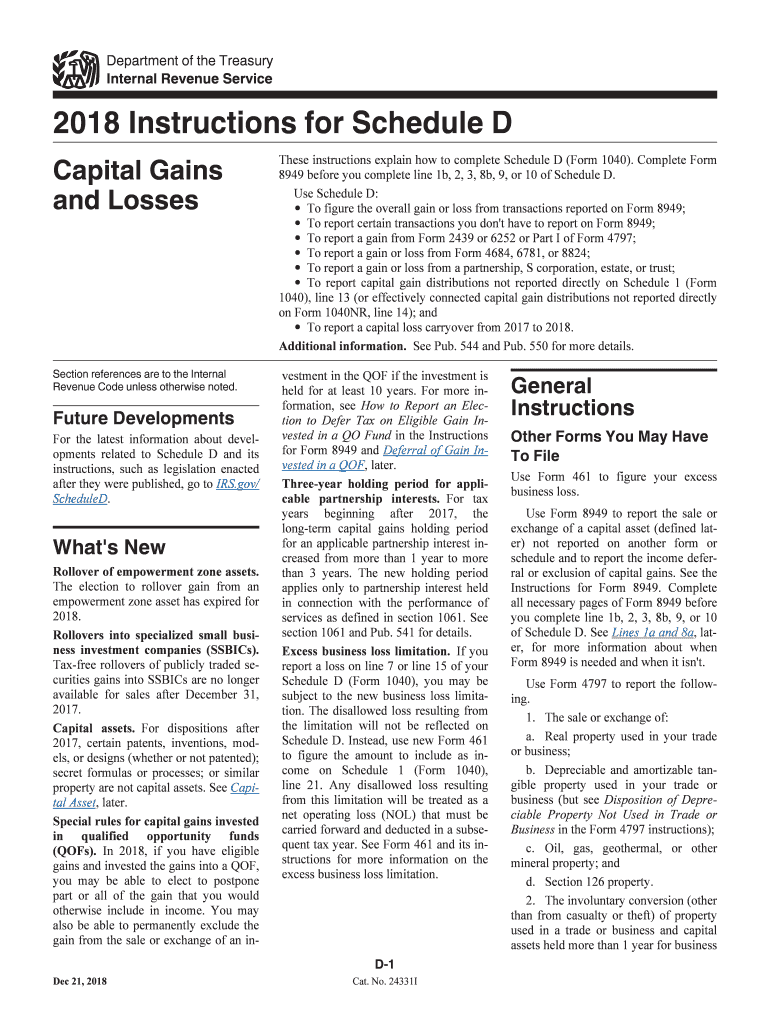
L rules for capital gains invested in qualified opportunity funds (QOFs). In 2018, if you have eligible gains and invested the gains into a QOF, you may be able to elect to postpone part or all of the gain that you would otherwise include in income. You may also be able to permanently exclude the gain from the sale or exchange of an in- D-1 Dec 21, 2018 Cat. No. 24331I General Instructions Other Forms You May Have To File Use Form 461 to figure your excess business loss. Use Form 8949 to repo.
Loading

Open form follow the instructions

Easily sign the form with your finger

Send filled & signed form or save
How to use or fill out the IRS 1040 Schedule D Instructions online
Filling out the IRS Schedule D can be a straightforward process with the right guidance. This guide provides user-friendly instructions on how to complete the IRS 1040 Schedule D instructions online, ensuring you navigate the form with ease and accuracy.
Follow the steps to successfully fill out the IRS Schedule D online.
- Click ‘Get Form’ button to obtain the form and open it in the editor.
- Start with Part I, where you will report your short-term capital gains and losses. Make sure to complete Form 8949 before entering amounts on Schedule D. List each transaction, including the details of sales or exchanges you processed during the tax year.
- Move to Part II for long-term capital gains and losses. Here, again, you will need to reference Form 8949 to determine which transactions qualify as long-term and ensure your entries reflect this categorization.
- If applicable, in lines 1a and 8a, report the aggregate totals from transactions you do not report on Form 8949. Ensure that these totals reflect only transactions where you received a Form 1099-B indicating the basis has been reported to the IRS.
- For lines 11 through 18, report capital gains distributions and complete the required worksheets for collectibles gains and unrecaptured Section 1250 gains, according to the specifics of the gains and losses you reported in previous parts.
- Conclude by thoroughly reviewing your entries. Save changes, download, print, or share the completed form as necessary with the relevant parties, ensuring you've retained a copy for your records.
Complete your documents online today and take the next step towards filing your taxes efficiently.
Experience a faster way to fill out and sign forms on the web. Access the most extensive library of templates available.
Related content
These instructions explain how to complete Schedule D (Form 1040). Complete Form 8949...
by D SCHEDULE · Cited by 1 — Complete the Qualified Dividends and Capital Gain Tax...
Dec 6, 2017 — Attach to Form 1045 a copy of Form. 6781 and Schedule D (Form 1040) for...
Get answers to your most pressing questions about US Legal Forms API.
Do I have to report the sale of inherited property to the IRS?
Yes, you must report the sale of inherited property to the IRS. The IRS requires you to disclose any capital gains or losses associated with these sales on Schedule D. It's essential to determine the fair market value at the time of inheritance, as this impacts tax calculations. Tools like those offered by USLegalForms can assist in properly documenting these transactions.
What sales are reported on Schedule D?
Sales reported on Schedule D include those of stocks, bonds, and other capital assets. Additionally, you should include gains or losses from inherited property or collectibles sold during the tax year. Keeping an organized record of these transactions will support your reporting process. For convenience, consider leveraging USLegalForms for detailed guidance.
How do I report capital gains and losses on my tax return?
To report capital gains and losses on your tax return, you will need to complete Schedule D and input the information on your IRS 1040 form. Begin by calculating your total gains and losses from the sale of assets. Next, transfer those amounts to the appropriate locations on your tax return. Using USLegalForms helps clarify these steps and ensures you meet all requirements.
What transactions can be reported directly on Schedule D?
You can report transactions involving the sale of stocks, bonds, mutual funds, and real estate directly on Schedule D. If you have made sales or exchanged other capital assets, those should also be included. It's important to accurately calculate your capital gains and losses for the IRS. Utilizing platforms like USLegalForms can facilitate this reporting process.
What should I report on Schedule D?
You should report all sales of capital assets, including stocks, bonds, and investment property, on Schedule D. Additionally, include any gains or losses from these transactions. Accurate reporting is crucial for complying with IRS regulations and maximizing your tax deductions. USLegalForms provides useful resources to help you navigate these instructions.
When and why must the Schedule D tax worksheet be filled out?
You must fill out the Schedule D tax worksheet when you have capital gains or losses during the tax year. This form helps ensure you report these amounts correctly on your tax return. Additionally, it assists in calculating your overall tax obligations. Using USLegalForms can simplify this process by guiding you through the necessary steps.
What do you report on Schedule D?
On the IRS 1040 Schedule D, you report capital gains and losses from your investments. This includes the sale of stocks, bonds, and real estate. It's essential to accurately account for these transactions to determine your tax liability. You can easily keep track of your investments using platforms like USLegalForms.
What is IRS Schedule D used for?
IRS Schedule D is primarily used to report capital gains and losses from the sale of securities and other capital assets. It helps taxpayers calculate their overall tax liability for the year related to these transactions. Understanding how to complete this form is crucial for accurate tax filing. You can find all necessary details in the IRS 1040 Schedule D Instructions to assist you in this task.
What is the difference between Schedule D and form 4797?
Schedule D and form 4797 address different aspects of tax reporting for capital assets. Schedule D focuses on capital gains and losses from investments like stocks and bonds, while form 4797 is used for reporting sales of business property or depreciated assets. Knowing the right form to use ensures compliance with IRS regulations. The IRS 1040 Schedule D Instructions help clarify these distinctions.
What is the difference between Schedule D and form 8949?
Schedule D and form 8949 serve distinct but complementary functions. Form 8949 is used to report each individual transaction involving capital assets, while Schedule D summarizes your overall capital gains and losses. Understanding this difference is key to proper tax reporting, ensuring you meet IRS requirements. The IRS 1040 Schedule D Instructions outline how to utilize both forms effectively.
Use professional pre-built templates to fill in and sign documents online faster. Get access to thousands of forms.
If you believe that this page should be taken down, please follow our DMCA take down process here.
This form is available in several versions. Select the version you need from the drop-down list below.