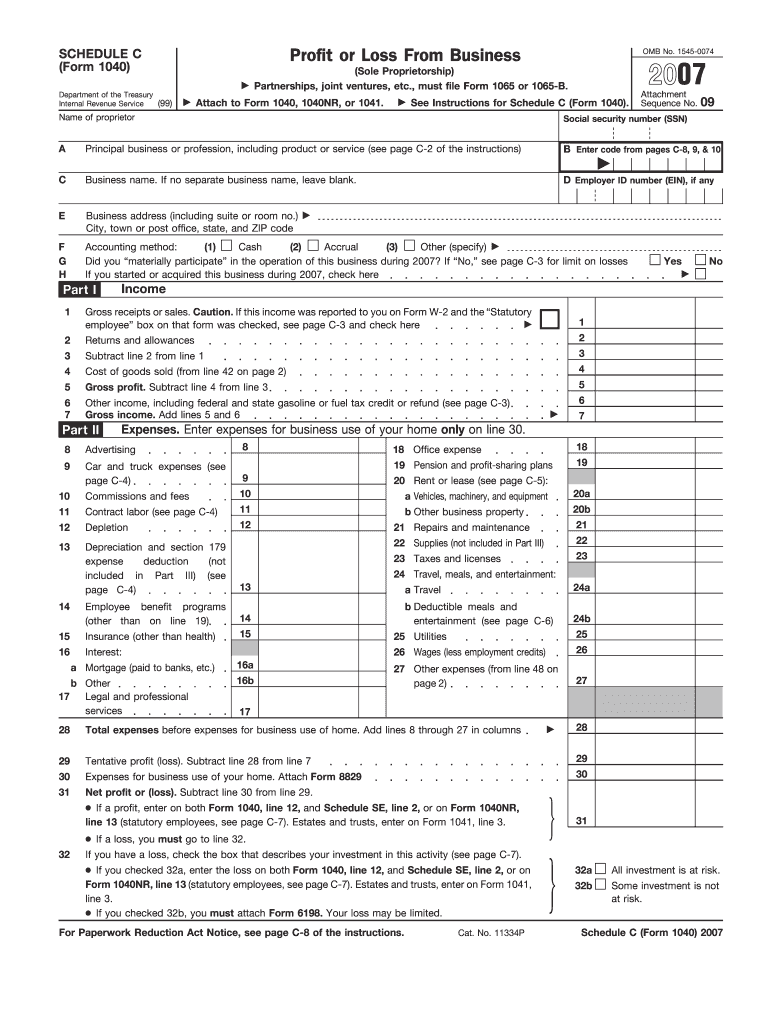
R the loss on both Form 1040, line 12, and Schedule SE, line 2, or on Form 1040NR, line 13 (statutory employees, see page C-7). Estates and trusts, enter on Form 1041, line 3. If you checked 32b, you must attach Form 6198. Your loss may be limited. For Paperwork Reduction Act Notice, see page C-8 of the instructions. Cat. No. 11334P 31 32a All investment is at risk. 32b Some investment is not at risk. Schedule C (Form 1040) 2007 Schedule C (Form 1040) 2007 Part III Page.
Loading

Open form follow the instructions

Easily sign the form with your finger

Send filled & signed form or save
How to fill out the IRS 1040 - Schedule C online
The IRS 1040 - Schedule C is a crucial document for individuals operating a sole proprietorship. This guide will help you understand and complete each section of the form online with clarity and confidence.
Follow the steps to successfully complete your Schedule C.
- Click ‘Get Form’ button to obtain the form and open it in the editor.
- Identify the name of the proprietor and enter your social security number in the designated fields.
- Provide the principal business or profession, including a brief description of the product or service offered, in the specified section.
- Enter the business name if applicable, or leave it blank if there is none.
- If you have an employer ID number, include it in the corresponding field; otherwise, leave it blank.
- Fill in the business address, including suite or room number, city, state, and ZIP code.
- Select your accounting method by checking the appropriate box for cash, accrual, or other.
- Indicate whether you materially participated in the operation of the business during the tax year.
- Complete Part I by entering your gross receipts or sales and any returns and allowances.
- Calculate your cost of goods sold and necessary expenses, filling out all relevant fields.
- Total your expenses before entering the specific expenses related to business use of your home.
- Determine your tentative profit or loss by subtracting total expenses from gross income.
- If applicable, enter expenses for business use of your home and calculate your net profit or loss.
- As a final step, review all entries for accuracy before saving, downloading, or printing the completed form.
Start filling out your IRS 1040 - Schedule C online today!
Experience a faster way to fill out and sign forms on the web. Access the most extensive library of templates available.
Related content
Jul 7, 2025 — Use Schedule C (Form 1040) to report income or loss from a business you...
If a profit, enter on both Form 1040, line 12 (or Form 1040NR, line 13) and on Schedule...
Complete this part ONLY if you are claiming car or truck expenses on line 10 and are not...
Get answers to your most pressing questions about US Legal Forms API.
How to avoid Schedule C audit?
To avoid an IRS audit on your Schedule C, ensure that all your financial records are accurate and complete. Report all income, avoid excessive or unusual deductions, and maintain clear documentation to support your claims. Utilizing platforms like US Legal Forms can help streamline your tax preparation process and keep you compliant. By being organized and meticulous, you can significantly reduce your audit risks.
What are the odds of being audited with Schedule C?
The odds of being audited with an IRS 1040 - Schedule C generally depend on various factors, such as your overall income and business type. Statistically, sole proprietors have a higher audit rate, particularly when they claim significant deductions. Staying informed about audit trends and ensuring precise records can help lower your audit risk. Consulting with tax professionals can also provide guidance.
Who is required to file a Schedule C?
Individuals who operate a business as a sole proprietor must file a Schedule C on their IRS 1040 tax return. If you receive income from self-employment or freelance work, you must report this on Schedule C. Even if your business incurs a loss, filing remains necessary to establish your income or losses. Understanding this requirement is crucial for compliance and accurate reporting.
What qualifies as expenses on a Schedule C?
On your IRS 1040 - Schedule C, qualifying expenses include costs directly related to running your business. This can involve rent, utilities, equipment, salaries, and other necessary expenses. It is vital to keep receipts and documentation for all expenses claimed. Understanding what qualifies ensures that you maximize your legitimate deductions.
What is most likely to trigger an IRS audit?
Certain practices can increase the likelihood of triggering an IRS audit on your IRS 1040 - Schedule C. Reporting high income alongside significant deductions, declaring hobby income as business income, and not reporting all income can raise suspicions. Keeping your records transparent and comprehensive can help minimize potential audit triggers.
What is a Schedule C on a 1040 form?
A Schedule C on your IRS 1040 form is used to report income or loss from a business you operated or a profession you practiced as a sole proprietor. This form details your business income, expenses, and the net profit or loss. Filling out Schedule C correctly can impact your overall tax liability. Understanding its components helps ensure that you accurately report your business's financial activity.
What triggers the IRS audit on Schedule C?
An audit on your IRS 1040 - Schedule C can be triggered by several reasons. High deductions, especially if they don't align with typical percentages for your industry, will attract scrutiny. If the IRS notices inconsistencies or patterns that seem unusual in your tax returns, they may choose to investigate further. Keeping detailed and accurate records is crucial to minimize this risk.
What triggers a Schedule C audit?
Certain factors can trigger an IRS audit related to your IRS 1040 - Schedule C. For instance, discrepancies between reported income and what banks or clients reported can catch the IRS's attention. Additionally, unusually high expenses compared to your income may also raise red flags. It’s essential to ensure that your reported information matches your financial records.
What is the minimum income for Schedule C?
There is technically no minimum income requirement to file a Schedule C with your IRS 1040. However, if you earn $400 or more in net earnings from self-employment, you must report this using Schedule C. If your income is less than that, you generally do not have to file, yet maintaining accurate records is still essential. To better understand your reporting obligations and options, consider the resources available at uslegalforms, which assist you in compliance with IRS requirements.
How do you calculate Schedule C income?
Calculating Schedule C income involves subtracting your total business expenses from your total business revenue. Begin by listing all income earned through your business, then outline every applicable expense, including operational costs and deductions. This calculation will give you your net profit or loss, which you report on the IRS 1040 - Schedule C. Using tools available on uslegalforms can simplify this process by providing helpful templates and calculators.
Use professional pre-built templates to fill in and sign documents online faster. Get access to thousands of forms.
If you believe that this page should be taken down, please follow our DMCA take down process here.
This form is available in several versions. Select the version you need from the drop-down list below.