Rements under title 11 of the United States Code (Bankruptcy Rules).3 Definitions Fiduciary. A fiduciary is any person acting in a fiduciary capacity for any other person (or terminating entity), such as an administrator, conservator, designee, executor, guardian, receiver, trustee of a trust, trustee in bankruptcy, personal representative, person in possession of property of a decedent s estate, or debtor in possession of assets in any bankruptcy proceeding by order of the court. 4 Person. A p.
Loading

Open form follow the instructions

Easily sign the form with your finger

Send filled & signed form or save
How to fill out the AntiShyster IRS Instruction 56 online
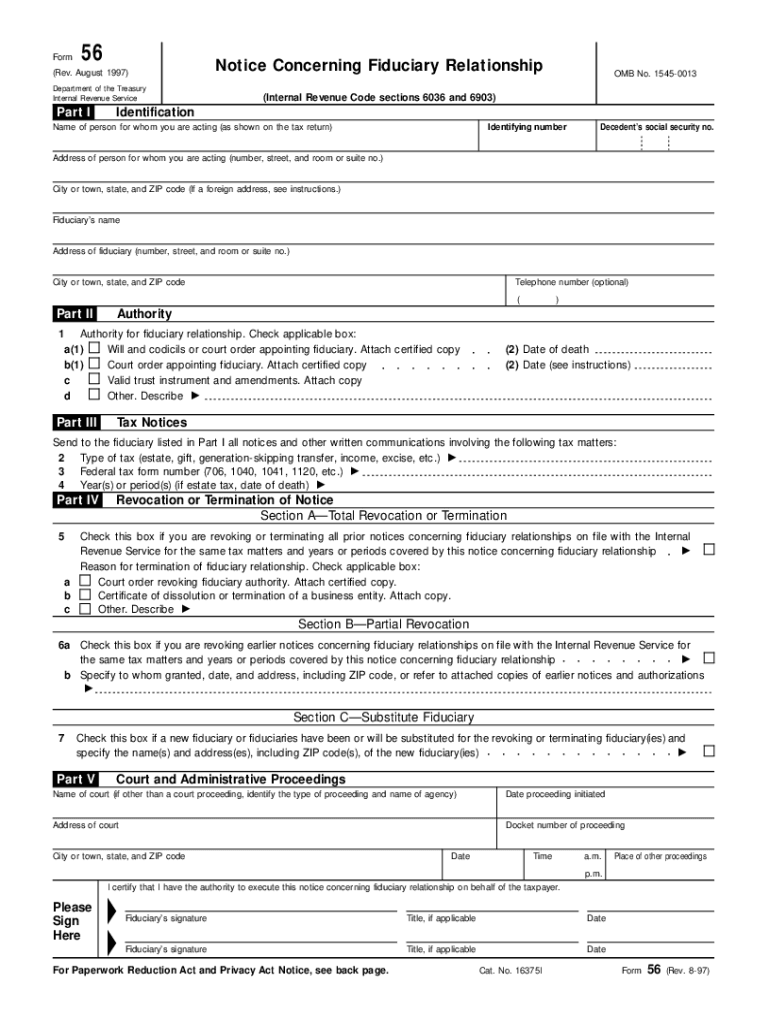
This guide provides a comprehensive overview of how to fill out the AntiShyster IRS Instruction 56 online. This form is essential for notifying the IRS of the creation or termination of a fiduciary relationship, and understanding its requirements can simplify the filing process.
Follow the steps to complete the AntiShyster IRS Instruction 56 with ease.
- Click ‘Get Form’ button to obtain the form and open it in the editor.
- In Part I, provide identification details. Enter the name of the person for whom you are acting, their Social Security Number (SSN) or Employer Identification Number (EIN), and their address. Ensure to include any apartment or suite number and the complete city, state, and ZIP code.
- In Part II, indicate your authority. Check the appropriate box depending on whether the decedent died with a will (testate) or without (intestate), and enter the date of death.
- In Part III, specify any tax notices you wish to receive. Indicate the type of tax involved and the relevant tax forms you want notifications for.
- If applicable, proceed to Part IV to revoke or terminate any prior fiduciary notices. Indicate the reason for termination and provide any necessary documentation.
- Part V is for those appointed as receivers or fiduciaries by a court. Fill out the details of the court or agency, including dates and addresses.
- Finally, sign the form and include your title, if applicable. Review the entire form for accuracy before submission.
- Once complete, you can save changes, download, print, or share the form as needed.
Complete your IRS documents online today for a smooth filing experience!
Experience a faster way to fill out and sign forms on the web. Access the most extensive library of templates available.
Related content
The injunction is a permanent order against Christopher M. Hansen for promoting tax-fraud...
The paper explores the concept of the “straw man” as an artificial entity created by...
Get answers to your most pressing questions about US Legal Forms API.
Do you have to file taxes after death?
In general, the final individual income tax return of a decedent is prepared and filed in the same manner as when they were alive. All income up to the date of death must be reported and all credits and deductions to which the decedent is entitled may be claimed.
What happens if you don't file taxes for a deceased person?
If you don't file taxes for the decedent and the estate promptly, the IRS can file a federal tax lien requiring you pay the decedent's income tax ahead of other bills. ... If the estate can't pay the debt because you spent the money on another debt or distributed assets to the heirs, the IRS may look to you for the money.
What is the purpose of IRS Form 56?
IRS form 56, Notice Concerning Fiduciary Relationship, is used to notify the Internal Revenue Service and state taxing authorities of either the initiation or termination of a fiduciary relationship between you and an artificial entity, such as a business, trust, corporation, or partnership.
Who Files Form 56?
Form 56 is filed with the IRS at the beginning and end of a fiduciary relationship. Form 56 must also be filed whenever the fiduciary relationship changes. Filing Form 56 notifies federal agencies and creditors to send mail regarding the estate to the fiduciary.
Do I have to file Form 56?
Form 56 Instructions In order to file Form 56, you will need to get a copy of the form from the IRS or a tax professional. The form will be filed directly with the IRS and it is the responsibility of the fiduciary to file in a timely manner after the establishment of fiduciary duties.
Does Form 56 need to be filed?
Generally, you should file Form 56 when you create (or terminate) a fiduciary relationship. File Form 56 with the Internal Revenue Service Center where the person for whom you are acting is required to file tax returns.
Use professional pre-built templates to fill in and sign documents online faster. Get access to thousands of forms.
If you believe that this page should be taken down, please follow our DMCA take down process here.