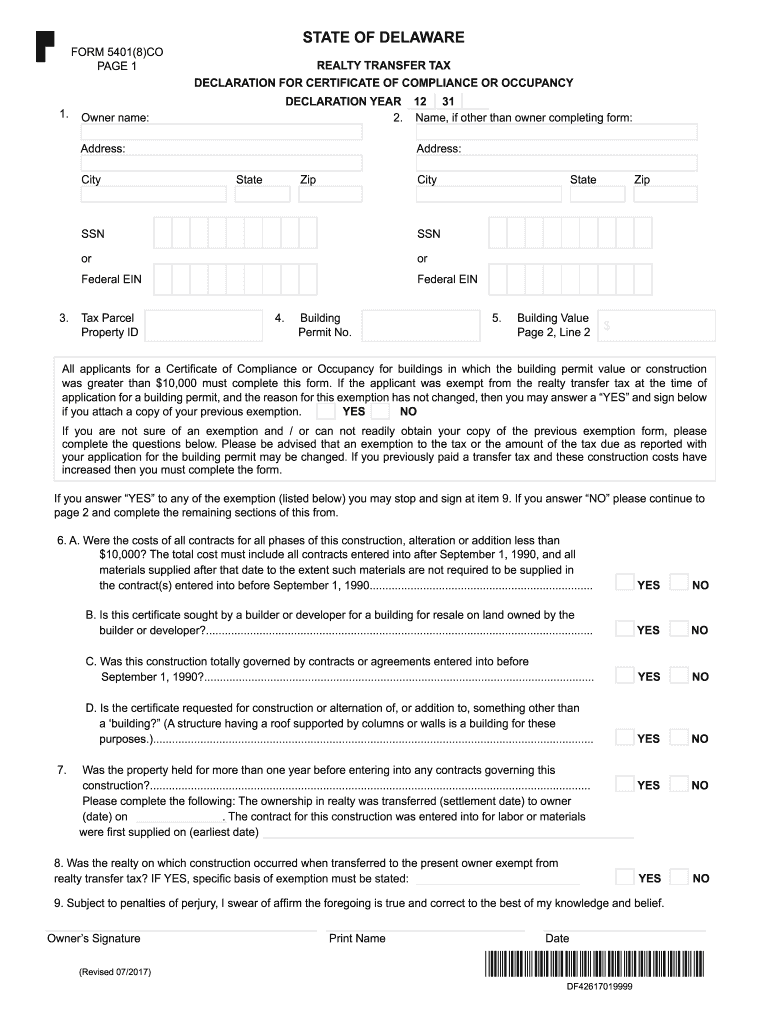
Form: Owner name: Address: Address: City City State Zip SSN SSN or or Federal EIN Federal EIN Tax Parcel Property ID Print Form 4. Building Permit No. 5. State Building Value Page 2, Line 2 Zip $ All applicants for a Certificate of Compliance or Occupancy for buildings in which the building permit value or construction was greater than $10,000 must complete this form. If the applicant was exempt from the realty transfer ta.
Loading

Open form follow the instructions

Easily sign the form with your finger

Send filled & signed form or save
How to fill out the DE 5401(8)CO online
This guide provides clear and supportive instructions for completing the DE 5401(8)CO form online. It aims to help users navigate the form efficiently, ensuring accurate submission for obtaining a certificate of compliance or occupancy.
Follow the steps to complete the DE 5401(8)CO online.
- Press the ‘Get Form’ button to access the DE 5401(8)CO form and open it for editing.
- Enter the owner's name in the designated field, along with their address, city, state, and ZIP code.
- Provide the Social Security Number (SSN) or Federal Employer Identification Number (EIN) as needed.
- Fill in the tax parcel number or property ID requested on the form.
- Indicate the building permit number and the estimated building value.
- Answer the exemption questions provided; if applicable, attach a copy of previous exemptions.
- Respond to the construction cost question by indicating if all contracts are under $10,000.
- If applicable, confirm whether the certificate is for a builder’s resale and if prior contracts were established before a certain date.
- Complete questions regarding the ownership and any exemptions related to realty transfer tax.
- Sign at the designated section to affirm the correctness of the information provided.
- Finally, save your changes, and you can choose to download, print, or share the completed form.
Complete your DE 5401(8)CO form online today to streamline your application process.
Experience a faster way to fill out and sign forms on the web. Access the most extensive library of templates available.
Related content
Commodity Taxes. CHAPTER 54. Realty Transfer Tax. Subchapter I. Realty Transfer Tax. §...
Apr 13, 2025 — The official box score of Baseball vs Carthage College on 4/13/2025.
The NI PXI/PCI-5401 has a 12-bit resolution, 40 MHz max update rate, 16 MHz sine frequency...
Get answers to your most pressing questions about US Legal Forms API.
How to avoid transfer tax in Delaware?
To avoid transfer tax in Delaware, you might explore exemptions such as those for family transfers and transactions involving trusts. Additionally, certain programs assist first-time home buyers in reducing their costs. Carefully assessing the DE 5401(8)CO can help identify your options. Consider using US Legal Forms to ensure you have the correct documentation and information needed to navigate these tax regulations.
How to avoid paying transfer tax?
There are several strategies to avoid paying transfer tax in Delaware, including specific exemptions and utilizing special programs designed for first-time home buyers. It's essential to familiarize yourself with the DE 5401(8)CO to discover available exemptions. US Legal Forms can provide the necessary documentation and guidance to assist you in this process.
Are there any tax breaks for first time home buyers?
Yes, Delaware offers tax breaks for first-time home buyers, including reduced transfer tax rates and potential access to grants or loans. These incentives help ease the financial burden when purchasing a home for the first time. Be sure to explore the specific eligibility criteria in the DE 5401(8)CO and consider assistance from US Legal Forms to clarify your options.
Who is exempt from transfer tax in Delaware?
Certain individuals and organizations may qualify for exemption from transfer tax in Delaware. Usually, exemptions apply to transfers between spouses, transfers to a trust for the benefit of a spouse, and certain government transactions. To understand your specific situation, it's helpful to consult the DE 5401(8)CO form for detailed guidance. You can also rely on platforms like US Legal Forms to help navigate these rules.
Who is exempt from paying property taxes in Delaware?
In Delaware, certain groups may be exempt from property taxes, including veterans, seniors, and disabled persons. These exemptions often require specific documentation and must adhere to state guidelines. Familiarizing yourself with these criteria can be beneficial, especially if you find yourself in a qualifying category. Utilizing resources related to the DE 5401(8)CO will help streamline this process.
Why is Delaware transfer tax so high?
Delaware's transfer tax is relatively high due to the state's overall tax structure, which aims to generate revenue for public services. This tax applies to a variety of transactions, including those covered under DE 5401(8)CO. The funding helps support essential programs and infrastructure within the state. Understanding these reasons can help you better prepare for your financial obligations.
What is 5401 settlement?
The 5401 settlement refers to the specific legal process associated with the DE 5401(8)CO form, which relates to property transfers in Delaware. Understanding this settlement is crucial for anyone involved in property transactions, as it establishes legal and financial obligations. The settlement process ensures that all related taxes and fees are properly addressed. Having the right resources can simplify this process significantly.
What is exempt from Delaware transfer tax?
Certain transactions may be exempt from the Delaware transfer tax, including transfers between spouses, transfers related to government entities, and certain non-profit organization transfers. Understanding which transactions qualify for these exemptions under the DE 5401(8)CO provisions can lead to substantial savings when transferring property.
What is Delaware Code Title 8 Corporations 220 Inspection of Books and Records?
Delaware Code Title 8, Section 220 provides shareholders of corporations the right to inspect books and records under specific circumstances. This regulation ensures transparency and accountability within corporations, allowing shareholders to access essential information. Understanding these rights can empower you as a shareholder, particularly in relation to DE 5401(8)CO.
Who is exempt from taxes?
Tax exemptions in Delaware extend to various entities and individuals. For example, state and local governments, certain non-profit organizations, and specific educational institutions may qualify for tax exemptions. By reviewing the criteria laid out in DE 5401(8)CO, you can better understand your eligibility and potential savings.
Use professional pre-built templates to fill in and sign documents online faster. Get access to thousands of forms.
If you believe that this page should be taken down, please follow our DMCA take down process here.
This form is available in several versions. Select the version you need from the drop-down list below.