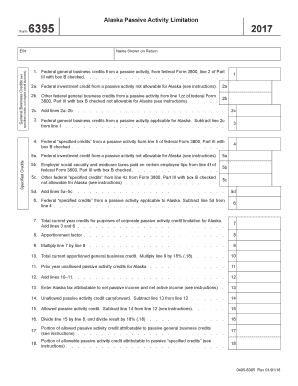
Business credits from a passive activity, from federal Form 3800, line 2 of Part III with box B checked. . . . . . . . . . . . . . . . . . . . . . . . 1 2a. Federal investment credit from a passive activity not allowable for Alaska (see instructions) . 2a 2b. Other federal general business credits from a passive activity from line 1zz of federal Form 3800, Part III with box B checked not allowable for Alaska (see instructions) . . . . . 2b 2c. Add lines 2a 2b . 2c 3. Federal general b.
Open form follow the instructions
Easily sign the form with your finger
Send filled & signed form or save
How to fill out the AK DoR 6395 online
The AK DoR 6395 form is essential for reporting passive activity limitations and specified credits in Alaska. This guide provides step-by-step instructions on how to accurately complete the form online, ensuring that users navigate the process easily and effectively.
Follow the steps to complete the AK DoR 6395 online
- Press the ‘Get Form’ button to obtain the form and open it for editing.
- Begin by entering your Employer Identification Number (EIN) in the designated field. Ensure that this number is correct, as it is vital for processing your form.
- In the next section, record the name displayed on your federal tax return. This should match the name associated with your EIN.
- Complete line 1 by entering the amount of federal general business credits derived from passive activities, as reported on federal Form 3800, line 2 of Part III with box B checked.
- Proceed to lines 2a and 2b. On line 2a, enter any federal investment credits from a passive activity that are not allowable for Alaska. On line 2b, input other federal general business credits that are similarly not allowable.
- Add the amounts from lines 2a and 2b, and record the total on line 2c.
- For line 3, subtract the total from line 2c from the amount reported on line 1 to determine the federal general business credits applicable for Alaska.
- Fill in line 4 with the federal “specified credits” from a passive activity based on line 5 of federal Form 3800, Part III with box B checked.
- Complete lines 5a through 5c by entering the necessary credit information as directed, ensuring that these figures represent amounts that are not allowable for Alaska.
- On line 5d, if applicable, document any additional specified credits based on the form instructions.
- Calculate line 6 by subtracting line 5d from line 4 to establish the federal “specified credits” that are applicable for Alaska.
- Sum the results of lines 3 and 6 on line 7 to find the total current year credits for corporate passive activity credit limitation for Alaska.
- On line 8, input the apportionment factor, which is crucial for determining your apportioned credits.
- Multiply the total from line 7 by the apportionment factor on line 9.
- For line 10, calculate the total current apportioned general business credit by multiplying the figure from line 9 by 18%.
- Document any prior year unallowed passive activity credits for Alaska on line 11.
- Add lines 10 and 11 together, and record the result on line 12.
- For line 13, enter the Alaska tax that is attributable to net passive income and net active income as instructed.
- Calculate the unallowed passive activity credit carryforward for line 14 by subtracting line 13 from line 12.
- On line 15, determine the allowed passive activity credit by subtracting line 14 from line 12.
- Divide the result from line 15 by the amount on line 8, and then divide that result by 18% for line 16.
- Complete line 17 with the portion of the allowed passive activity credit that is attributed to passive general business credits.
- On line 18, record the portion of the allowable passive activity credit that relates to passive specified credits.
- Once all fields are accurately filled, ensure to save your changes. You can download, print, or share the completed AK DoR 6395 as needed.
Complete your AK DoR 6395 form online today!
Experience a faster way to fill out and sign forms on the web. Access the most extensive library of templates available.
Related content
Jul 1, 2024 — ... 6395. 208.52. 206.11. 203.69. 201.27. 198.86. 196.44. 194.02. 6395...
by B Franke · 2018 · Cited by 824 — ADHD is common in childhood, but can persist into...
Jun 15, 1994 — MacUser 9406 June 1994. The rowering pines, the rain, the light, the...
Get answers to your most pressing questions about US Legal Forms API.
What is the tax revenue of Alaska?
Alaska's tax revenue primarily comes from oil, as well as various state and local taxes. This revenue is crucial in funding public programs and services. The overall tax revenue fluctuates based on oil prices and economic activity, impacting the state's budget. For detailed insights into the figures associated with AK DoR 6395, consider using tax resources available through platforms like uslegalforms.
At what age do you stop paying property taxes in Alaska?
In Alaska, property tax exemptions for seniors typically begin at age 65, allowing eligible homeowners to reduce or eliminate their property tax burden. However, specifics can vary by municipality. It's worthwhile to review local guidelines to understand all available exemptions. Resources regarding AK DoR 6395 can provide assistance in navigating these tax regulations.
What are the tax benefits of living in Alaska?
Living in Alaska offers unique tax benefits, most notably the lack of a state income tax. Residents can enjoy dividends from the Alaska Permanent Fund, which disburses earnings from state oil revenues. Moreover, property taxes are relatively low compared to many other states. Familiarizing yourself with AK DoR 6395 can help you maximize these benefits and plan effectively.
What is the corporate income tax rate in Alaska?
The corporate income tax rate in Alaska varies based on the taxable income. Generally, it ranges from 0% for lower earnings to a maximum of 9.4% for income exceeding a certain threshold. Understanding these rates is essential for business planning. For clarity on AK DoR 6395 and its implications for your business, consider consulting resources or platforms offering guidance on Alaska's tax structure.
How does Alaska make up for no income tax?
Alaska compensates for the absence of an income tax primarily through revenue generated from natural resources. The state relies heavily on oil and gas production, which contributes a significant portion to the budget. Additionally, Alaska collects taxes on various industries, which helps fund public services. Staying informed about AK DoR 6395 can provide you with insights on how these funds are allocated.
How do I report K-1 on my tax return?
To report a K-1 on your tax return, locate the income amounts listed on the K-1 form. Enter these amounts in the appropriate sections of your tax return. Be sure to keep a copy of the K-1 for your records, as it may be needed for future reference or in case of an audit. You can utilize platforms like UsLegalForms to find templates and forms you may need while referring to AK DoR 6395 for guidance.
Are K-1 distributions considered income?
Yes, K-1 distributions are generally considered income and must be reported on your tax return. These distributions can include various types of income, such as dividends, capital gains, and interest. Make sure you accurately report these amounts to comply with tax regulations. For comprehensive guidance, expect insights from AK DoR 6395 to help you navigate such filings.
Which version of TurboTax handles K-1?
TurboTax Premier and higher versions are specifically designed to handle K-1 forms effectively. These versions allow users to include all relevant K-1 information seamlessly during the tax preparation process. It’s crucial to choose the right version for your filing needs to avoid complications. For further clarification about filing, consider checking resources like AK DoR 6395.
How to file taxes in Alaska?
Filing taxes in Alaska involves gathering all your necessary documents, including W-2s and any K-1 forms for your income. Then, you can use an online tax software, like TurboTax, which is tailored for various tax situations. Make sure you understand any state-specific requirements, and consult resources related to AK DoR 6395 for additional information on local tax laws.
Why is Schedule K-1 not available on TurboTax?
Schedule K-1 may not appear in TurboTax if you are using a version that does not support this form. Ensure you are using TurboTax Premier or higher to gain access to K-1 support. If Schedule K-1 is still missing, check for software updates or consider reaching out to customer support for assistance. You can also refer to AK DoR 6395 for more detailed filing instructions.
Use professional pre-built templates to fill in and sign documents online faster. Get access to thousands of forms.
If you believe that this page should be taken down, please follow our DMCA take down process here.
This form is available in several versions. Select the version you need from the drop-down list below.