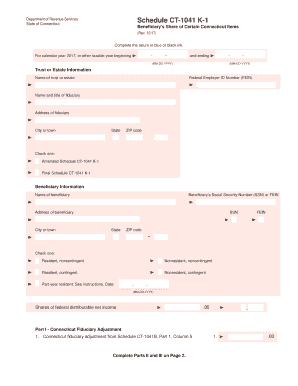
Ear 2017, or other taxable year beginning and ending (MM-DD-YYYY) (MM-DD-YYYY) Trust or Estate Information Name of trust or estate Federal Employer ID Number (FEIN) Name and title of fiduciary Address of fiduciary City or town State ZIP code Check one: Amended Schedule CT-1041 K-1 Final Schedule CT-1041 K-1 Beneficiary Information Name of beneficiary Beneficiary s Social Security Number (SSN) or FEIN Address of beneficiary.
Loading
Open form follow the instructions
Easily sign the form with your finger
Send filled & signed form or save
How to use or fill out the CT DRS Schedule CT-1041 K-1 online
Filling out the CT DRS Schedule CT-1041 K-1 online is essential for reporting the shares of certain Connecticut items for beneficiaries. This guide provides you with a detailed, step-by-step process to ensure a complete and accurate submission.
Follow the steps to fill out the CT DRS Schedule CT-1041 K-1 online:
- Click ‘Get Form’ button to access the schedule CT-1041 K-1 and open it in an online editor.
- Begin with the trust or estate information section. Fill in the name of the trust or estate, its federal employer identification number (FEIN), and the name and title of the fiduciary responsible for managing it.
- Provide the fiduciary's address, including city, state, and ZIP code.
- Indicate if it is an amended or final Schedule CT-1041 K-1 by checking the appropriate box.
- Next, move to the beneficiary information section. Enter the name of the beneficiary and their Social Security Number (SSN) or FEIN.
- Complete the address information for the beneficiary, including their city, state, and ZIP code.
- Check the box that indicates the beneficiary's residency status, such as resident, nonresident, or part-year resident.
- Document the beneficiary's share of federal distributable net income in the designated field.
- Proceed to Part I for the Connecticut fiduciary adjustment. Enter the relevant figures from Schedule CT-1041B, including any adjustments.
- Complete Part II for the Connecticut-sourced portion of items by transferring relevant information from the federal Schedule K-1.
- Fill in Part III regarding Schedule CT-IT credit, ensuring to reserve specified lines for future use.
- After completing all sections, review your entries for accuracy, save any changes made, and prepare to download or print the form if needed.
Complete your CT DRS Schedule CT-1041 K-1 online for a seamless filing experience.
Experience a faster way to fill out and sign forms on the web. Access the most extensive library of templates available.
Related content
A fiduciary must furnish Schedule CT-1041 K-1, Beneficiary's. Share of Certain Connecticut...
Apr 15, 2019 — ... to you on. Schedule CT K-1, Part III, Line 1, or Schedule CT-1041...
Dec 30, 2024 — This antimetabolite was the only chemotherapeutic agent available for...
Get answers to your most pressing questions about US Legal Forms API.
What is a CT k1?
A CT K-1 is a form used to report income distributions from partnerships, S corporations, estates, or trusts to their beneficiaries. This form provides critical information that beneficiaries need to report their income accurately when filing their taxes. It is closely tied to the CT DRS Schedule CT-1041 K-1, ensuring that all income is reported correctly.
Who must file a Connecticut estate tax return?
A Connecticut estate tax return must be filed if the taxable estate exceeds the exemption limit set by Connecticut law. This includes all assets owned by the deceased at the time of death. To navigate the complexities of estate taxes, you might consider using forms and tools like the CT DRS Schedule CT-1041 K-1.
Who must file CT 1041?
Fiduciaries managing estates and trusts must file the CT 1041 if the trust or estate has gross income above the filing threshold. Moreover, if the estate or trust is generating taxable income, you are responsible for filing this return. By utilizing resources like the CT DRS Schedule CT-1041 K-1, you can ensure that you manage your filings efficiently.
What is the fiduciary adjustment in CT?
The fiduciary adjustment in Connecticut refers to the adjustments made to the income reported on the CT DRS Schedule CT-1041 K-1. This adjustment ensures that the income reported aligns with Connecticut tax laws. It allows fiduciaries to account for specific differences between federal and state income tax requirements, providing better compliance and clarity.
Do I need to file Schedule K-1 Form 1041?
If you are a beneficiary receiving distributions from an estate or trust, you will likely receive a Schedule K-1 Form 1041. This form reports your share of the income, deductions, and credits from the estate or trust. It is essential for accurately filing your tax return, especially when utilizing the CT DRS Schedule CT-1041 K-1.
Who must file a Connecticut income tax return?
Any resident or non-resident who earns income in Connecticut must file a Connecticut income tax return. Additionally, estates and trusts that generate income must also comply with this requirement. Using tools like the CT DRS Schedule CT-1041 K-1 ensures that you report the necessary income accurately to avoid penalties.
How do I know if I need to file a 1041?
To determine if you need to file a 1041, check if the estate or trust has any taxable income that exceeds the filing threshold set by the IRS. Generally, if the estate shows gross income above the threshold, a filing is required. Keeping track of income and using resources like the CT DRS Schedule CT-1041 K-1 can help simplify this process.
Who must file a 1041 form?
You must file a 1041 form if you are the fiduciary of a trust or estate with gross income exceeding certain thresholds set by the IRS. This form is crucial for reporting income, gains, and losses from the estate or trust. Moreover, if the estate or trust is required to file a federal tax return, it will need to file the CT DRS Schedule CT-1041 K-1.
How to report schedule K-1 form 1041?
You will report Schedule K-1 Form 1041 income by including its details on your individual tax return. Follow IRS guidelines for where to place each type of income, deduction, or credit on your Form 1040. It's vital to ensure every detail correlates with the information on the CT DRS Schedule CT-1041 K-1 to guarantee a smooth filing process.
How do I report income from Schedule K-1 Form 1041?
To report income from Schedule K-1 Form 1041, you will input the relevant amounts on your IRS Form 1040, particularly on lines dedicated to the income types indicated in the K-1. Following the instructions provided for each type of income ensures accuracy. Remember, this reporting is essential for those utilizing the CT DRS Schedule CT-1041 K-1 to stay compliant.
Use professional pre-built templates to fill in and sign documents online faster. Get access to thousands of forms.
If you believe that this page should be taken down, please follow our DMCA take down process here.
This form is available in several versions. Select the version you need from the drop-down list below.