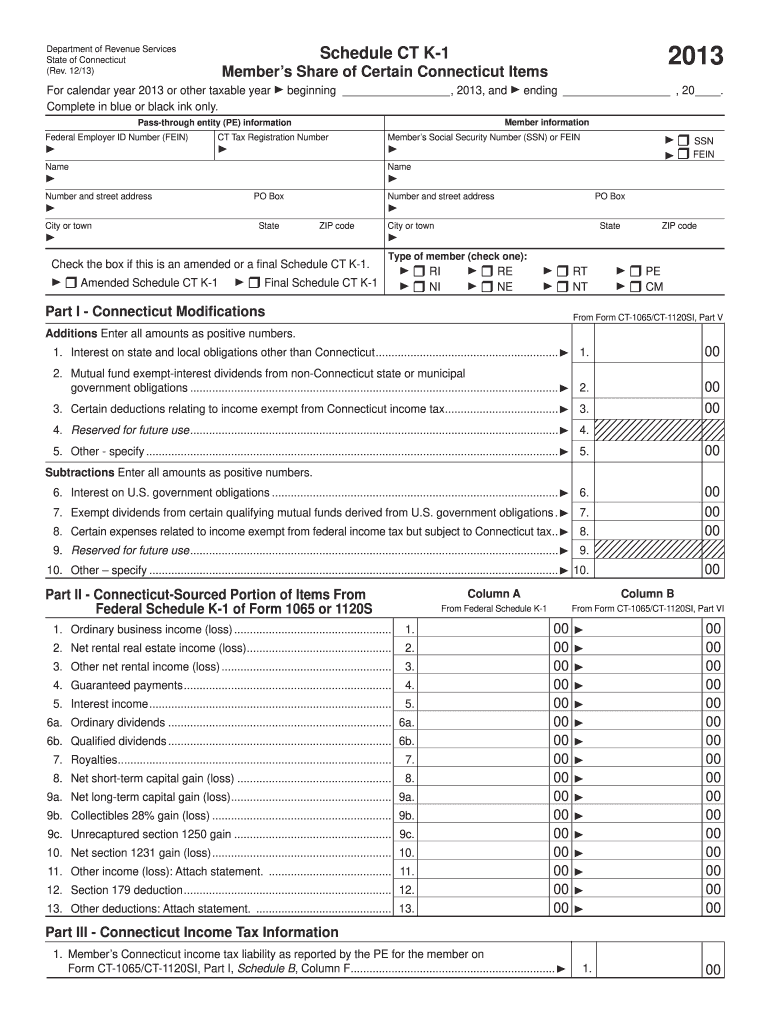
4. 5. Interest income ............................................................................. 5. 6a. Ordinary dividends ....................................................................... 6a. 6b. Quali ed dividends ....................................................................... 6b. 7. Royalties....................................................................................... 7. 8. Net short-term capital gain (loss).
Loading

Open form follow the instructions

Easily sign the form with your finger

Send filled & signed form or save
How to fill out the CT DRS Schedule CT K-1 online
The CT DRS Schedule CT K-1 is an essential form used by pass-through entities in Connecticut to report a member's share of certain items. This guide provides comprehensive, step-by-step instructions to help users navigate the process of completing this form online with ease.
Follow the steps to successfully complete your Schedule CT K-1.
- Click 'Get Form' button to access the Schedule CT K-1 and open it in the appropriate editor.
- Begin by filling in the member information section. This includes entering the member’s Social Security Number (SSN) or Federal Employer Identification Number (FEIN), and ensuring that the correct box is checked to indicate which is provided.
- Next, complete the pass-through entity (PE) information section. This requires entering the PE's Federal Employer ID Number (FEIN) and CT Tax Registration Number, along with the entity's name, address, city or town, state, and ZIP code.
- Check the box to indicate whether this is an amended or a final Schedule CT K-1 based on your situation.
- Move to Part I – Connecticut Modifications. Enter all applicable additions and subtractions as positive numbers based on the member's share from Form CT-1065/CT-1120SI.
- Proceed to Part II – Connecticut-Sourced Portion of Items from Federal Schedule K-1. Fill out Column A with amounts from Federal Schedule K-1 and Column B with Connecticut-sourced amounts from CT-1065/CT-1120SI.
- In Part III, report the member's Connecticut income tax liability based on the PE's records from Form CT-1065/CT-1120SI.
- Complete Part IV to summarize any income tax credits earned by the member. Enter relevant details in Columns A and B, transferring any necessary information from Form CT-1065/CT-1120SI.
- Review all filled sections for accuracy, ensuring that information is complete and correct before proceeding.
- Finally, save your changes, then download, print, or share the Schedule CT K-1 as needed.
Complete your Schedule CT K-1 online today for accurate and efficient reporting.
Experience a faster way to fill out and sign forms on the web. Access the most extensive library of templates available.
Related content
A PE must furnish Schedule CT K-1 on or before the fifteenth day of the third month...
Jan 15, 2022 — Tax Credit reported to you on Schedule CT K-1, Part 3, Line 1, or...
We are honoured to present the 2017 edition of the European Association of Urology (EAU)...
Get answers to your most pressing questions about US Legal Forms API.
What is a CT K-1 form?
A CT K-1 form is a state-level version of the IRS K-1, issued by partnerships or S corporations in Connecticut. This form reports a taxpayer's share of income, deductions, and credits specific to Connecticut's tax laws. Properly completing the CT DRS Schedule CT K-1 is essential for compliance with state tax requirements. Make sure to keep accurate records of your income to facilitate this filing.
What is the filing threshold for CT?
The filing threshold for Connecticut varies based on your income and filing status. Typically, if your income exceeds a certain amount, you must file a state tax return, including potentially needing to complete the CT DRS Schedule CT K-1. Staying informed about these thresholds can help you avoid penalties. Consult the Connecticut Department of Revenue Services website for the latest updates on these thresholds.
What is IRS Form K-1 used for?
IRS Form K-1 is used to report income, deductions, and credits from partnerships, S corporations, and estates or trusts. Taxpayers use the information from this form when preparing their individual tax returns. For those in Connecticut, the CT DRS Schedule CT K-1 serves a similar function within state tax filings. It's critical to comprehend each figure on the K-1 to accurately account for income on your taxes.
What is a CT W4 form?
The CT W4 form is a withholding certificate for individuals in Connecticut. It helps employees establish their federal and state tax withholdings, which is crucial for accurate payroll processing. By understanding your obligations, you can avoid tax surprises at the end of the year. Remember, this form should be submitted to your employer promptly to reflect any changes in your withholding preferences.
How do I file a Schedule K-1?
Filing a Schedule K-1 involves gathering your financial information and correctly completing the form. You will report your share of income, deductions, and credits from partnerships or trusts, which you can record on the CT DRS Schedule CT K-1. Ensure you file it alongside your tax return for accurate reporting. Using platforms like US Legal Forms can streamline this process and ensure compliance.
What is a k1 inheritance tax form?
1 inheritance tax form helps report income for beneficiaries who inherit from a trust or partnership. This form is particularly relevant when dealing with CT DRS Schedule CT K1, which reflects the allocation of income or losses. Understanding this form is essential for accurate tax reporting. Always consult with a tax professional if you have questions about your specific situation.
Who must file CT 1120?
Connecticut businesses that are incorporated must file a CT 1120 tax return. This applies to C Corporations doing business in Connecticut, including those earning income from sources within the state. Be sure to gather necessary information, such as details from your CT DRS Schedule CT K-1, if applicable.
Who do I make a check payable to for CT state taxes?
When paying CT state taxes by check, make it payable to the 'Connecticut Department of Revenue Services.' Ensure to include your Social Security number or the tax ID number to avoid any confusion. If you need assistance, including information on how to file with the CT DRS Schedule CT K-1, consider using the uslegalforms platform.
Do I have to file a CT nonresident tax return?
Yes, if you have earned income from Connecticut while residing in another state, you must file a CT nonresident tax return. This ensures you are taxed only on the income earned in Connecticut. The CT DRS Schedule CT K-1 might be relevant if your income comes from certain pass-through entities.
Who must file a CT estate tax return?
Any individual whose estate exceeds a certain value when they pass away must file a CT estate tax return. This includes estates valued over a specified amount, requiring compliance with state laws. If your estate involves partnerships or corporations, make sure to reference the CT DRS Schedule CT K-1 for reporting purposes.
Use professional pre-built templates to fill in and sign documents online faster. Get access to thousands of forms.
If you believe that this page should be taken down, please follow our DMCA take down process here.
This form is available in several versions. Select the version you need from the drop-down list below.