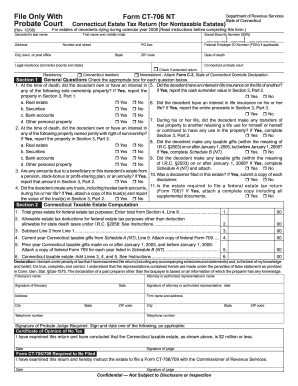
Ts. Yes No Section 2 Connecticut Taxable Estate Computation 1. Total gross estate for federal estate tax purposes: Enter total from Section 4, Line 8.................................. 1. 00 2. Allowable estate tax deductions for federal estate tax purposes other than deduction allowable for state death taxes under I.R.C. 2058: See Instructions....................................................... 2. 00 3. Subtract Line 2 from Line 1.
Open form follow the instructions
Easily sign the form with your finger
Send filled & signed form or save
How to fill out the CT DRS CT-706 NT online
Filling out the CT DRS CT-706 NT form is an essential step in reporting a nontaxable estate in Connecticut. This guide provides a clear, step-by-step approach to ensure that you complete the form accurately and efficiently.
Follow the steps to successfully complete the form
- Click ‘Get Form’ button to obtain the CT DRS CT-706 NT form and open it in the online editor.
- Start by entering the decedent’s last name, first name, and middle initial in the designated fields.
- Fill in the decedent’s Social Security Number (SSN) accurately, ensuring that all numbers are correct.
- Provide the decedent's address, including the number and street, PO box, city, town, state, and ZIP code.
- Indicate the date of death in the specified field.
- Specify the legal residence (domicile) of the decedent by providing the county and state.
- Check the box if you are filing an amended return, and indicate residency status as either Connecticut resident or nonresident.
- Complete Section 1 by answering the general questions. For each question, check ‘Yes’ or ‘No’ based on the decedent's situation.
- Move on to Section 2 for the Connecticut taxable estate computation, entering the appropriate amounts as instructed.
- In Section 3, report property and proceeds for federal estate tax purposes, including solely-owned and jointly-owned property.
- Complete Section 4 by calculating and entering the total gross estate as valued for federal estate tax purposes.
- Final steps include reviewing the information for accuracy, signing the declaration, and saving your changes. You can then download, print, or share the completed form as needed.
Complete your CT DRS CT-706 NT form online today to ensure compliance.
Experience a faster way to fill out and sign forms on the web. Access the most extensive library of templates available.
Related content
Form CT-706 NT (Rev. 06/22). Page 2 of 5. Part 1 - Solely-Owned Property. A. Item. No. B...
2021 Form CT-706 NT Instructions: Connecticut Estate Tax Return (for Nontaxable Estates)...
KEY PART NUMBER. U/M DESCRIPTION. 135420-09-000. EA RADIO-AM/FM/CASS/CD COMBO-AUX/CD...
Get answers to your most pressing questions about US Legal Forms API.
Who is responsible for filing form 706?
Typically, the executor or representative of the estate holds the responsibility for filing form 706. This individual is tasked with ensuring that the estate complies with federal and state regulations. It's important for the executor to understand the filing requirements and deadlines to avoid penalties. Engaging professional assistance can streamline the filing process and help you meet all necessary obligations.
Who must file CT 706?
Any individual or entity that represents an estate exceeding the Connecticut estate tax exemption limit must file the CT 706. This includes the deceased's executor or administrator, who is responsible for ensuring all tax obligations are met. Filing this form is crucial for compliance with Connecticut’s tax regulations. Understanding the thresholds and requirements will help you fulfill this responsibility accurately.
How do I get a CT tax registration number?
To obtain a Connecticut tax registration number, you must complete the online application available through the Connecticut Department of Revenue Services (CT DRS) website. This process is straightforward and allows you to register your business for tax purposes. Having a CT tax registration number is essential for compliance with state tax laws. Ensure you have all the required information handy for a smooth registration process.
How to avoid estate tax in Connecticut?
To avoid estate tax in Connecticut, consider strategies like gifting assets while you are alive and setting up a trust. These actions can reduce the estate's taxable value, thereby minimizing tax liability. Understanding estate laws and regulations is critical to effectively plan your estate. Consulting with a tax professional can provide tailored guidance based on your specific situation.
What is a CT-706 NT?
706 NT is the Connecticut Estate Tax Return form specifically designed for estates that qualify for nontaxable status. This form is essential for reporting relevant details without triggering any estate tax payment. Filing a CT706 NT assists in ensuring compliance with state laws while also documenting the estate's financial situation. Make sure to utilize the appropriate form to navigate this process confidently.
Where do I mail my CT income tax return?
To mail your Connecticut income tax return, you should send it to the designated address provided by the Connecticut Department of Revenue Services (CT DRS). The mailing address varies depending on whether you are sending a paper return or associated payment. Always check the latest guidelines for the most accurate information. This practice helps ensure that your return is received and processed without issues.
Where do I file my CT 706?
You should file your CT 706, the Connecticut Estate Tax Return, with the Connecticut Department of Revenue Services (CT DRS). The mailing address is provided in the form instructions. Submit all required schedules and documentation to avoid delays in the processing of your return. Ensure you meet all deadlines to avoid any potential penalties.
Where do I file my CT amended return?
To file your Connecticut amended return, you should submit it to the Connecticut Department of Revenue Services (CT DRS). Make sure to use the appropriate form designated for amended returns. It's important to follow the filing guidelines to ensure your return is processed smoothly. This will help you keep your tax records accurate and up to date.
Who must file CT-706?
Any executor or administrator of an estate that exceeds the exemption threshold must file the CT-706. This includes estates that may owe state death taxes based on their total value. If you are uncertain about the obligations related to the CT DRS CT-706 NT, consulting with estate planning professionals can help clarify these requirements. It is essential to comply to avoid penalties and ensure a smooth estate settlement.
How long is an extension for Form 706?
The extension for Form 706 generally allows an additional six months to file the return. This is similar for the CT DRS CT-706 NT, given it involves filing for estates not subject to tax. However, it is critical to understand that even with an extension, the tax payment deadline remains unchanged. Submitting the extension request form timely ensures you stay compliant with Connecticut's regulations.
Use professional pre-built templates to fill in and sign documents online faster. Get access to thousands of forms.
If you believe that this page should be taken down, please follow our DMCA take down process here.
This form is available in several versions. Select the version you need from the drop-down list below.